Giveaways
IN Manila — about which Part 1 is here —there is a district called Binondo, which is both the local Chinatown and the centre of commerce more generally.
In Binondo, I went for a guided walking tour.

There is an interesting local museum, the Chinatown Museum, and an old church, variously known as the Binondo Church, the Porta Sancta, or the Minor Basilica of San Lorenzo Ruiz, one of the patron saints of the Philippines.
San Lorenzo Ruiz was a Chinese Filipino who served as an altar boy in the Binondo Church in the early 1600s, before becoming a missionary and then being martyred by the Japanese Tokugawa Shogunate in 1637, during its attempts to prevent the spread of Christianity to Japan.

Binondo has its own fire engines, which are purple in colour. They were donated by Gerry Chua, the proprietor of the purple-themed Eng Bee Tin bakery, and are run by volunteers.
Gerry Chua is best known for his ube hopia, a pastry snack (hopia) with purple yam (ube) filling, and is known as ‘Mr Ube.’ Supposedly, the purple fire engines donated by Mr Ube are better than the government fire engines.

The ube, or purple yam, is popular in other Filipino foods as well, such as pandesal, Spanish for ‘bread of salt,’ which is actually more like brioche. It comes in various flavours, including ube.
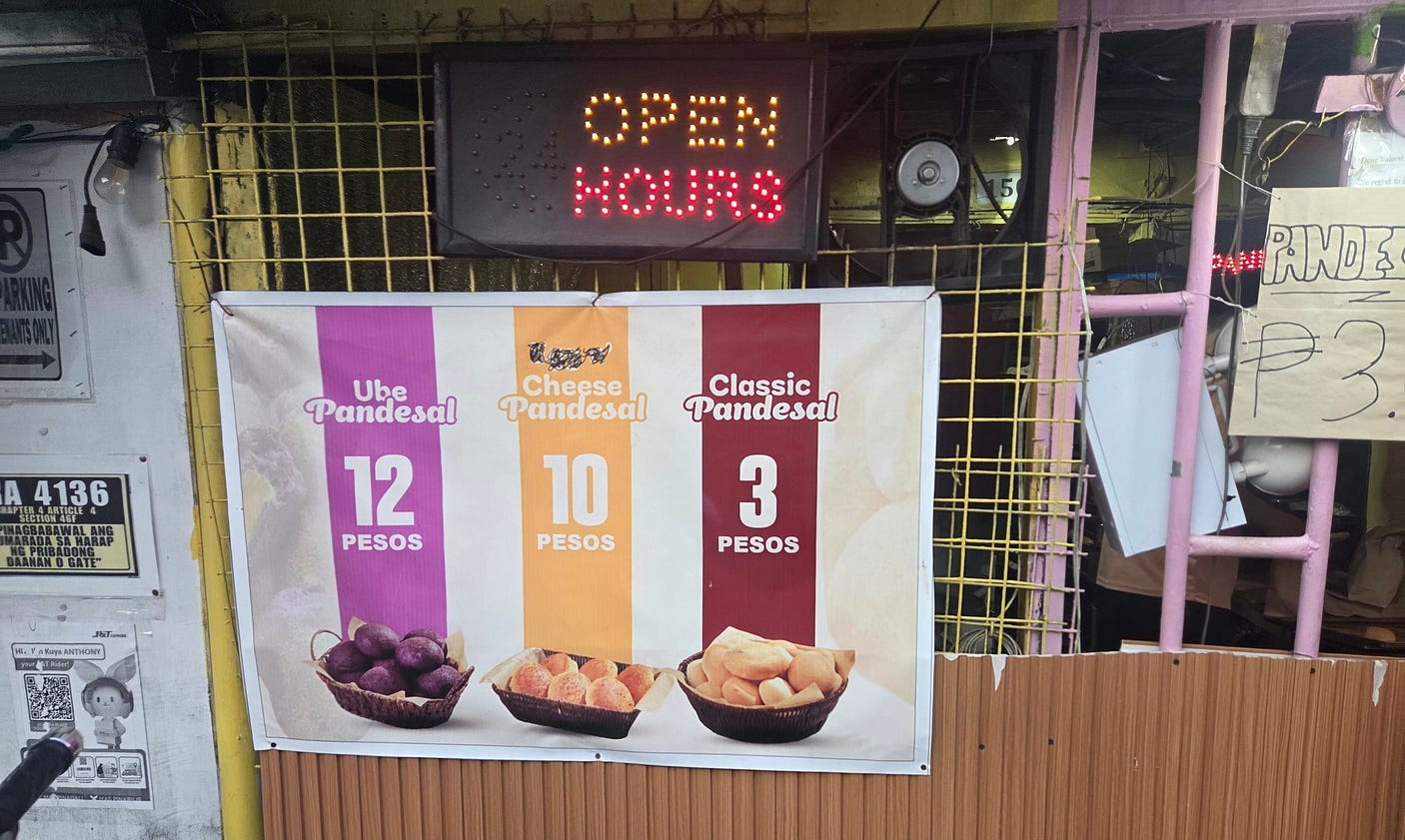
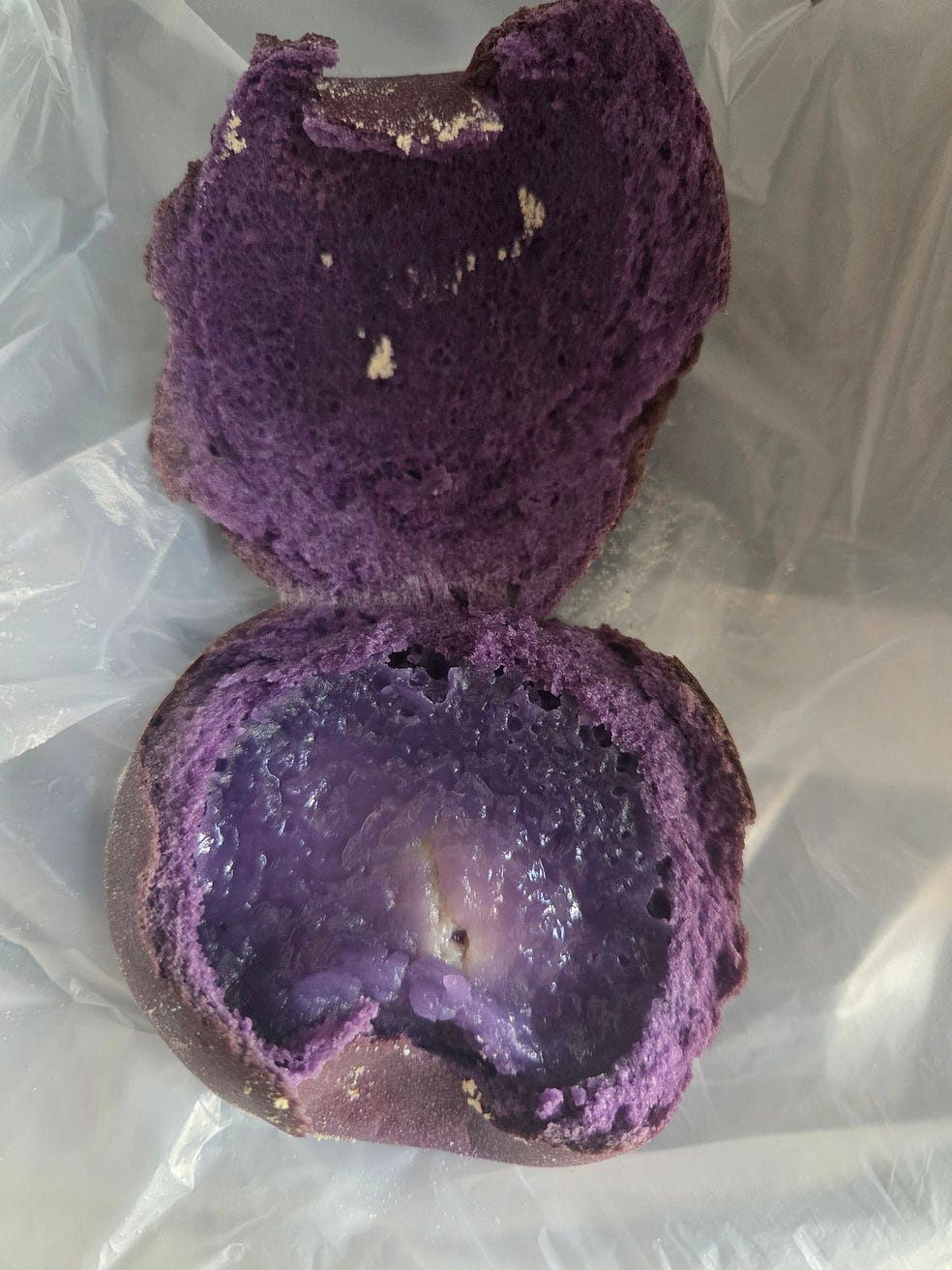
The food has to be one of Manila’s major attractions, though, as everywhere in the tropics, it probably pays to have food that is well-cooked and served hot or fruit you can peel, such as bananas.
I would get anything cold, such as bread, from an actual shop rather than an open-air street vendor. For, some of the water in the canals is pretty filthy, with all kinds of garbage floating on top, and Manila also floods regularly. There are even cases of cholera from time to time, which I talk about in this video while filming chickens that live on the street.
The food is cheap, though (and delicious). For seventy pesos, I had coconut curry. And then, on other occasions, beef with bok choy and a fish chili stew. And I could have had grilled fish as well.


As you can see with the T-shirt advertising Baybayin characters, some of the Philippines’ pre-Spanish heritage is being reclaimed, though the country retains a massive Spanish-Catholic overlay.
Nuestra Señora de los Remidios, Our Lady of the Remedies, of whom an early icon was brought over from Spain in 1624, seems to be as familiar a sight in the Philippines as the Virgin of Guadalupe in Mexico.

I mean, check out this next photo — you could practically be in Guatemala.

Here’s a sign explaining everything in English.

The Philippines were colonised for a third time by the Americans in 1898, after Spain’s disastrous defeat in the Spanish-American War of that year.
The Philippines, whose freedom the Americans claimed to have won, became an American colony until 1946. Rebels who had fought the Spanish switched to fighting the Americans instead for a time.
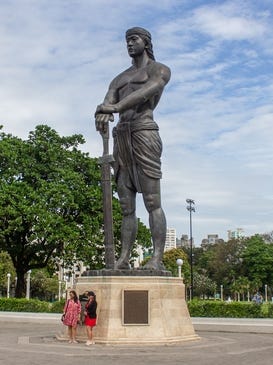
The two great national heroes of the Philippines are Lapulapu, a traditional chieftain who fought the Spanish in the earliest days of colonisation, and José Rizal, a late-19th-century intellectual who wrote two novels and spoke numerous languages, and generally seems like one of the most incredible people who ever lived.
A huge statue of Lapulapu, called the Sentinel of Freedom, was erected in Rizal Park in 2004. I took a couple of photos of the statue, but this one, from Wikipedia, gives a better idea of just how big it is.
As for Rizal, though he advocated a peaceful transition to nationhood, based on growing levels of education and industry so that the Filipinos would one day be able to stand on their own two feet in the modern world, the Spanish nonetheless had him taken out and shot on charges of being one of the rebels on the second to last day of 1896, little more than a year before the outbreak of the Spanish-American War.

Such overreactions to rebellions that were just then going on in the Philippines, and in Cuba also, drove popular support in the USA for the Spanish-American War, thereby lending a cloak of legitimacy to deeper expansionist motives.
In the twilight of their years as an American colony, the Philippines were overrun by the World War II-era Empire of Japan, the archipelago’s fourth colonisers after the Malayo-Polynesians, the Spanish, and the Americans.
Toward the end of World War II, the Americans retook the Philippines. The Japanese Army converted the old Spanish fortifications of Intramuros into their last redoubt, with the result that much of the historic old city was destroyed, and had to be restored stone by stone and brick by brick.
This fight was called the Battle of Manila: the biggest urban battle of the Pacific Theatre of the war, comparable in its destructiveness to the battles of Stalingrad and Berlin in the European Theatre.
In Intramuros, I came across a display describing the battle across several panels, which had been created for the 80th anniversary in 2025. There were also banners in the street advertising the 81st anniversary.

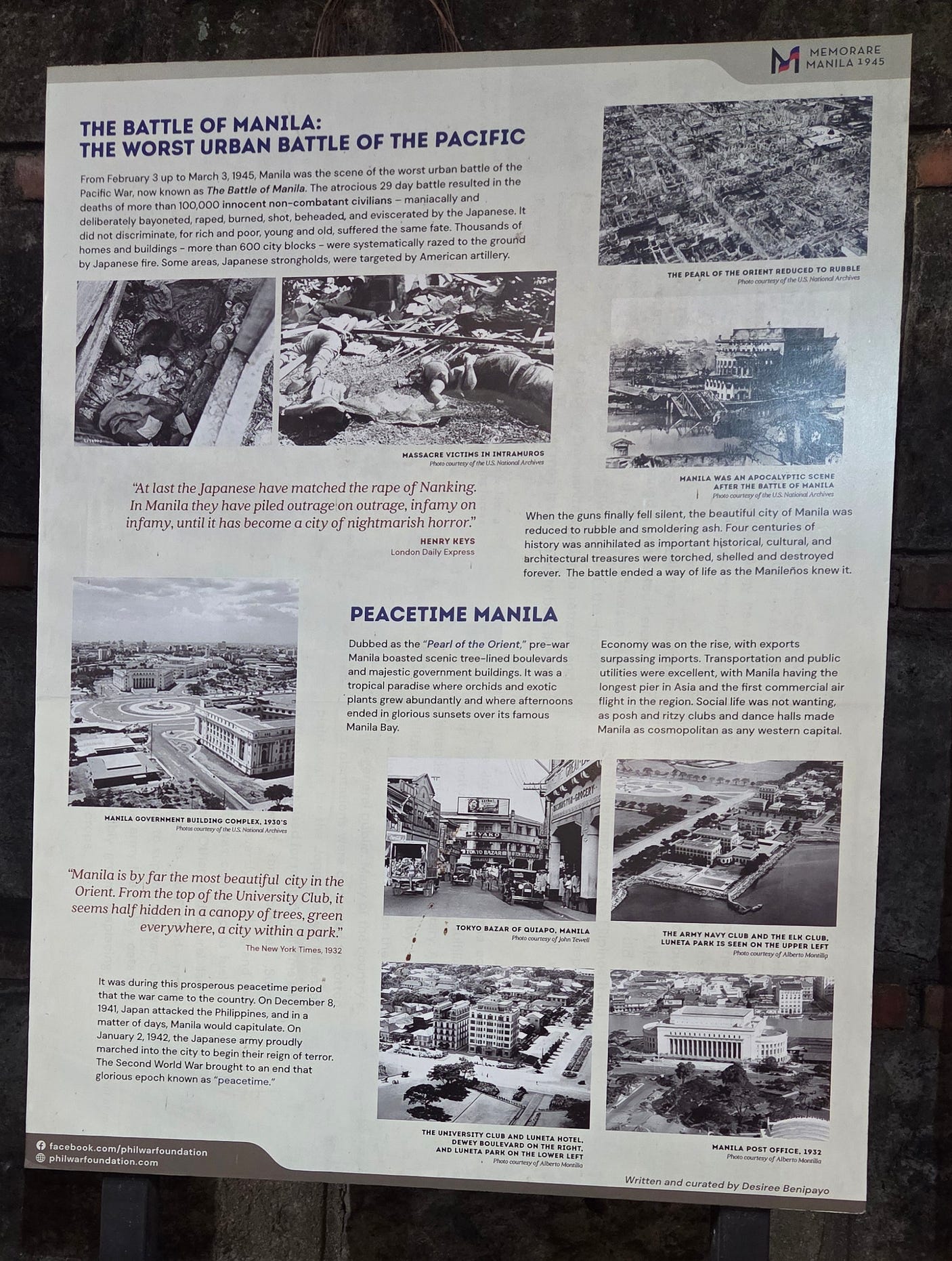

Here’s a closer look at the photo of the destroyed Intramuros district in May 1945, which appears in the detailed information panel above.
Apparently, there wasn’t much left standing apart from the San Augustin Church.

Looking at this destruction, I can’t help thinking of the saying that ‘if you think war is the answer, you must be asking the wrong question.’
The Christchurch earthquakes were bad enough, but fancy doing something similar to a city, or worse, deliberately.
In 1946, the Philippines finally became independent, fulfilling Rizal’s dream on paper. But in reality, the archipelago was still greatly underdeveloped, and thus quickly succumbed to such controversial ‘strongmen’ as Ferdinand Marcos and his wife Imelda, she of the 3,000 pairs of shoes.
At the local level, each of its scattered islands, or pieces of them, tended to be under the thumb of a local ‘cacique,’ a bit like a feudal lord in the 20th century. That is, someone who pledged ultimate allegiance to whatever strongman inhabited the Malacañan Palace in Manila at the time, in return for which he was free to lord it over the local peasants.
There is still a lot of corruption, violence, and caciqueism, which has helped to keep the Philippines noticeably poor and underdeveloped compared to its neighbours.
For instance, under Roderigo Duterte, the president previous to the current one (Bongbong Marcos, a member of the Marcos family, but pledged to democracy), about 15,000 people mysteriously disappeared in the course of a war on drugs and gangs. Some of the other countries nearby execute drug dealers as well, but not on that scale, and they do at least get a trial first.
A guide told me that their house in Manila floods three times a year and that they keep their prized possessions in a plastic box, which floats. It sounded ridiculous, but apparently a lot of the flood relief expenditure has never got to the people who do the flood control. Instead of the waters being drained, the funds get drained.
I also met a young woman who was an engineer. She was laid off the flood protection project, due to lack of funds presumably, and had to find another job. She left her hometown in the end, because there was no more work for engineers there, and ended up working in a casino downtown instead.
Which really sounds like the essential economic problem of the Philippines in a nutshell.
My next post will be Thrilling Manila (Part 3), in which I visit the National Fine Art Museum and talk a bit more about Manila, and then visit Taal Lake and the nearby city of Tagaytay, before heading to some outer islands!
The apps to use for taxis are called Grab and inDrive.
Useful travel apps include PH Railway Transit — MRT & LRT, Travel Philippines, Guide to the Philippines, and ‘Map of Philippines offline.’
I also used a Wise travel card, which enables you to put money onto your card cheaply (the best-known alternative, Travelex, does not offer the Philippines’ peso).
Ptix is the Parañaque Integrated Terminal Exchange, which gives good information on bus and light rail routes and fares on Luzon.
Other useful travel and destination booking websites include Agoda, Klook, and Trip.com.
If you are in the Philippines for a long time, it pays as always to get a local SIM, which can be an e-SIM these days. Some of the destination and booking websites, such as Agoda, offer these as well.
There are tours that you can just turn up for.
And some bookings are cheaper on Airbnb.
I came with US $1,000 cash and a whole bag full of medicines, after having obtained the requisite vaccinations.
I took the MRT metro, which is under reconstruction. The metro is 25 pesos, while the same journey using Grab or InDrive apps would be 170; so it does pay to use the MRT.
Apart from the electric tuktuk I hired, another common mode of public transport is the jeepney, which is like a small bus. The jeepneys are very cheap as well.
Finally, for day trips out of Manila, such as to Lake Taal, I would recommend Klook or Tripadvisor.
Subscribe to our mailing list to receive free giveaways!

