Giveaways
IT took me eight hours to fly from Basco in the Batanes to Cebu City, a distance of 1,150 km as the crow flies. That was with a stopover, though you can also fly direct.
Cebu is the middle island in a southern group of Philippine islands called the Visayas, where a group of languages related to the Tagalog of Luzon but not the same, called the Visayan or Bisayan languages, are spoken.

Founded in 1569, on the east coast of Cebu Island, Cebu City is the oldest city in the Philippines, slightly predating Manila.
Pre-World War II Manila was known as ‘the Pearl of the Orient.’ Cebu City, for its part, is known as ‘the Pearl of the South’ and the ‘Queen City of the South.’
The next map shows the location of Cebu City on Cebu Island. For scale, Cebu Island is 196 km long from north to south and about 32 km wide at its widest point.

Just off the coast of Cebu City, there is a smaller island called Mactan Island, which is connected to Cebu Island by three bridges. The Mactan-Cebu International Airport is on Mactan Island, as are several resorts.
At one called Dusit Thani Mactan, I paid to have a swim and a meal even though I wasn’t staying there: this is called ‘night use.’
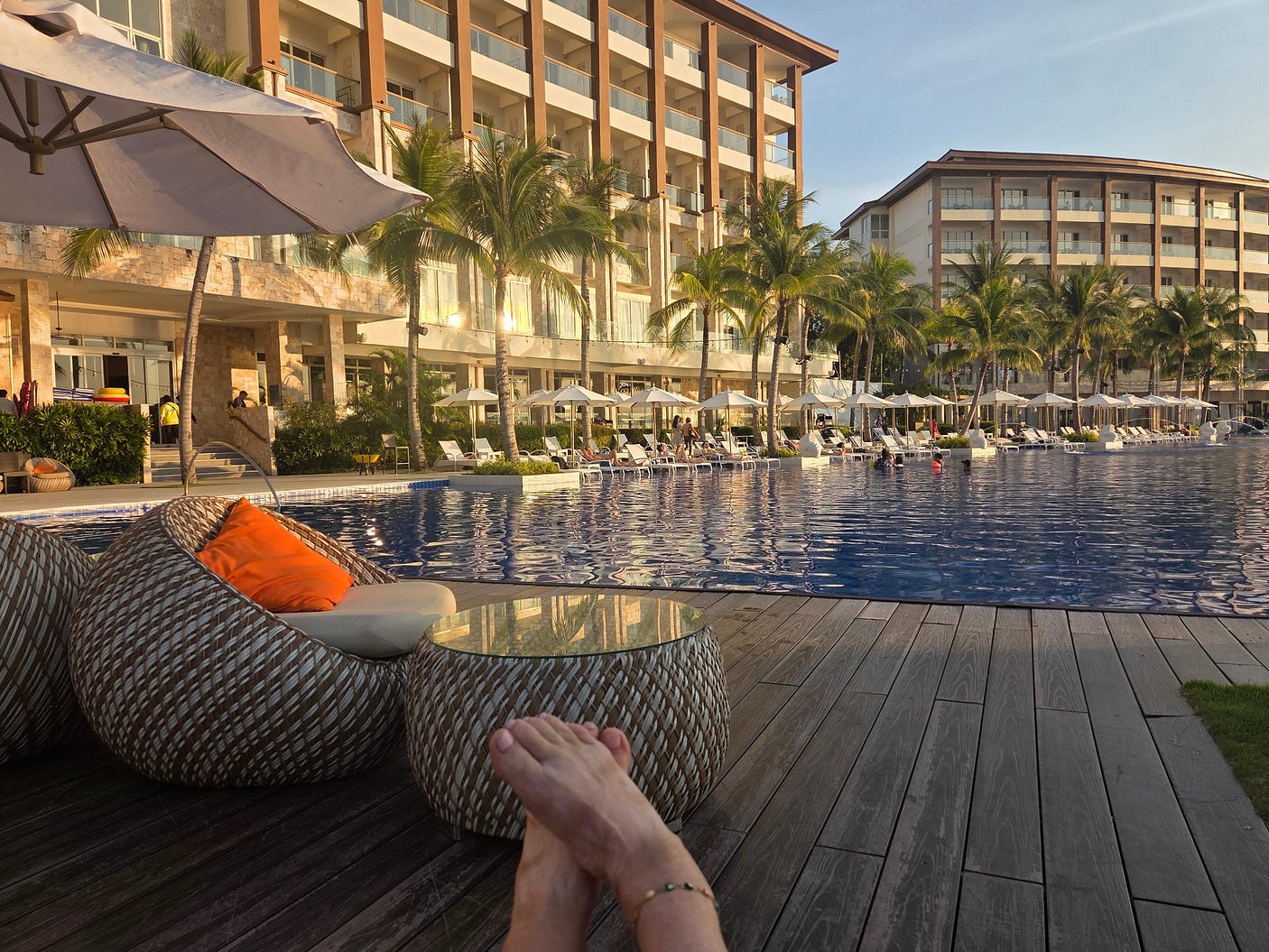
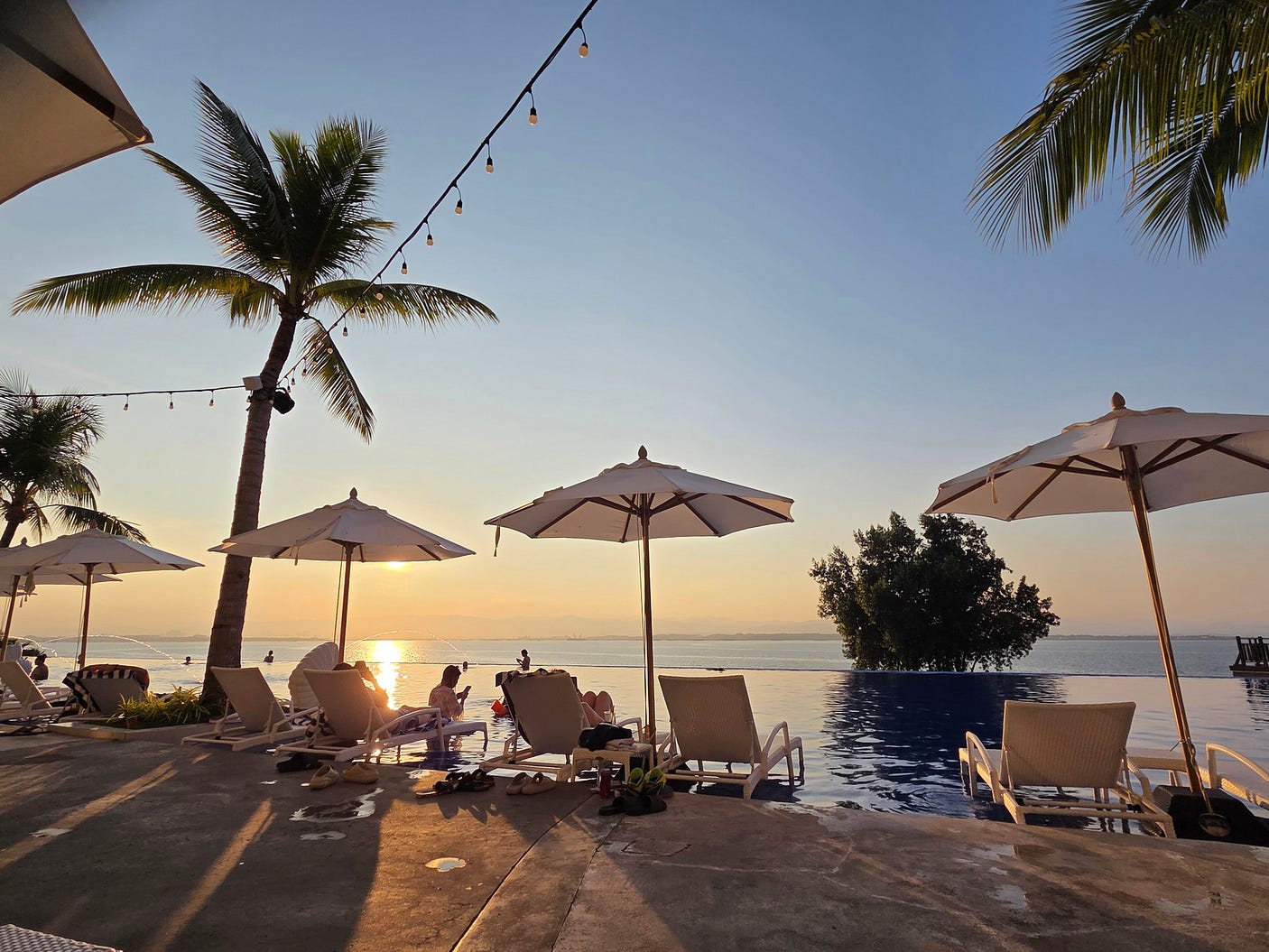
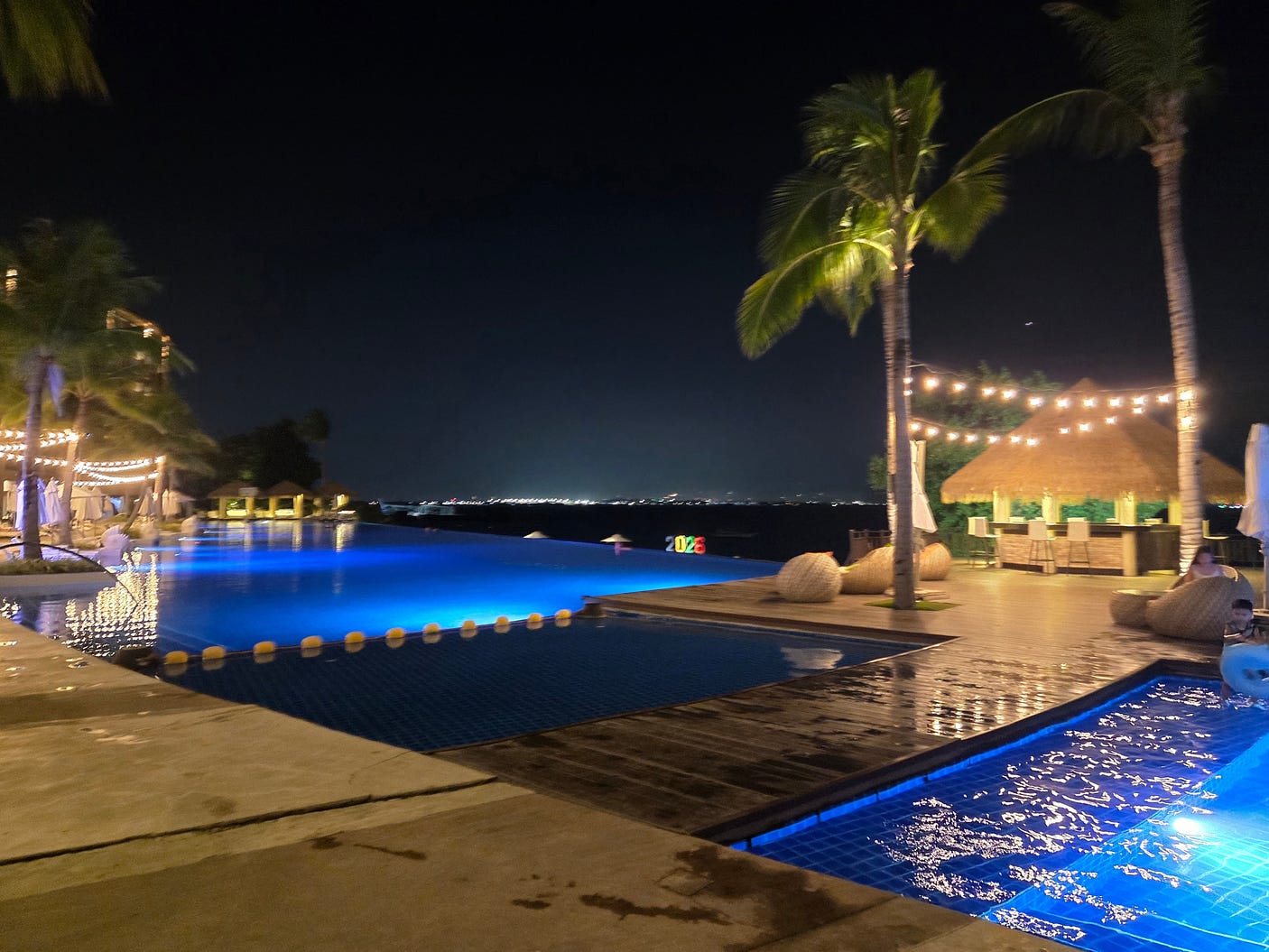
However, I did not stay on Mactan Island but rather at the Murals Hostel and Cafe on the Cebu Island side, about 6 km from the airport on Cebu and 5 km from the middle of town.
I decided to do some daywalks, with Guru Walks and a guide who really explained the connection between Polynesia and the Philippines.
Filipinos belong to the Malayo-Polynesian cultural and linguistic group of the wider Austronesian group of peoples, the ones who came out of Taiwan.
I imagine that this seafaring must have really taken hold in the Philippines, with all its islands, before their descendants radiated out into the Pacific, eventually even colonising New Zealand as Māori.
Cebu is probably most famous for its connection to Ferdinand Magellan’s great voyage, the first circumnavigation of the world: a voyage originally intended to gain access to the so-called Spice Islands, the Maluku Islands of modern-day Indonesia, where valuable spices were harvested and shipped to Europe, by a westward route.

When the expedition set out, Magellan supposed that the Spice Islands were only a short way west of the Americas, which were just then in a process of being colonised by Spanish and Portuguese conquistadors.
And that all he had to do was sail round the southern end of South America, which he hoped might be just south of Rio de Janeiro, and keep going, thus adding the Spice Islands to Spain’s American conquests.
Unfortunately, the southern end of South America was way further south. The expedition eventually passed to the west through a narrow fiord between the mainland and Tierra del Fuego that the King of Spain, upon hearing of it, named the Strait of Magellan.
And then it turned out that the Spice Islands were separated from South America by the entire width of the vast Pacific Ocean.
Even more unfortunately, though the Pacific is covered in lots of islands of its own, Magellan only managed to sight two before he got to Guam, neither suitable for obtaining fresh provisions and water. And then, at Guam, the expedition was chased away by the local Chamorro people.
Magellan’s crew wasn’t able to get fresh provisions until the expedition had crossed the entire ocean and made landfall in the Philippines, where the locals were more friendly at first.
Unfortunately, by that time, some of the crew had died of their hardships. Most of the others were in a bad way.
A man who spoke Malay found that he could communicate with the Filipinos, so it appeared they were near the fabled spice islands at last.
Magellan erected a cross on the site of modern-day Cebu City, thereby claiming the area for Spain. Amazingly, Magellan’s cross still exists (supposedly), inside a protective pavilion built by the Spanish in the 1830s, and encased in an outer layer made of the same type of wood as the original cross, because people kept whittling bits off the original cross in the belief that it would bring them good luck. These days, whittling is forbidden but you can make a wish on Magellan’s Cross.

There is some skepticism as to whether anything actually remains of the original cross, or whether it is perhaps a bit like the proverbial grandfather’s axe. Or, even, a later cross erected once Spanish rule had finally been consolidated.
For the expedition’s run of misfortune wasn’t over once they had reached Cebu and erected their cross. Magellan’s crew eventually got into a fight with the Filipino national hero Lapulapu on Mactan Island and lost. This was the so-called Battle of Mactan Island, during which Magellan was killed.
A battle which, like the cross, is somewhat shakily documented. There’s no doubt that there was a battle with Lapulapu in which Magellan was killed. But it might have actually taken place on another small island tens of kilometres from Mactan, called Poro Island.
Magellan’s deputy, Juan Sebastián Elcano, took over the remnants of the expedition and limped back westward to Spain.
Only 18 of the original 270 expedition members who set out with Magellan, and just one ship out of his original five-ship armada, ever made it back.
Lapulapu’s victory postponed the effective Spanish colonisation of the Philippines, and the founding of the Spanish colonial city of Cebu, by nearly fifty years.
As legendary as it is now, the Magellan-Elcano voyage around the world, in which, from the European point of view, the Strait of Magellan, the Magellanic Penguin, the Magellanic Clouds of the southern night sky, and even the vast Pacific Ocean were all discovered, seemed like a disaster at the time. A disaster in which Magellan lost nearly all his crew, four ships, the Battle of Mactan, his own life, and failed to gain the Spice Islands for Spain, even if Elcano did manage to pick up a load of cloves on the way back.
All the same, stirring accounts of the voyage were written and distributed by one of the 18 survivors, Antonio Pigafetta, the first known writer to have used the name ‘Pacific Ocean.’ Gradually, Magellan’s expedition began to be remembered in heroic terms.

The enclosure in which Magellan’s (supposed) Cross is kept was damaged by a big earthquake in 2013, along with much of the rest of Cebu City, which is being rebuilt. In fact, there was another earthquake just before I got there, about 6 on the Richter scale.
The fort, Fort San Pedro, is made of coral. The fort was built about fifty years after Magellan by the first Spanish governor of the Philippines, Miguel López de Legazpi, who also built Fort Santiago in Manila.
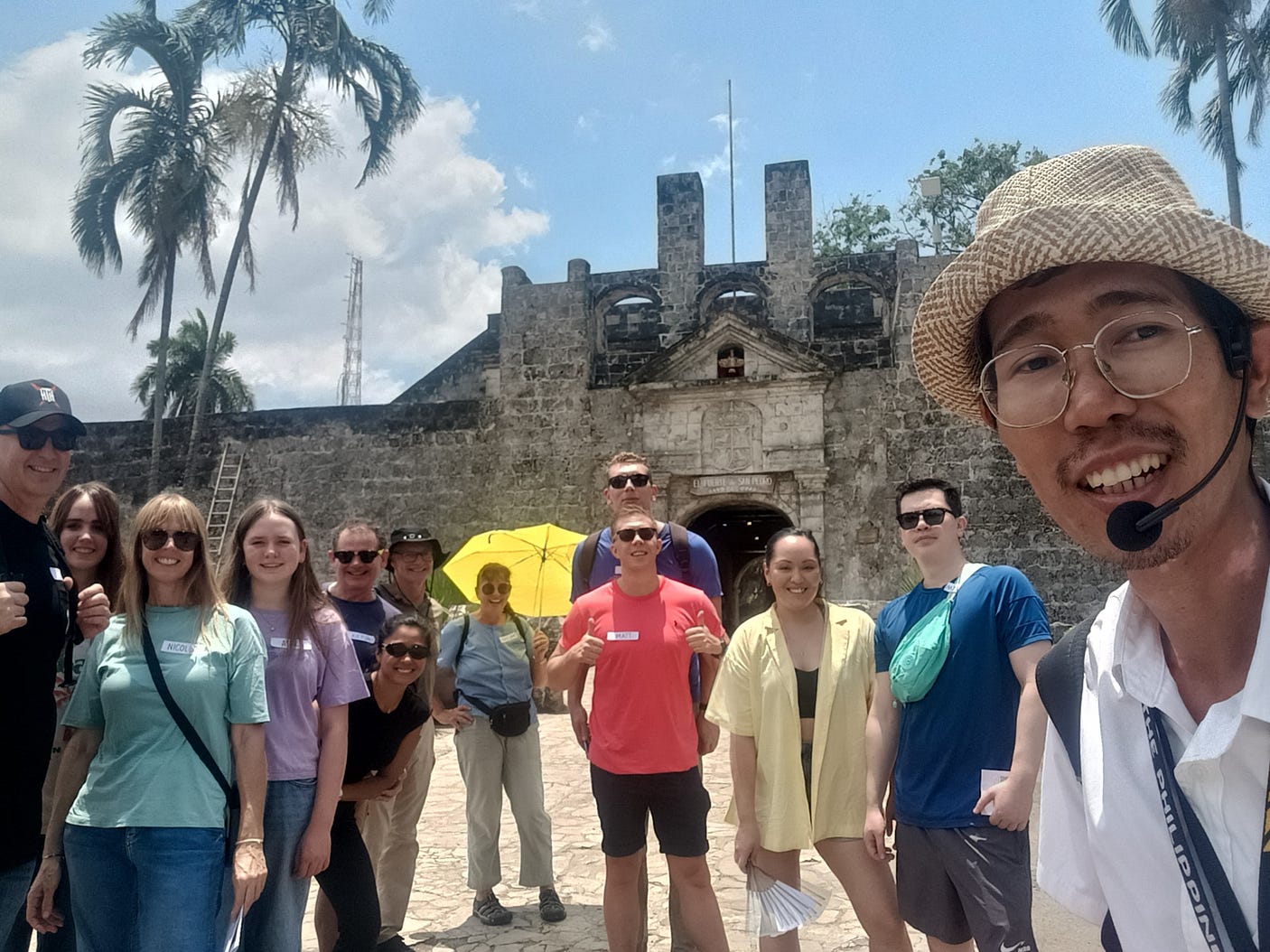
I quite enjoyed the fort, and then we went through the old Chinatown. There was a Chinese house that was significant, it had gone through thirteen generations in one family.
I went to the National Museum of the Philippines at Cebu, one of several museums in the city, where I discovered that the Filipinos make about twenty types of boat.
Indeed, the Filipinos were long seen as the master boatbuilders of the whole of the western part of the Malayo-Polynesian realm. The skills of Filipino boatwrights were therefore much sought after in the islands that now make up Indonesia, and elsewhere in the region.
People from Fujian Province of China also migrated to the Philippines in the thirteenth century. So, it really is a multicultural nation.
There are 3.5 million people on Cebu Island. Only about 60% of them are locals, however, and there is an incredible amount of poverty, and some homelessness.
Tourism can relieve this poverty. But our guide said that the Philippines government was keen to prevent over-tourism, which can be a problem as well. For instance, on Batan, I noticed that the locals mostly had their swimming areas to themselves.
The former president, Rodrigo Duterte, in office from 2016 to 2022, implemented many progressive policies, including expanded access to university education, but his record is marred by an overreaction to the country’s drug problem, in which many low-level drug addicts and dealers were killed by the police, apparently with Duterte’s approval.
After a big drive against corruption under Duterte, it seems that the corruption is seeping back, with public works projects coming to a halt, apparently because the funds are being siphoned off. That is closer to business as usual in the Philippines.
I wandered into Puso Village, where the first word is more properly spelt Pusô in the local Visayan language, Cebuano. The circumflex accent, the little hat on top of the o, means that Pusô is pronounced sharply, like Poo-SOH!, and definitely not poozohhh. It means rice wrapped in coconut leaves.
Pusô Village is a new food hall, opened in 2025, where they have local food such as the lechon cebu, an extremely flavourful form of spit-roasted pig stuffed with such herbs as lemongrass. And seaweed with grapes on it, octopus wrapped around a pepper, and fish dishes.
It is worth getting down to Pusô Village: it’s a clean place to eat, and you know the food is safe.
There are also Filipino takeaway chains, which are very popular with the local people. There is Chowking, which offers Chinese fast food; another one is Jollibee, which mostly specialises in fried chicken. American chains like McDonalds, while they exist, thus face some real domestic competition.
I ended up going to a shopping mall, called Ayala, because I had to replace a few things. And then I did another tour, which took in the Taoist temple, where you could recline a sculpture of two giant hands.
And then there was the Temple of Leah, an extraordinary neoclassical structure “built as a symbol of undying love, commissioned by local businessman Teodorico Adarna in 2012 as a tribute to his late wife, Leah Albino-Adarna.” Thus does Guide to the Philippines describe it, as of the time of writing.
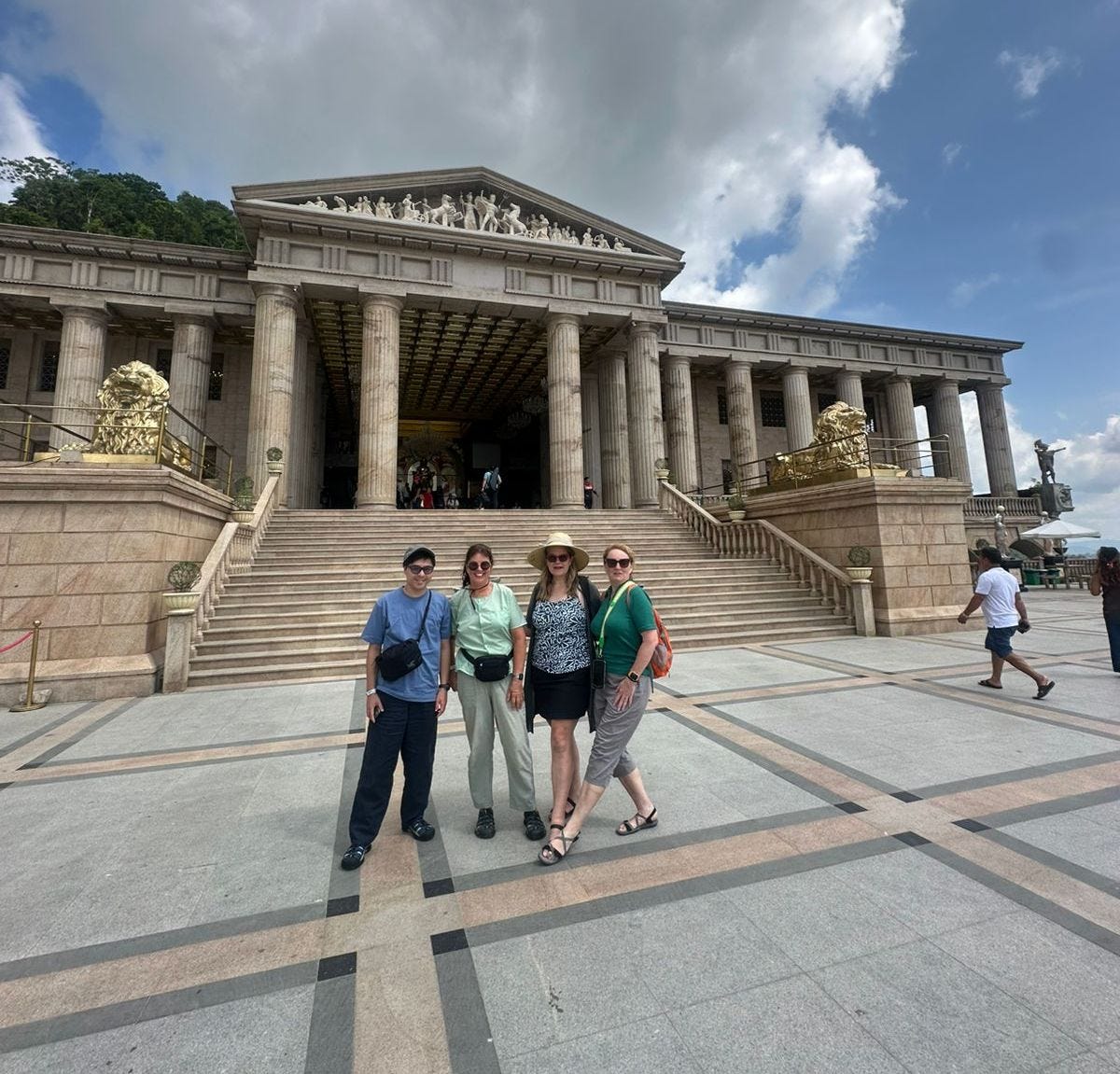
There was a wedding going on there while we visited. And then we went to the Sirao Garden Little Amsterdam, said to be the best park in Cebu City, though you have to pay to get in.
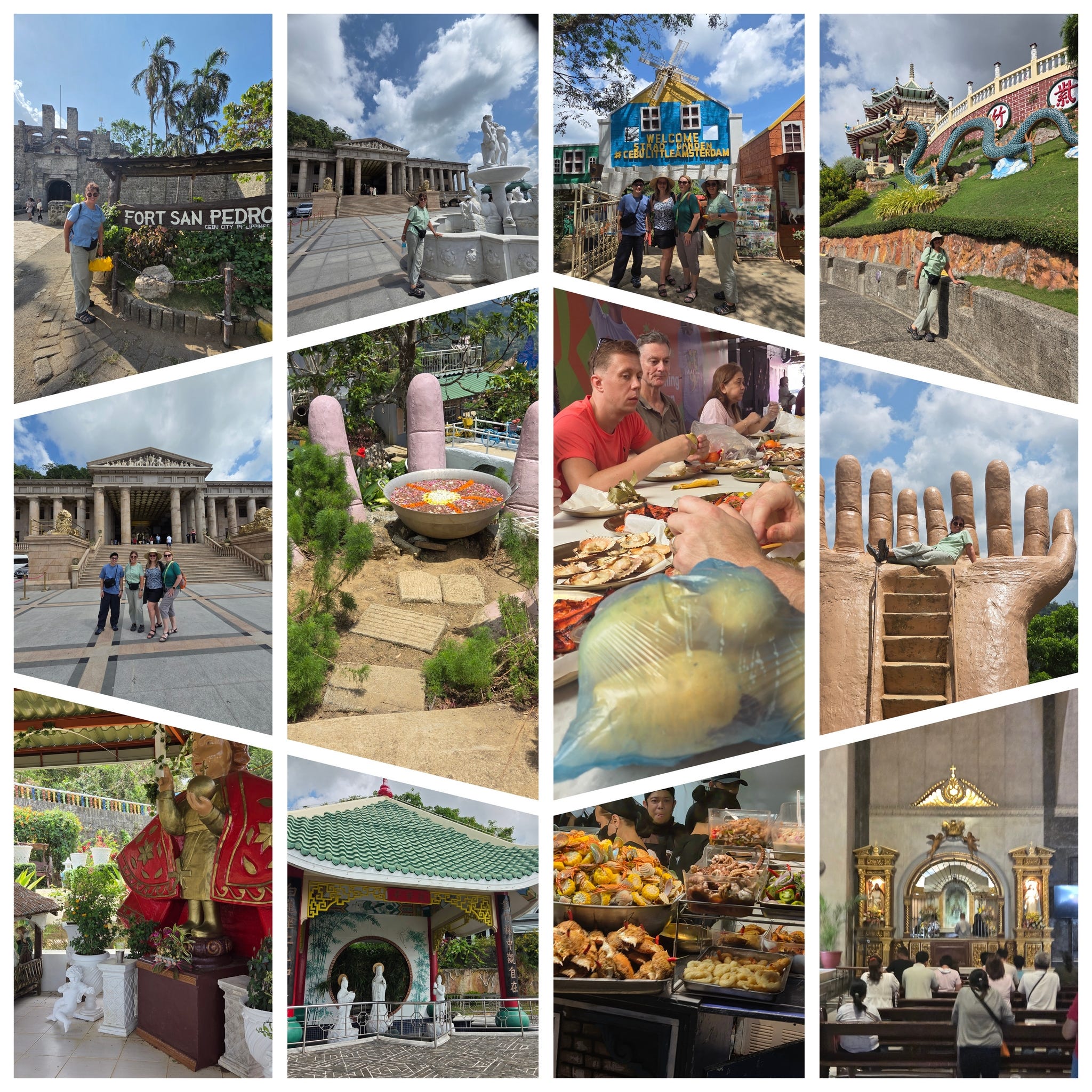
We did all of that on a tour. And to be honest, I thought it was really worthwhile, because I didn’t have to walk around, and it was the best that I could do.
To round off, I really enjoyed staying at Murals Hostel and Cafe in Cebu City; it had a really nice cafe, and it had local eateries nearby as well. There is another Murals Hostal in the municipality of Lapulapu, on Mactan Island, nearer the airport: it depends on where you want to go.
In my next post, I’ll be talking about how I went snorkelling with the turtles and sardines at another resort on Cebu Island called Moalboal, and hiked up the island’s highest peak, Osmeña Peak.
Subscribe to our mailing list to receive free giveaways!

