Giveaways
THE former Portuguese colony of Macao sits on the far side of the broad Pearl River estuary from Hong Kong, about which I posted last week.
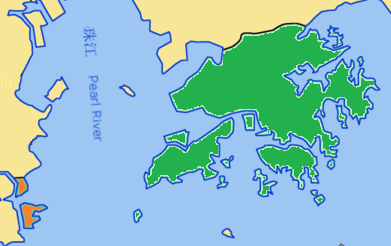
Here’s a more detailed map of Macao, which is tiny compared to Hong Kong, even though each is a Special Administrative Region (SAR) of China.
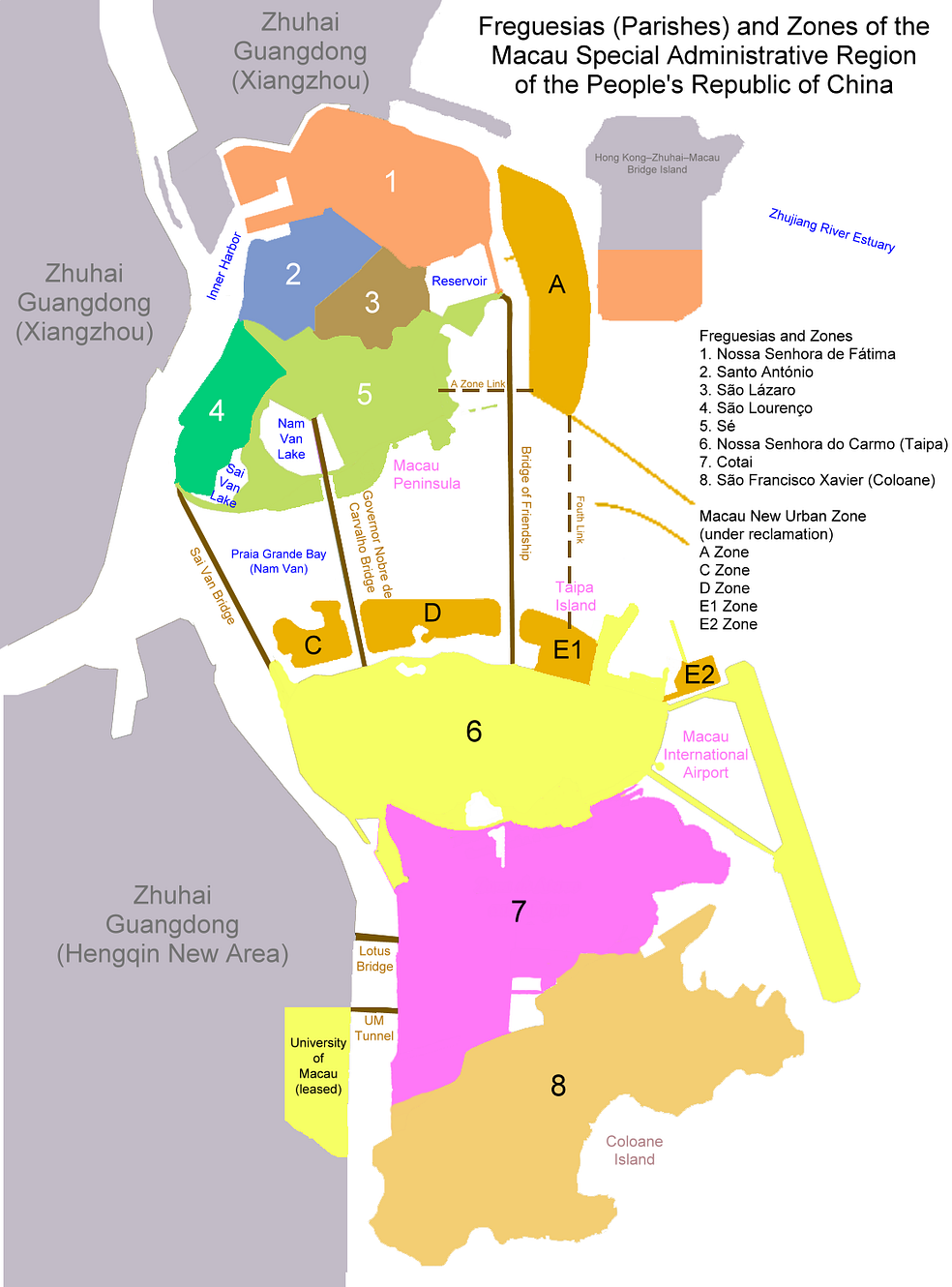
As you can see from the map just above, the northern part of Macao is on a peninsula, while the southern part is on an island.
The Portuguese first arrived at the estuary of the Pearl River in 1513, and established Macao as a permanent settlement in 1557. Their colony, now referred to as Portuguese Macau, lasted until 1999, two years after Hong Kong, and thus has the distinction of being both the first and the last European outpost in China.
(In 1911, a Portuguese spelling reform changed the last letter of the name of Macao from ‘o’ to ‘u,’ though Macao is usually still spelled with an ‘o’ in English.)
The peninsula contains the historic (Portuguese) centre of Macao, a nowadays UNESCO-listed World Heritage Site.
Historically, the island was actually the two islands of Taipa and Coloane, which have since been joined by a land reclamation from the Pearl River, known as the Cotai Strip.
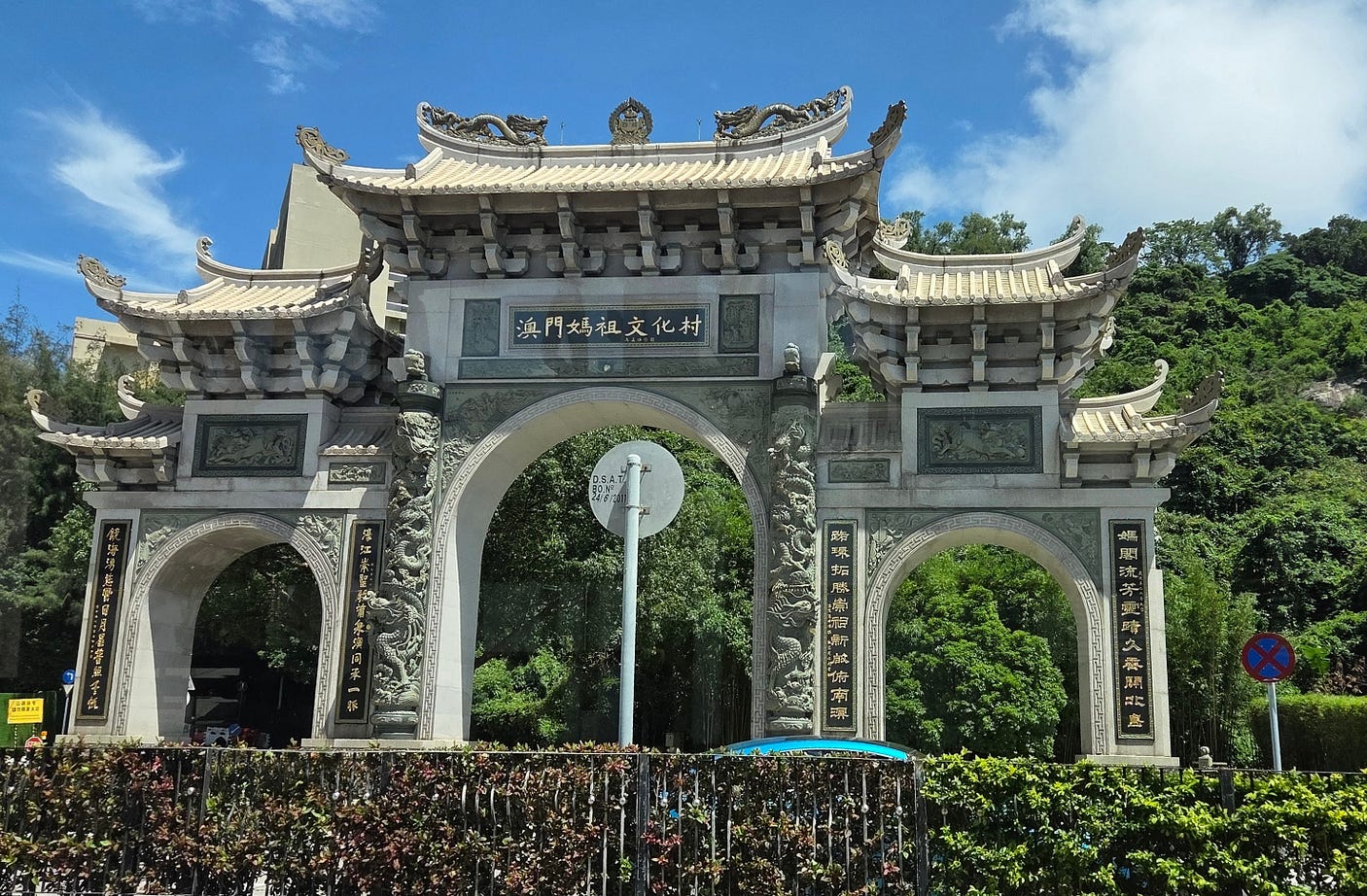
One interesting site on the island is the A-Ma Cultural Village. The name honours the sea-goddess A-Má, also honoured by a temple on the peninsula that was built in 1448, thus predating the Portuguese.
The name Macao is thought to come from a phrase meaning ‘the place where people honour A-Má,’ as heard by early Portuguese colonists and explorers, and written down as best they could at the time.
Incredibly, there is now a road bridge, broken in the middle by a tunnel, between Hong Kong and Macao. At 55 km in total length, this bridge-tunnel complex, officially the Hong Kong-Zhuhai-Macao Bridge, opened in 2018, is the longest fixed sea crossing in the world.
Shuttle buses run back and forth across the bridge, all day and all night. But you can still catch a ferry, and that is what I did.
The first thing I did when I got to Macao was to go on a road tour past the casino resorts for which the territory is now famous (or notorious).
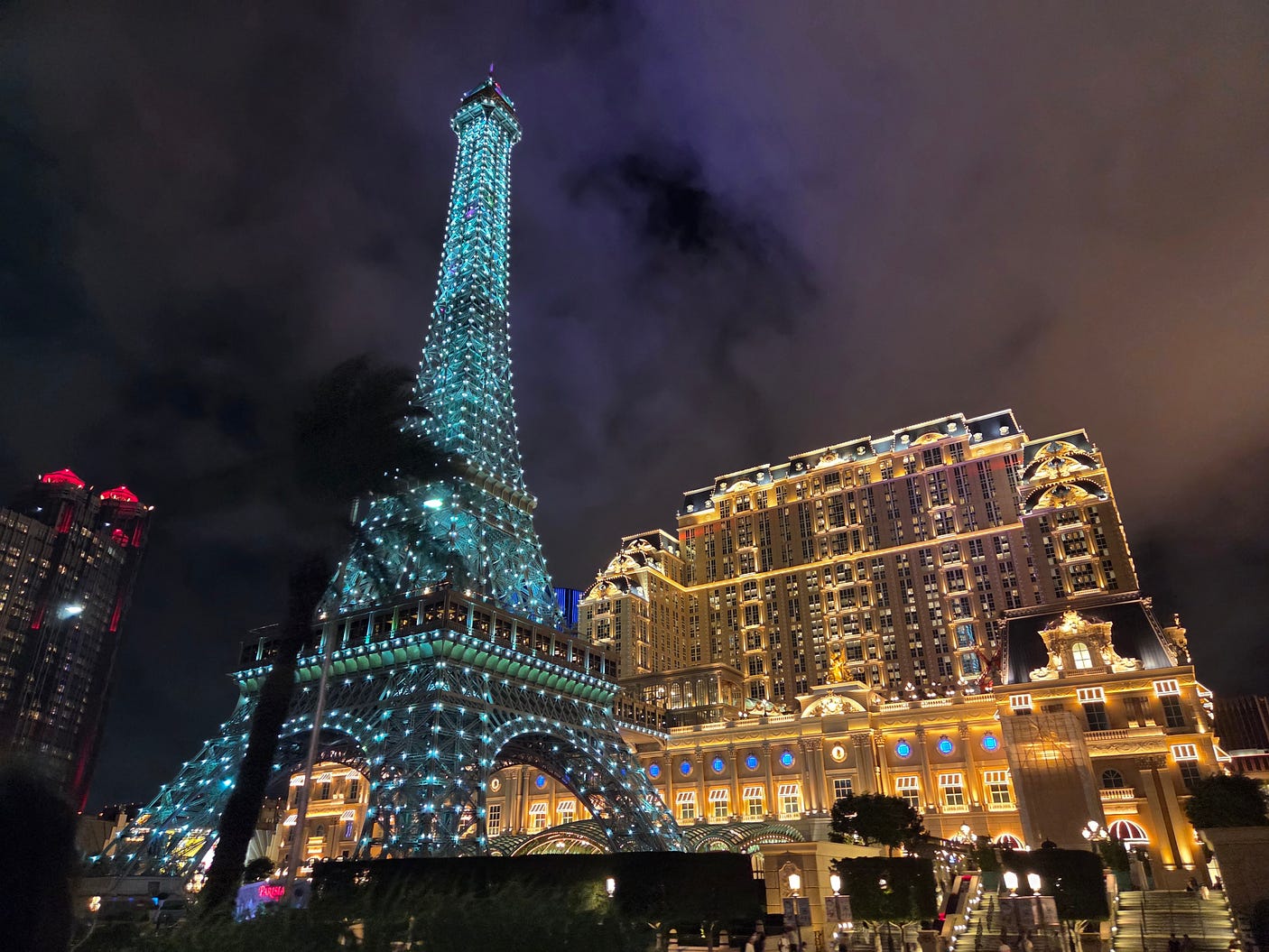
And the very first thing that caught my eye on this tour was a half-size replica of the Eiffel Tower, 160 metres (525 feet) tall! This was completed in 2016, as one of the landmarks of the Parisian Macao, a French-themed casino resort.
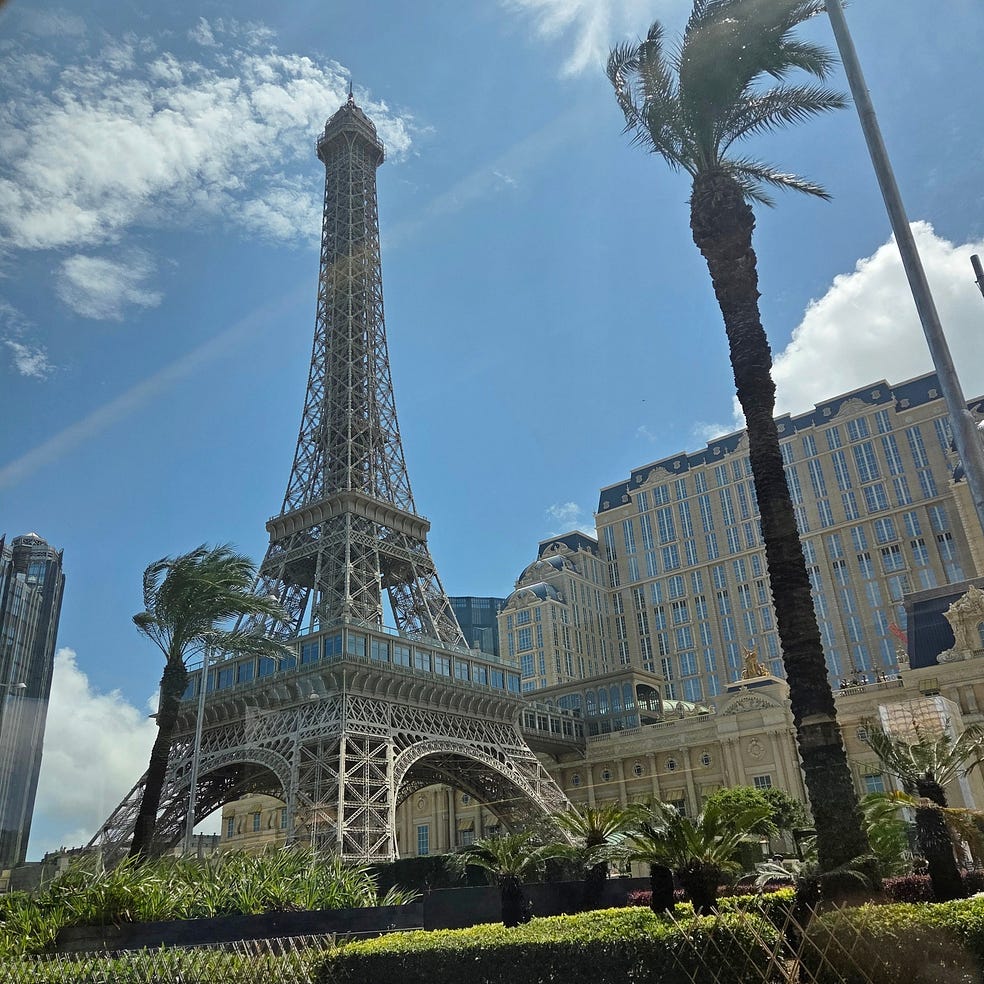
As I was soon to discover, Macao out-Vegases Vegas in that regard. Under Portuguese rule, which ended in 1999, roughly two years after the British handed over Hong Kong, there was only one casino in Macao. Against all expectation, the Communists then proceeded to liberalise things quite a bit.
Casinos are still banned on the mainland, so the casinos of Macao do a roaring trade, in much the same way as the casinos in Vegas did when casinos were illegal just about everywhere else in the United States.
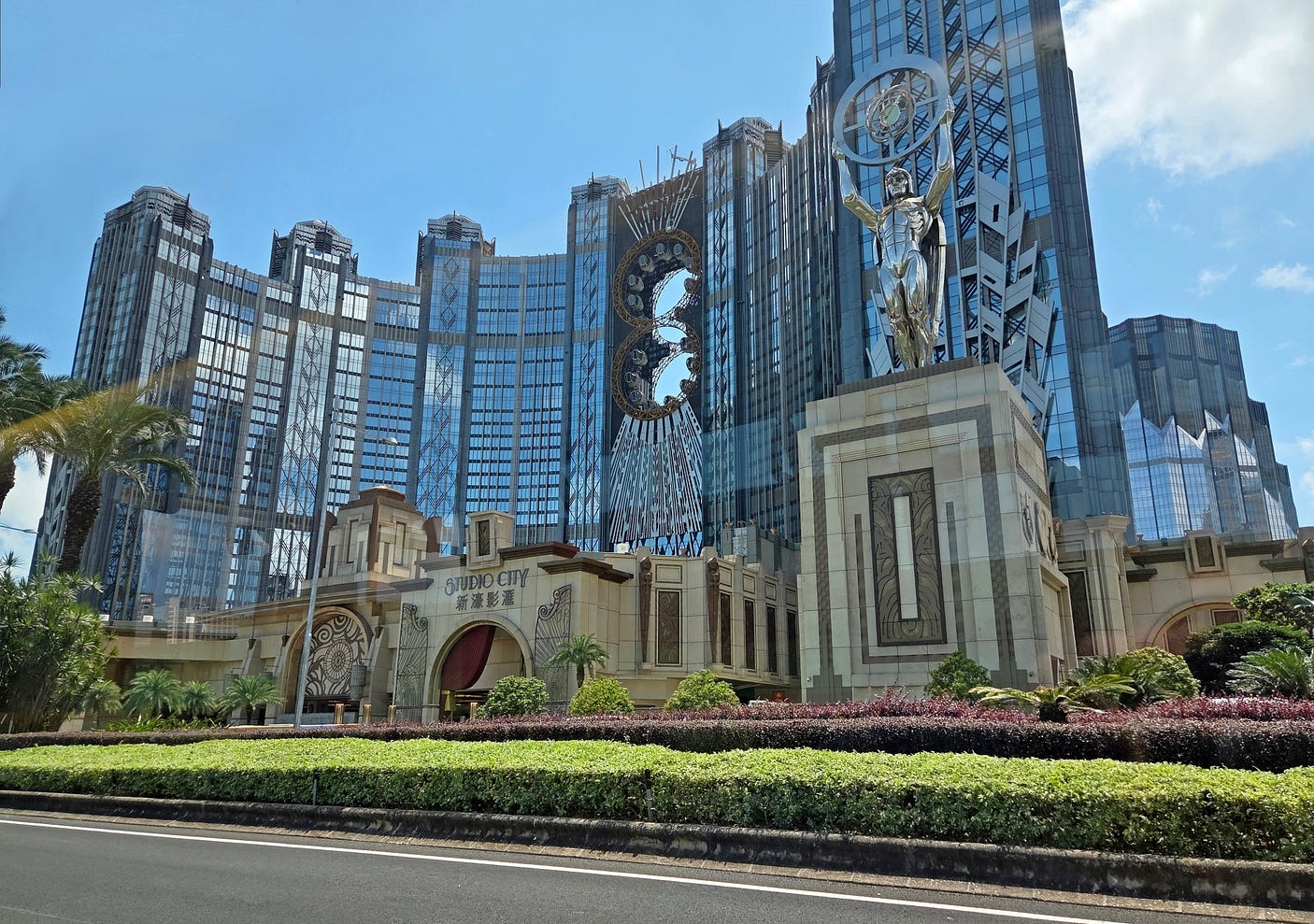
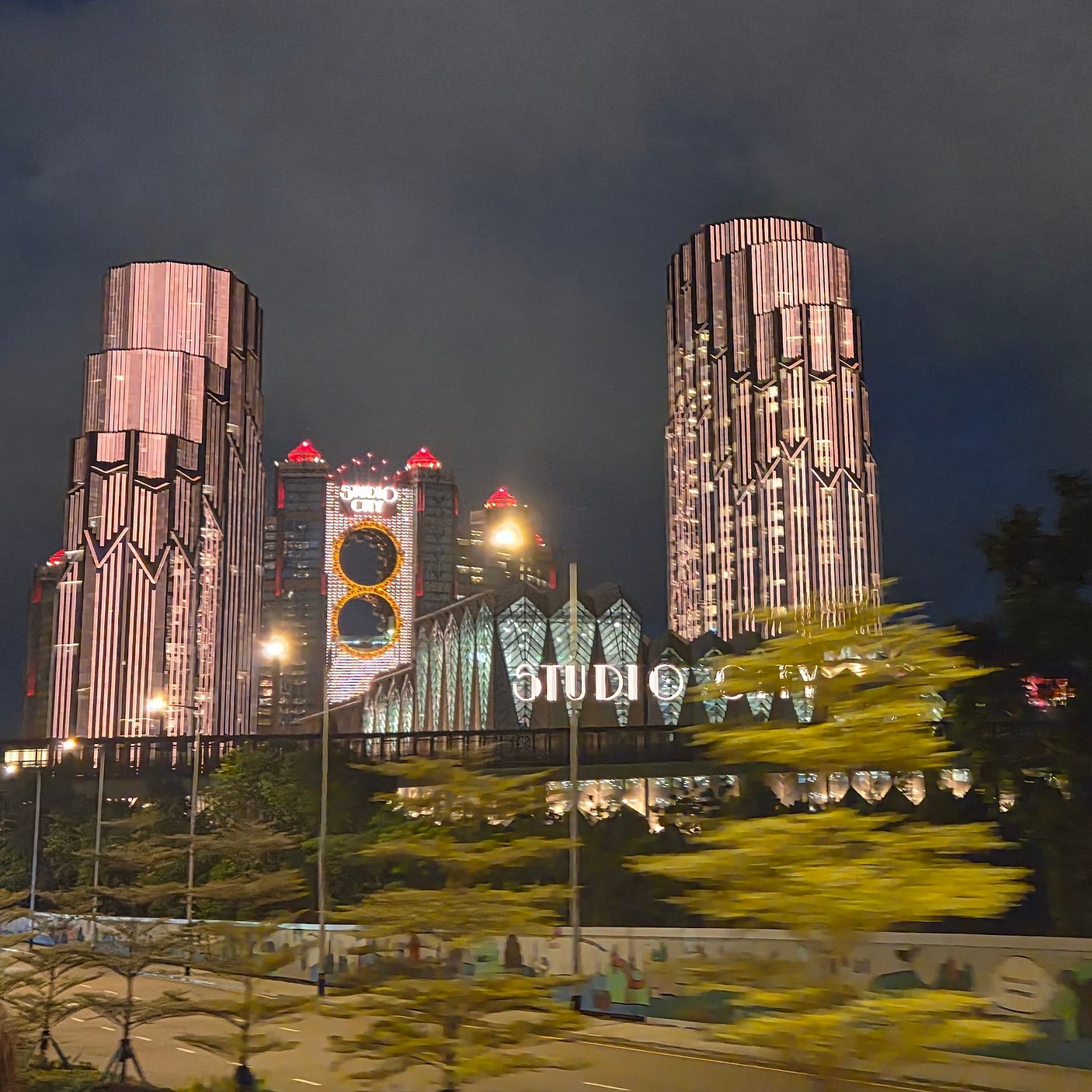
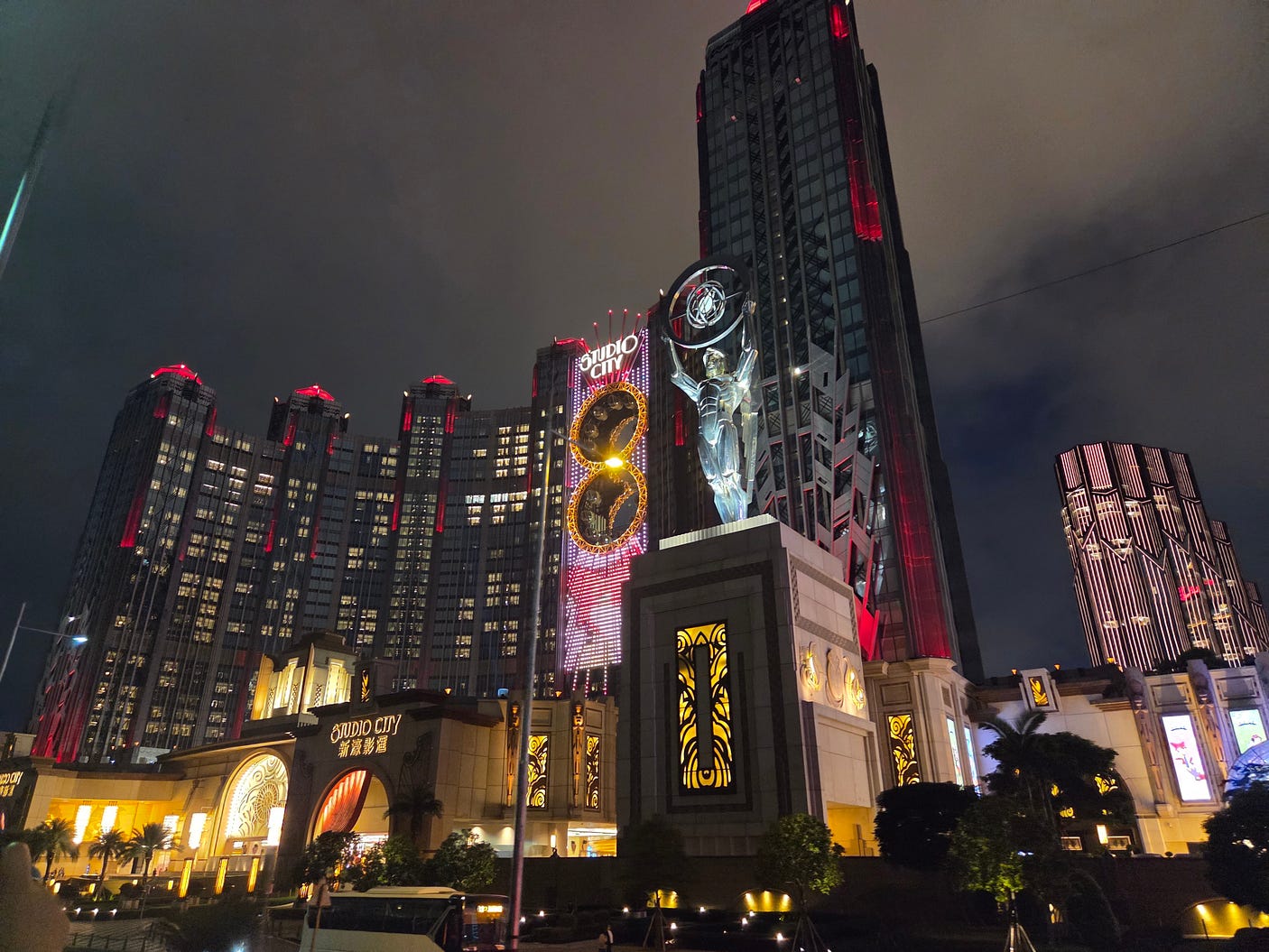
Here’s another casino resort, the golden-age-of-Hollywood-themed Studio City.
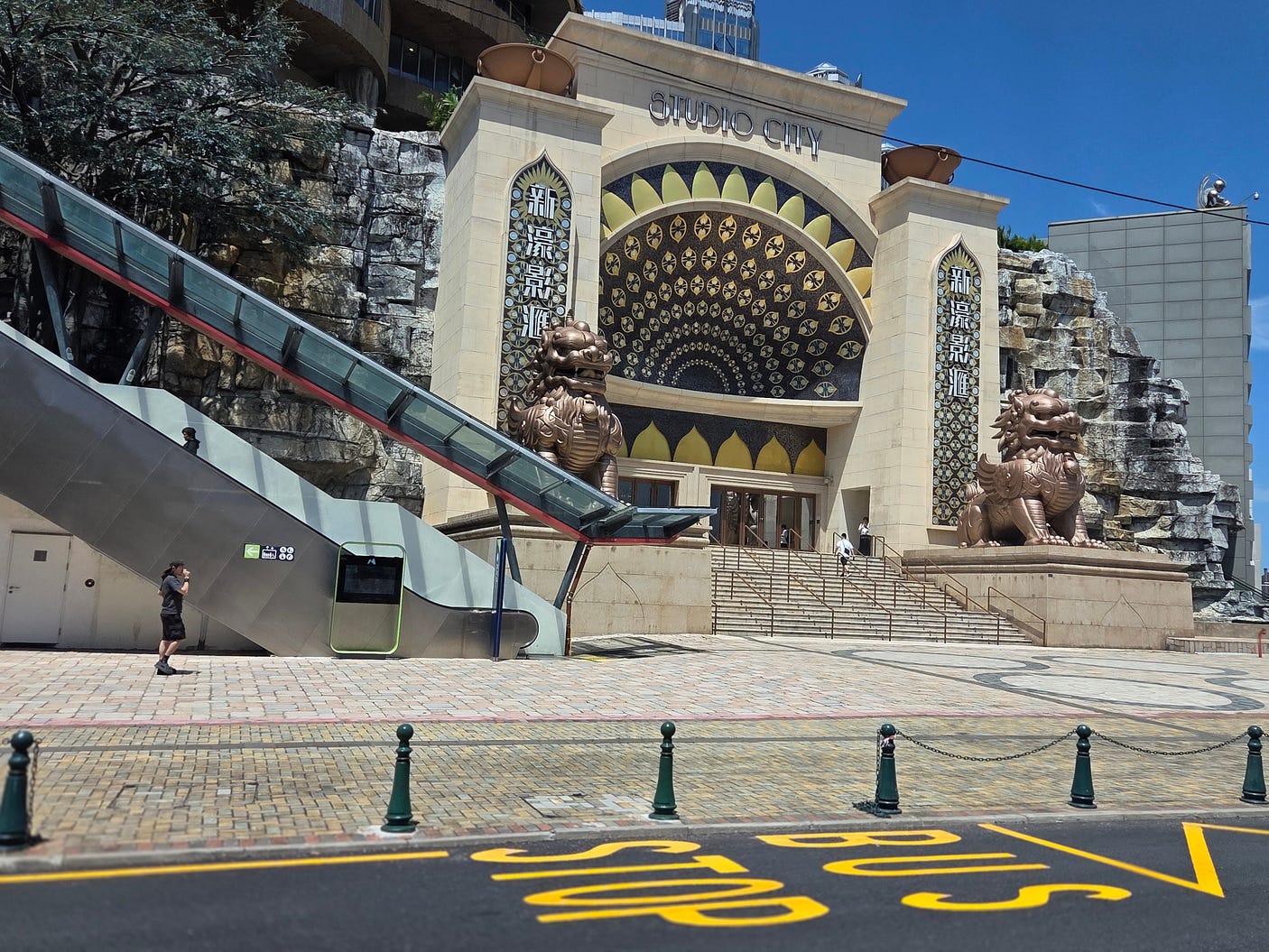
And here’s a closer photo of an entrance to Studio City. One thing that stands out in this photo is that the bus stop is labelled Bus Stop in English and that it is on the left side of the road. Even though China and Portugal both drive on the right, Macao, like Hong Kong, drives on the left, and also has English-language road markings.
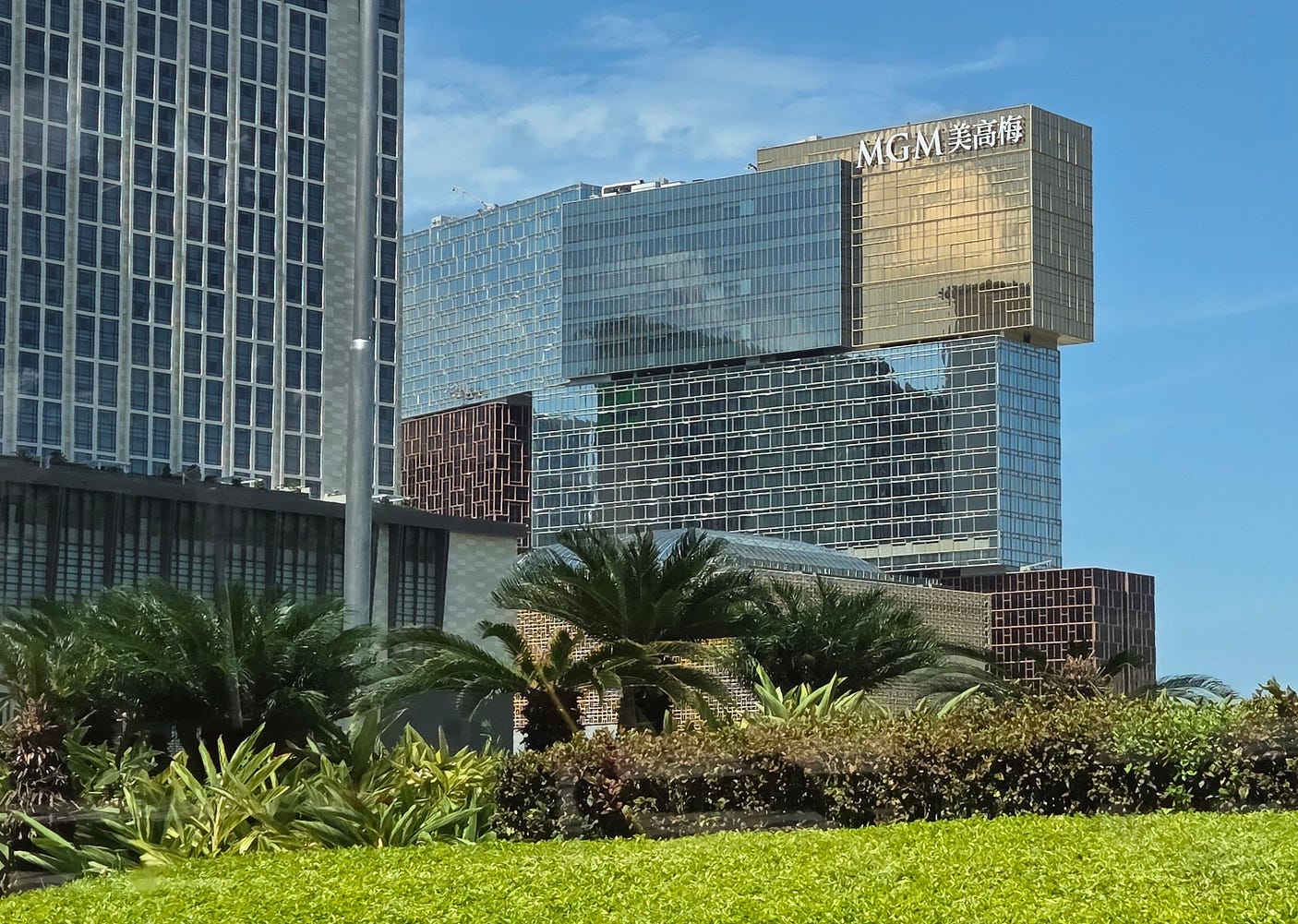
Another casino resort complex, the MGM, seemed to pile one glass box on another.
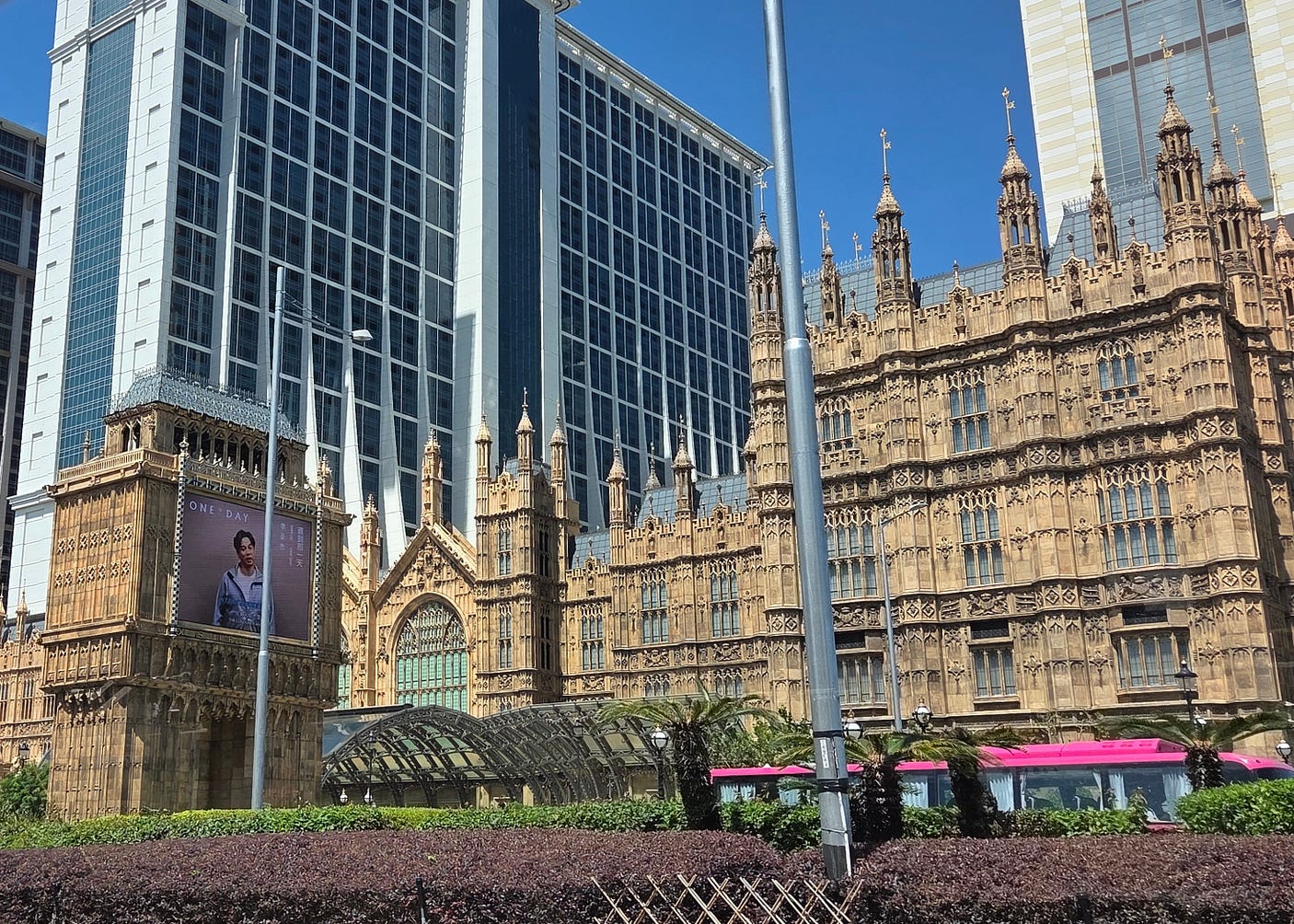
But what really took the biscuit, from the road (thus far), was the Londoner, another casino resort, this time modelled on London!
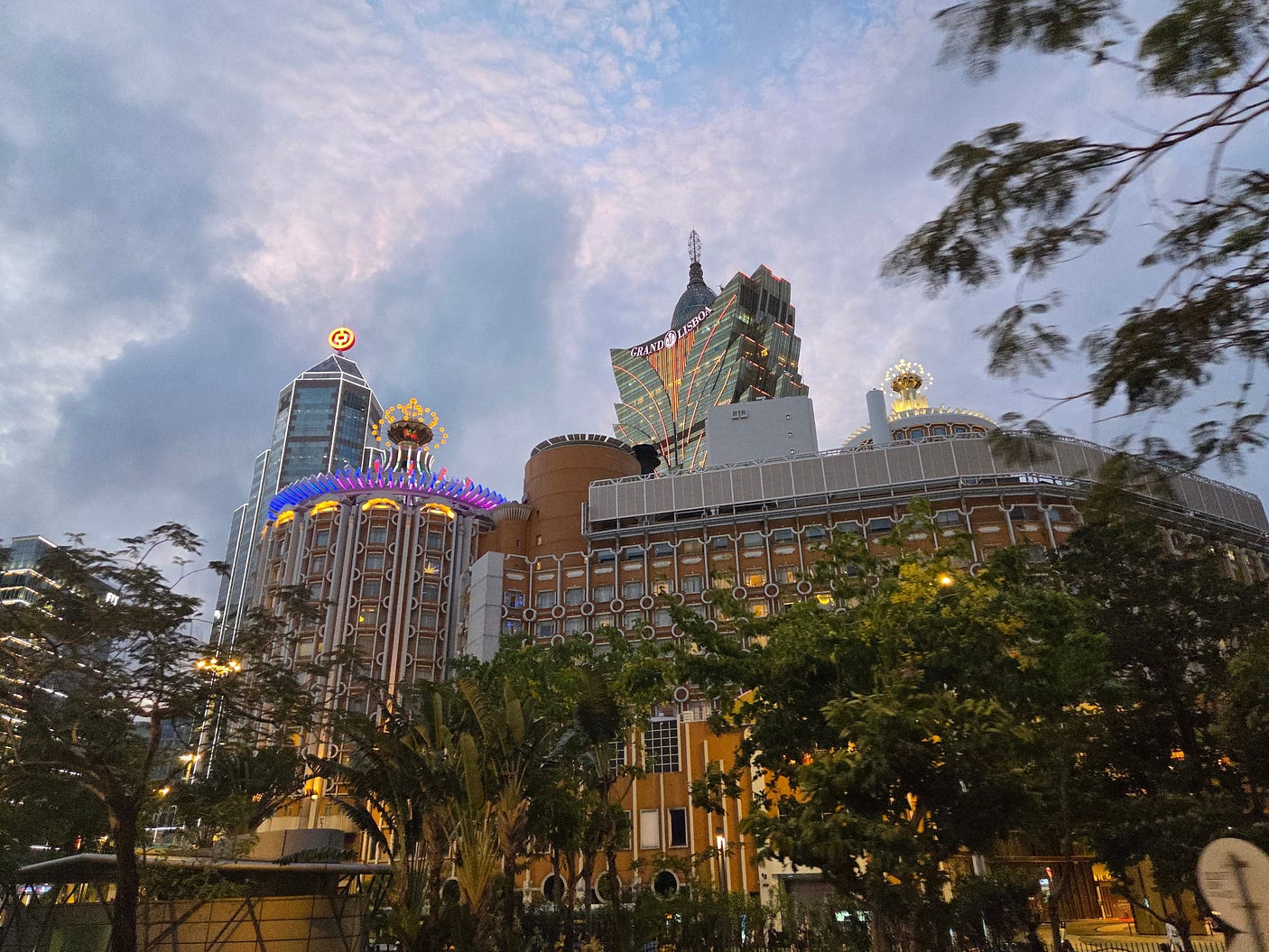
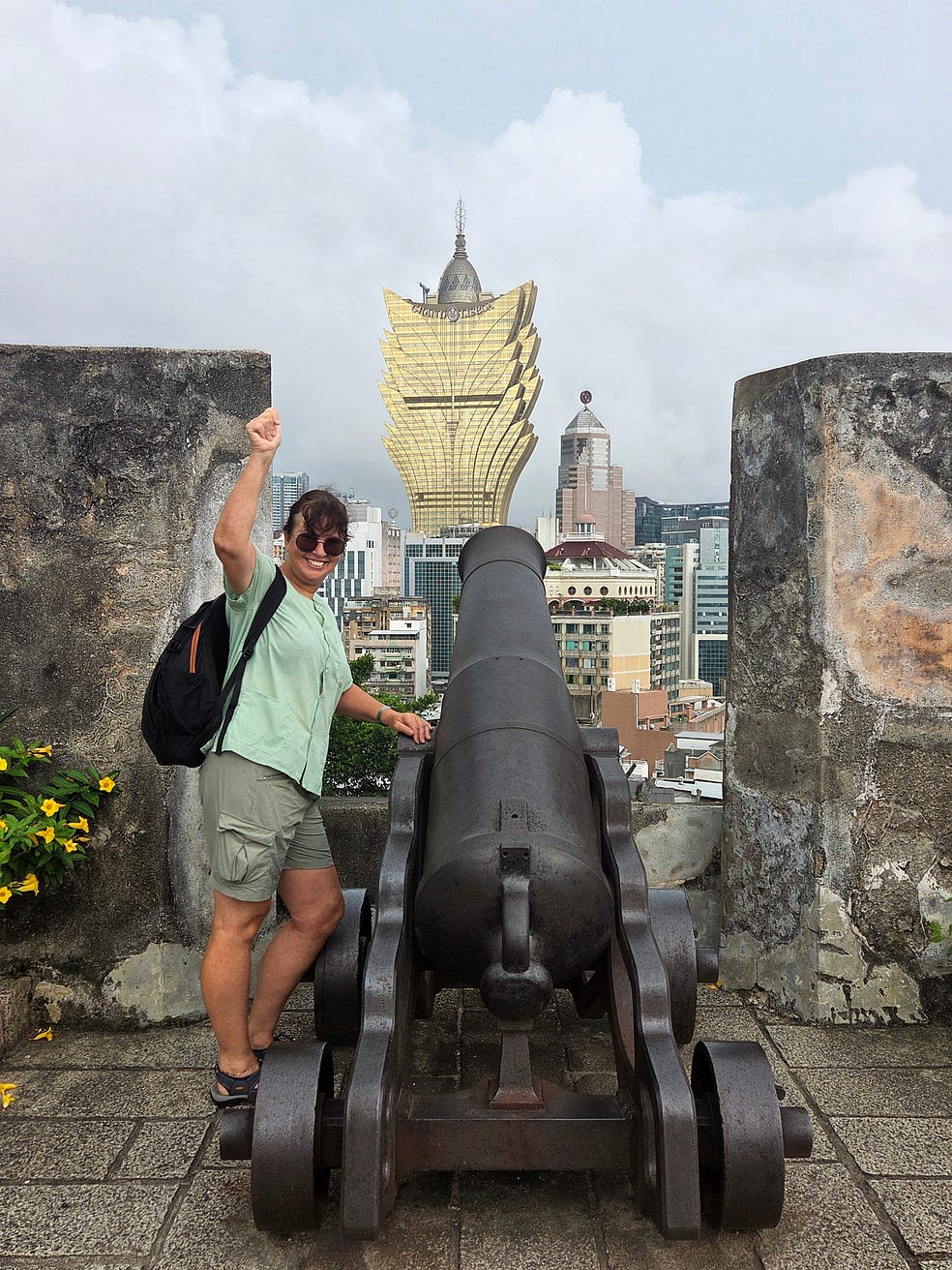
Just as striking, but in a more modern sense, is the tower of the Grand Lisboa (i.e., Lisbon) Hotel on the peninsula, currently the tallest building in Macao at 261 metres (856 feet), which I came back and photographed the next day so as to get a proper shot of the strange, leaf-like glass tower and its equally extraordinary round base. The Grand Lisboa Hotel was opened in December 2008.
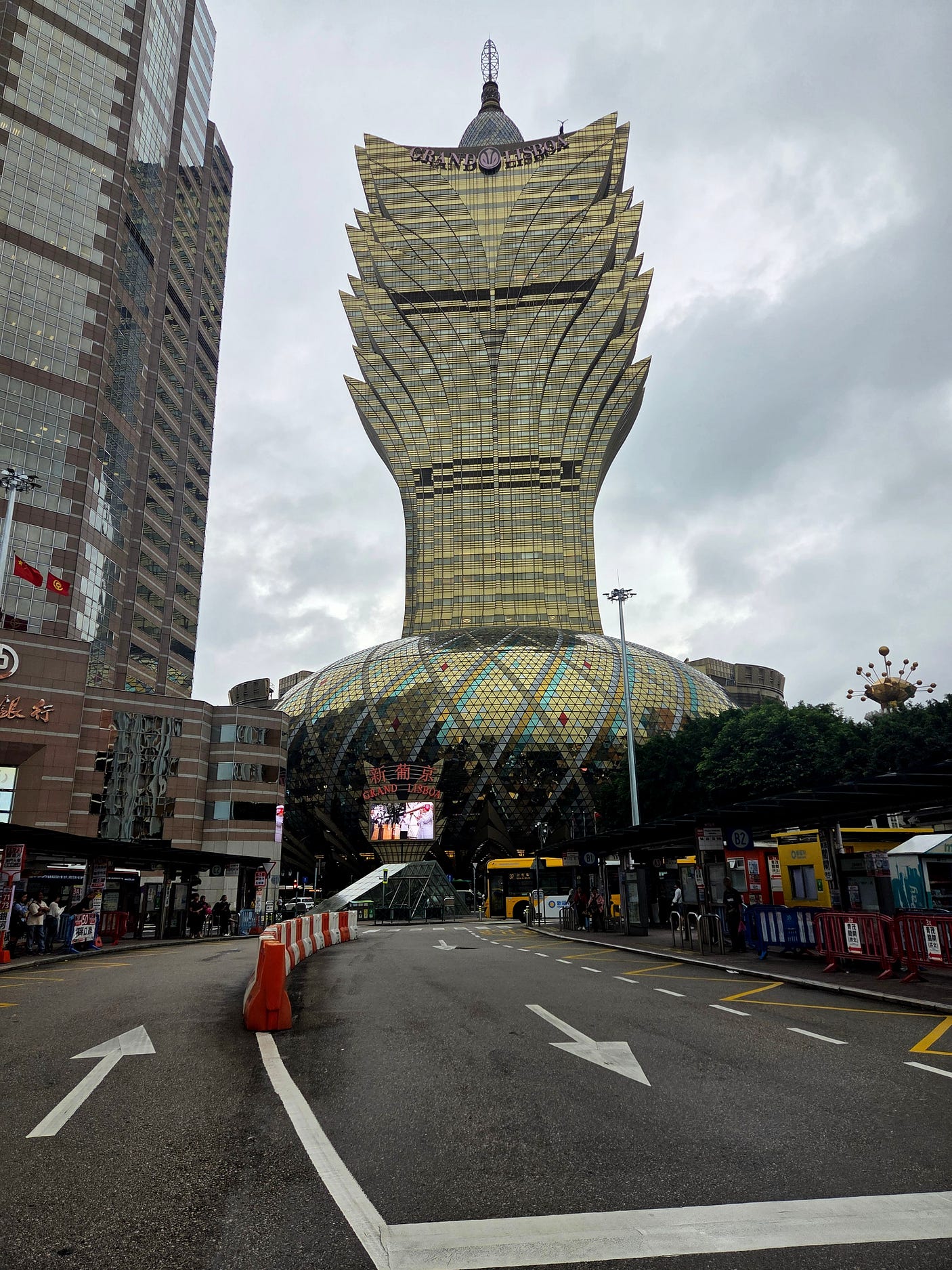
What you can also see in that photo are road markings urging people to keep left!
Here’s a closer view of the base of the Grand Lisboa Hotel.
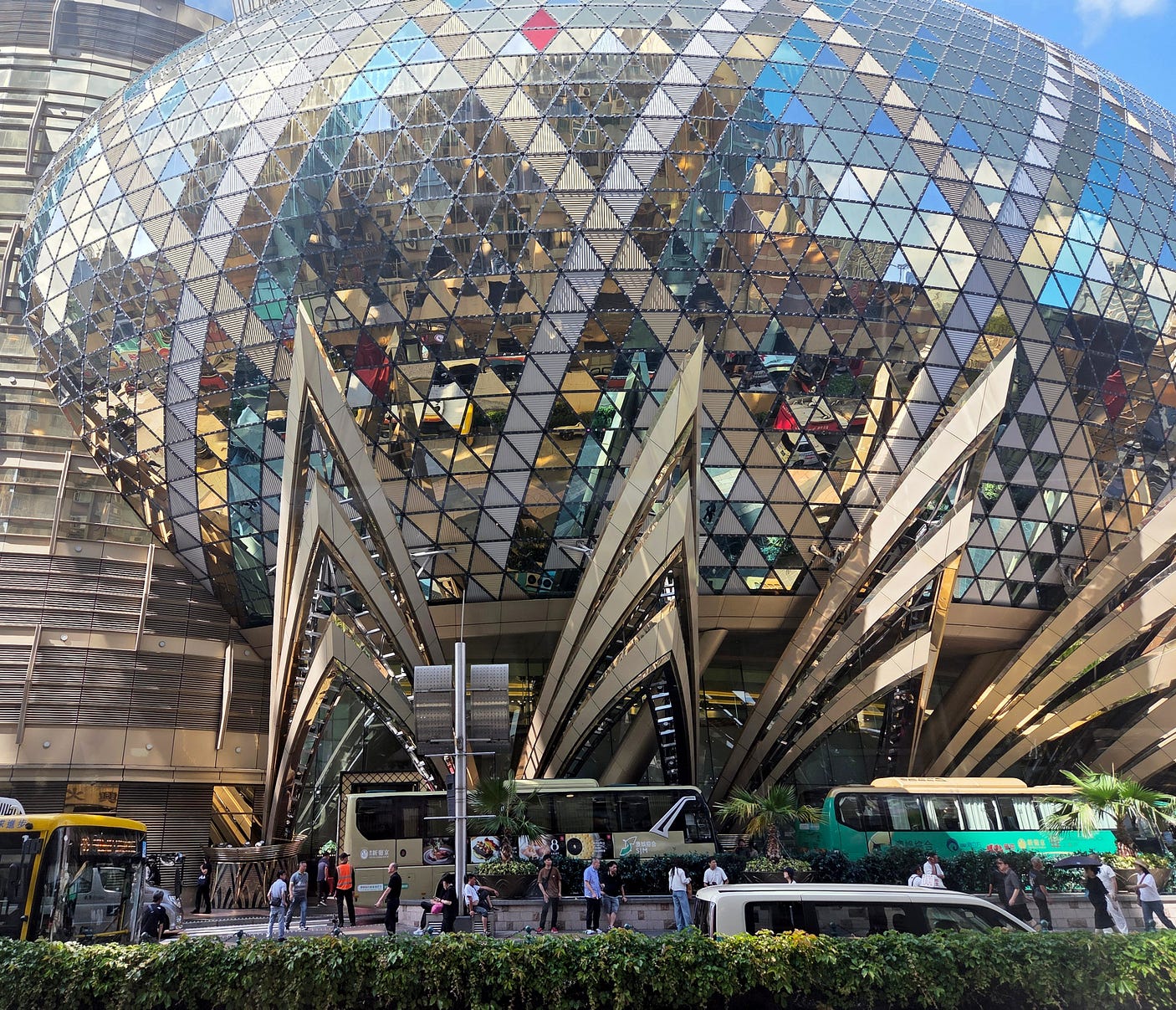
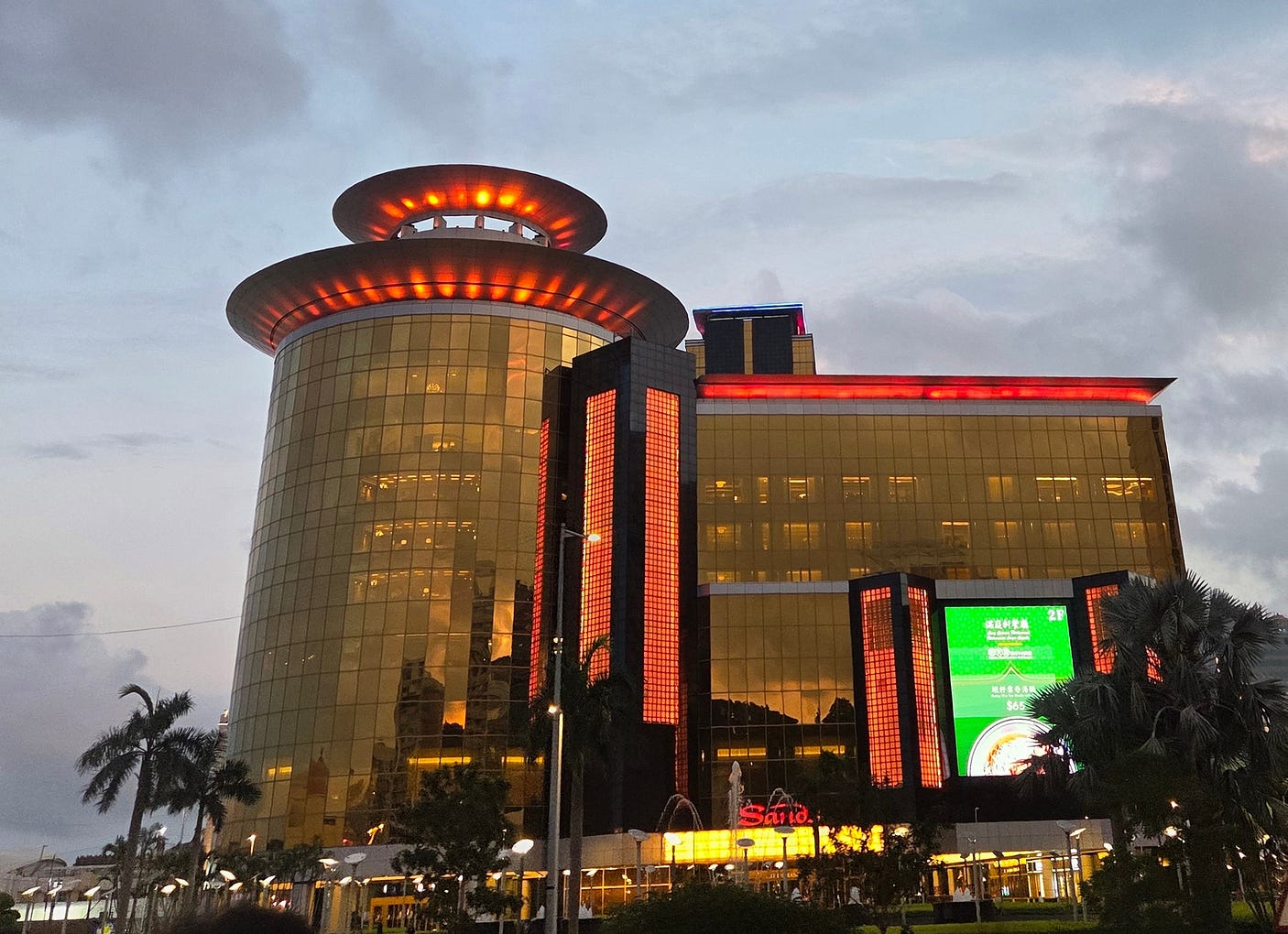
The Grand Lisboa Hotel also has a casino at its base, called the Casino Lisboa. Along with another casino called the Sands Macao, the Casino Lisboa is on the peninsula. Apparently, all the other casinos are on the Cotai Strip.
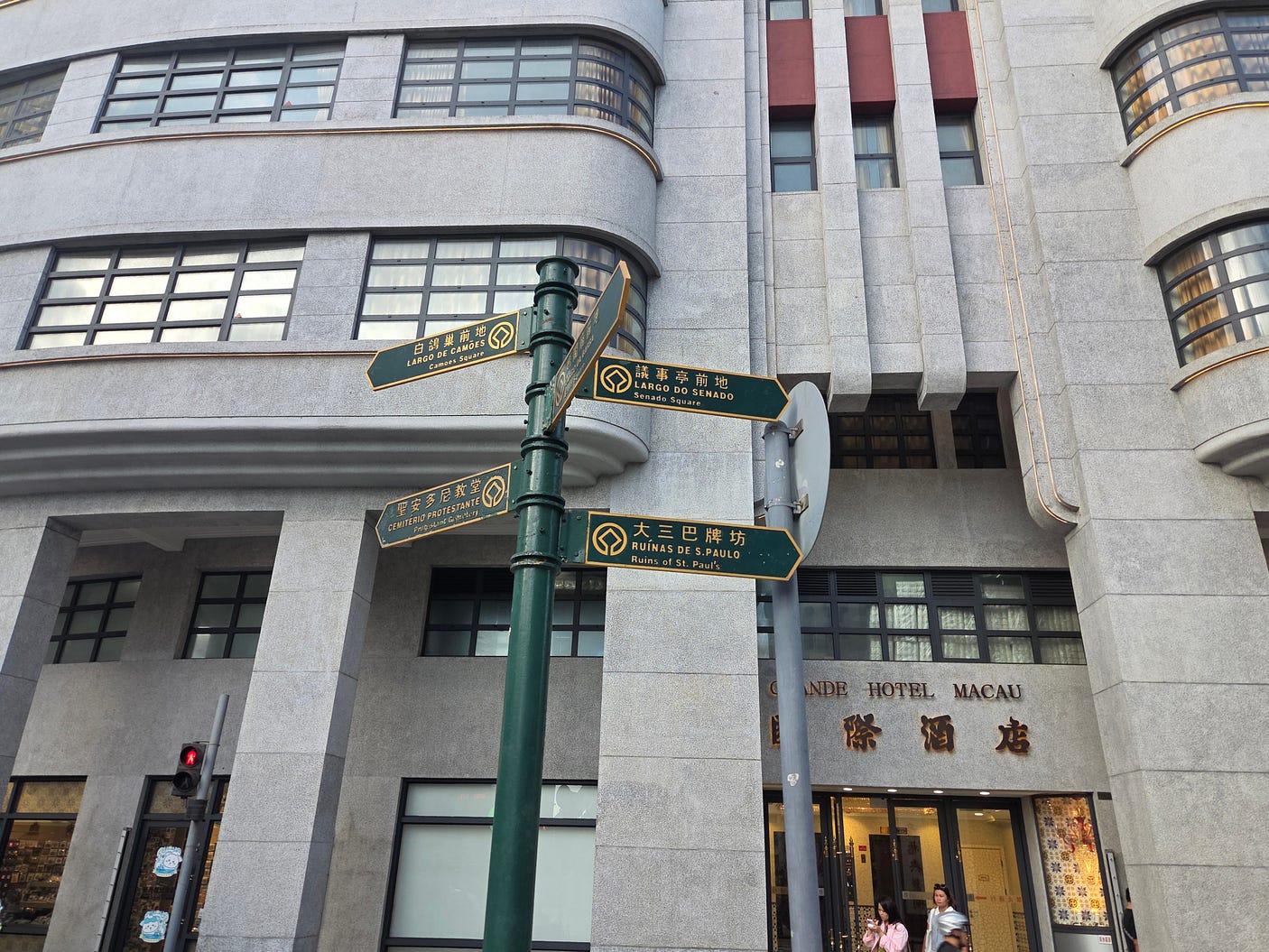
Somewhat more restrained is the Grande Hotel Macau, on Avenida de Almeida Ribeiro, which opened, as the architecture suggests, in 1941. The Grand used to be a luxury hotel, but is now quite budget-friendly. As you can also see, many of the streets and attractions still have Portuguese names, featured prominently in the road signs.
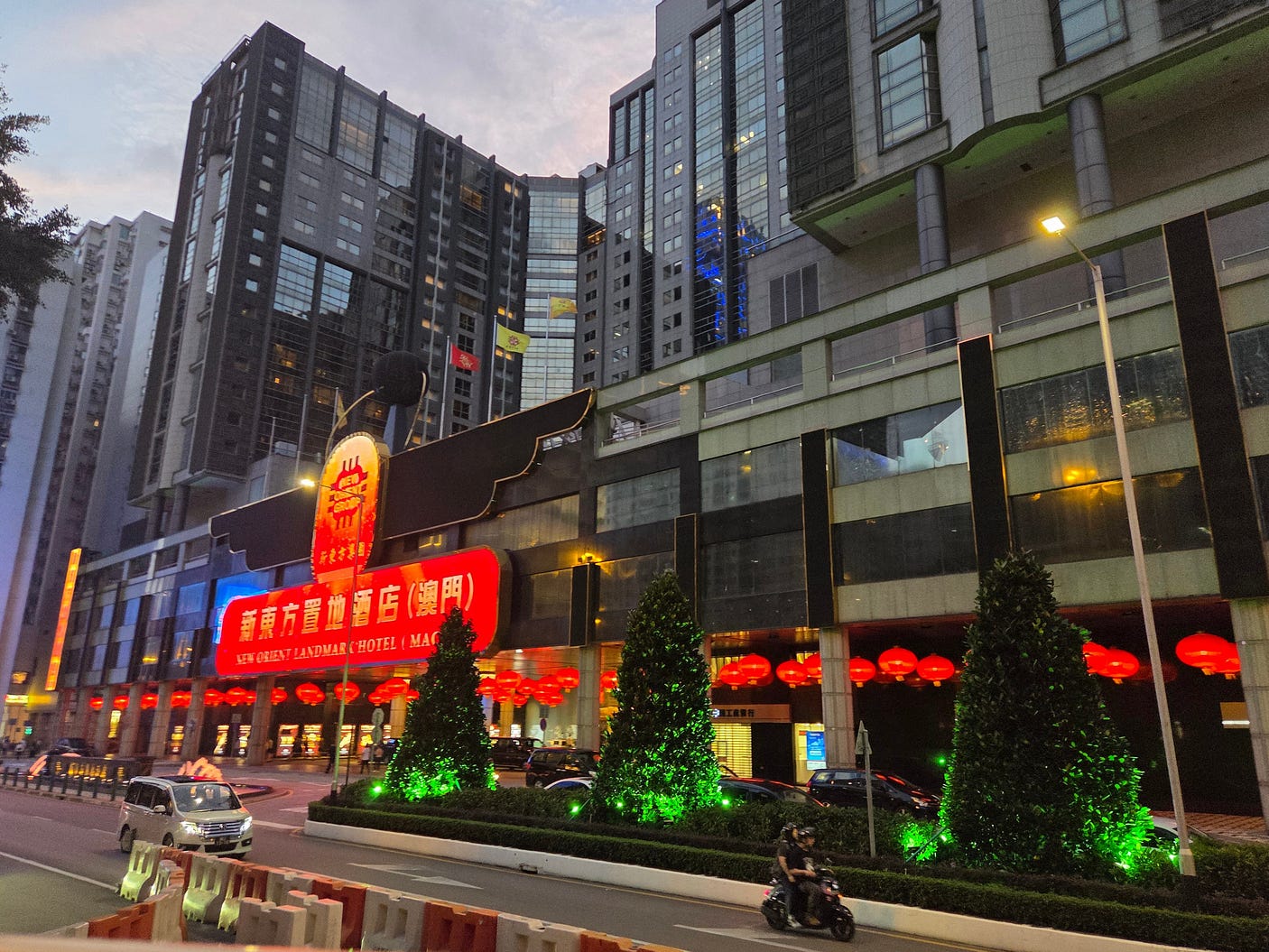
The same day, I went on an evening tour. Some of the sights I had seen earlier looked even more magnificent in the gathering twilight.
Here’s a video I’ve made of my tours around the modern parts of Macao, including a couple of scenes at the end where I visit the Venetian Macao and MGM.
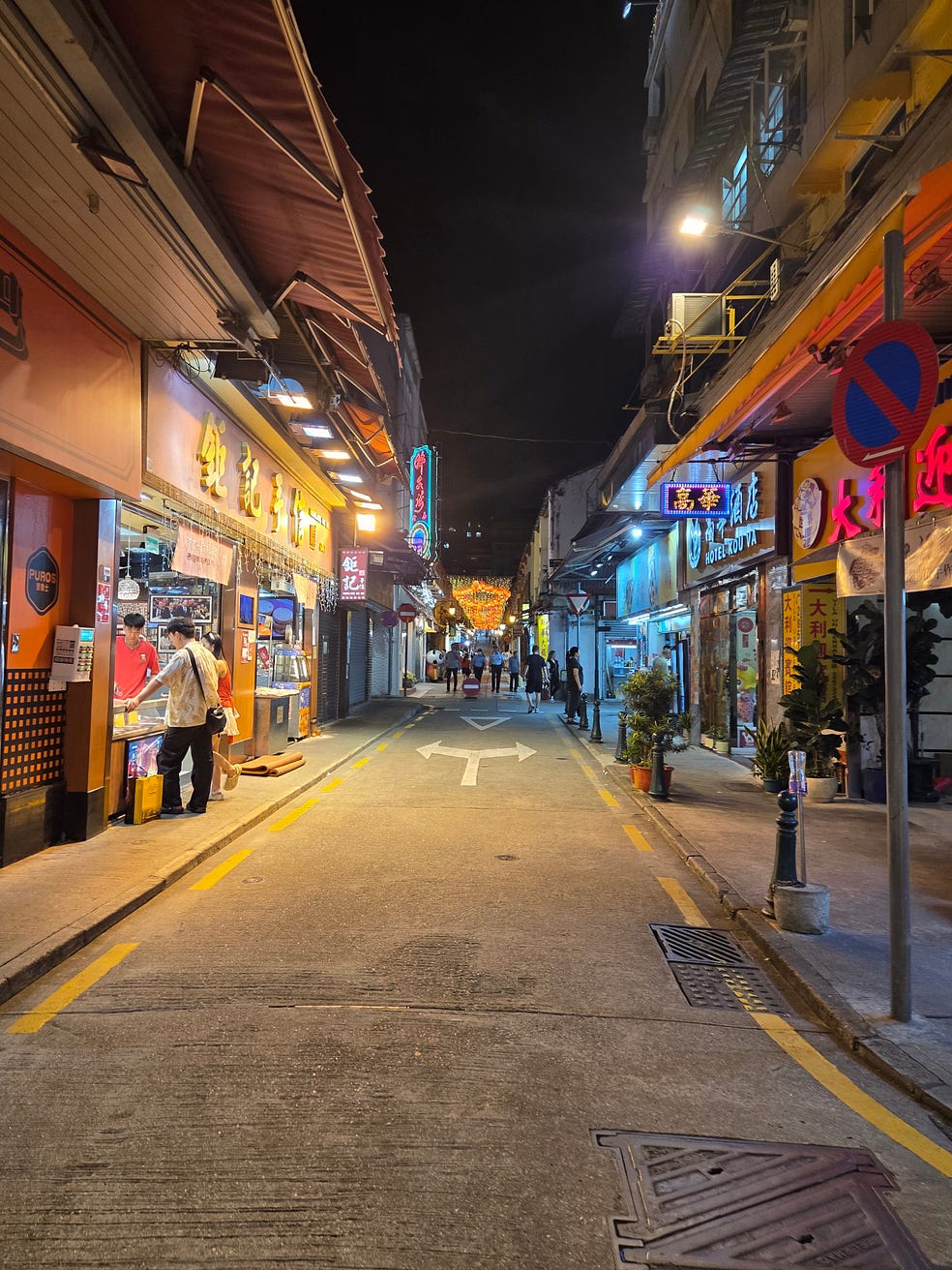
And here are some ordinary streets, at night-time.
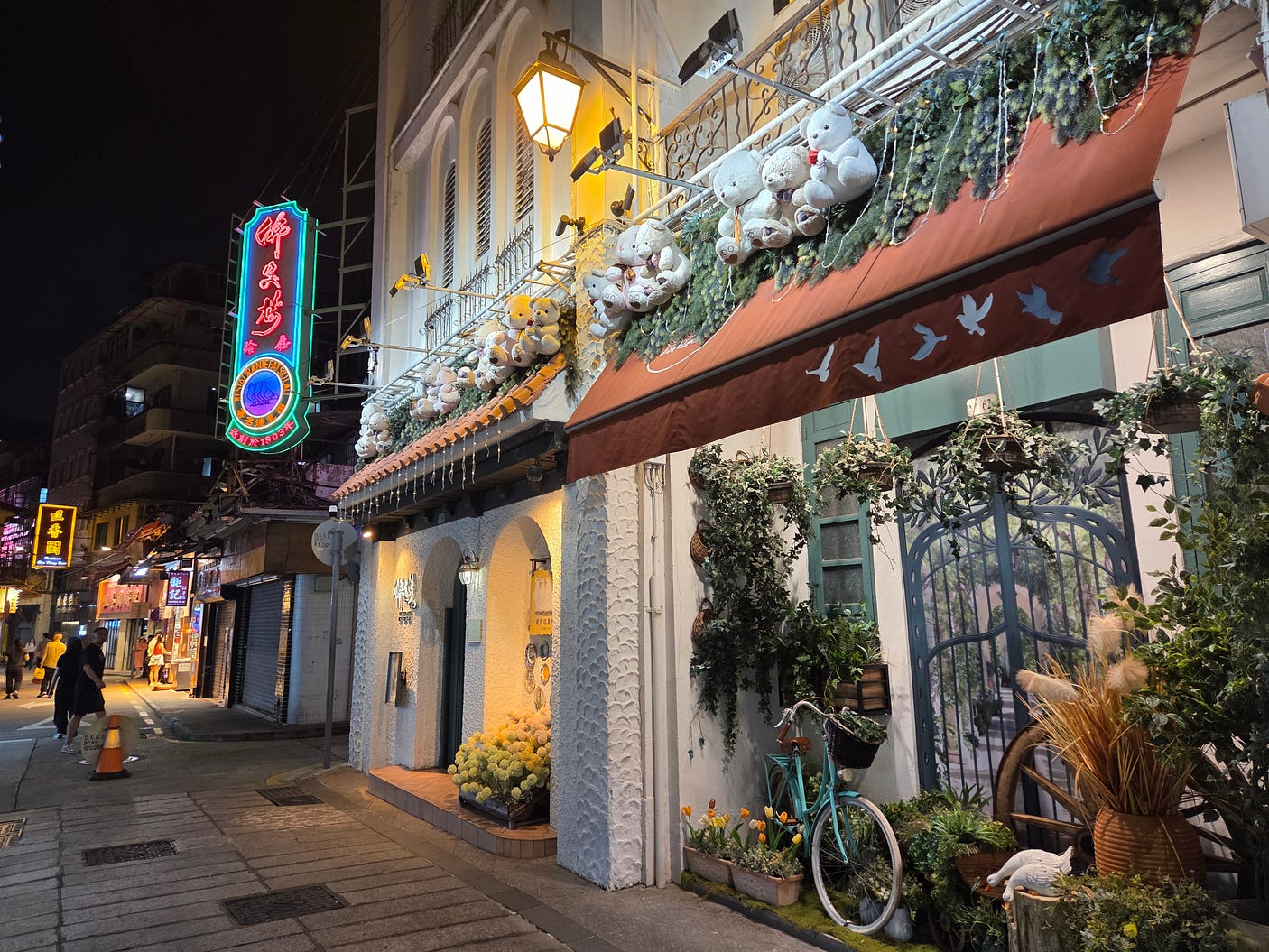
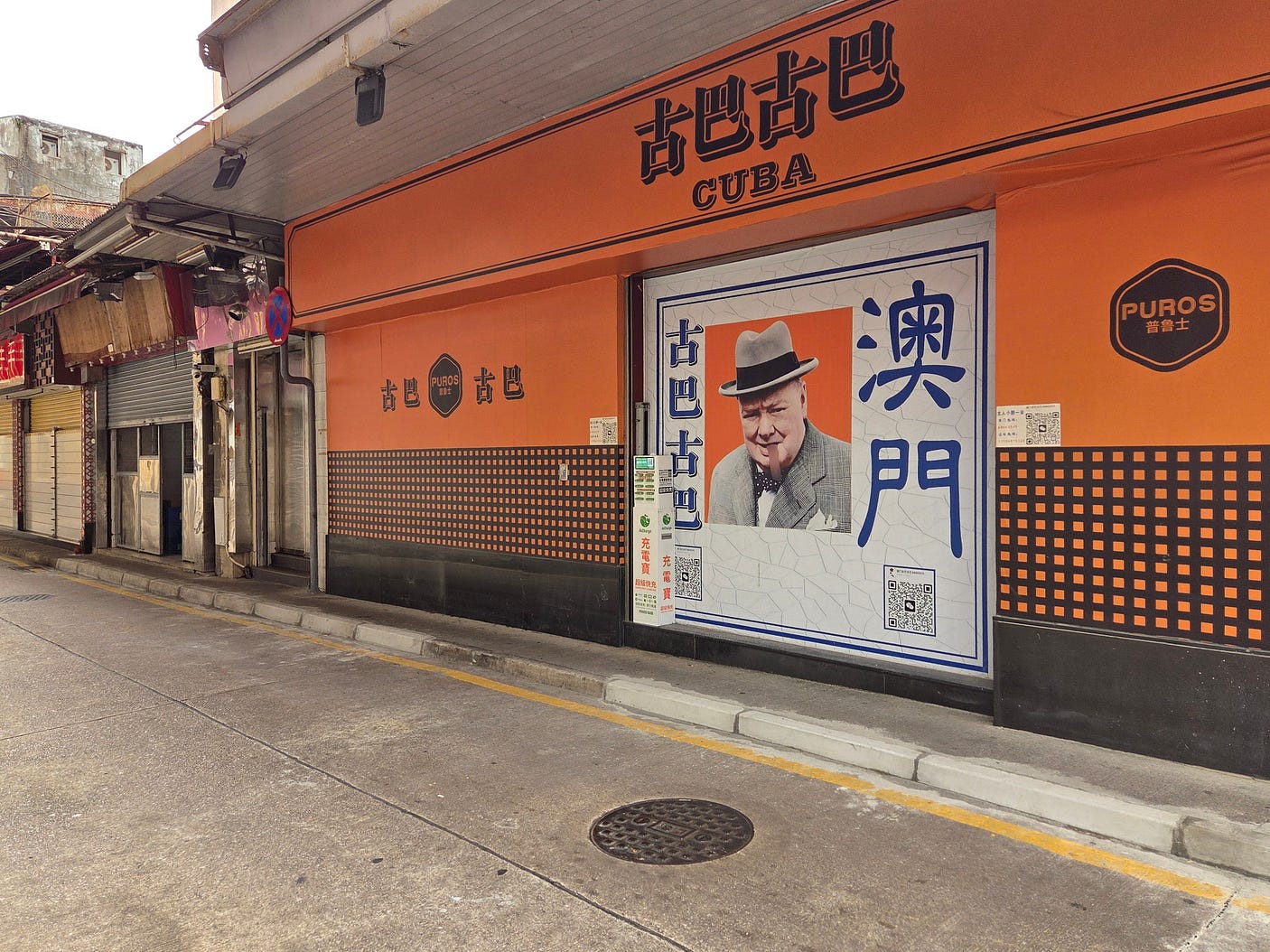
The next day, I got another photo in the same traditional neighbourhood, of what seemed to be a cigar shop, with at least one satisfied customer.
After that, I set out on a tour of the Historic Centre of Macao.
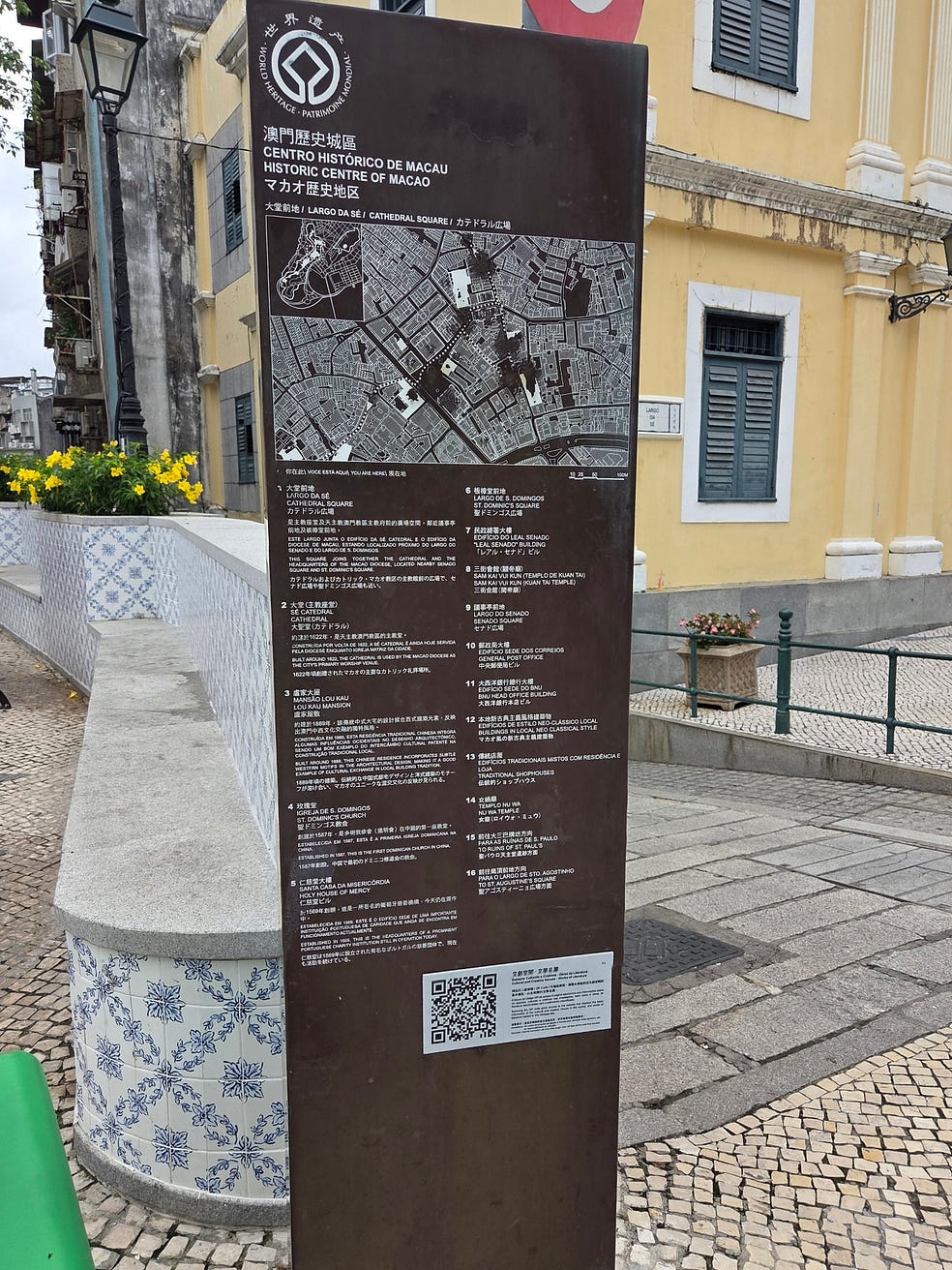
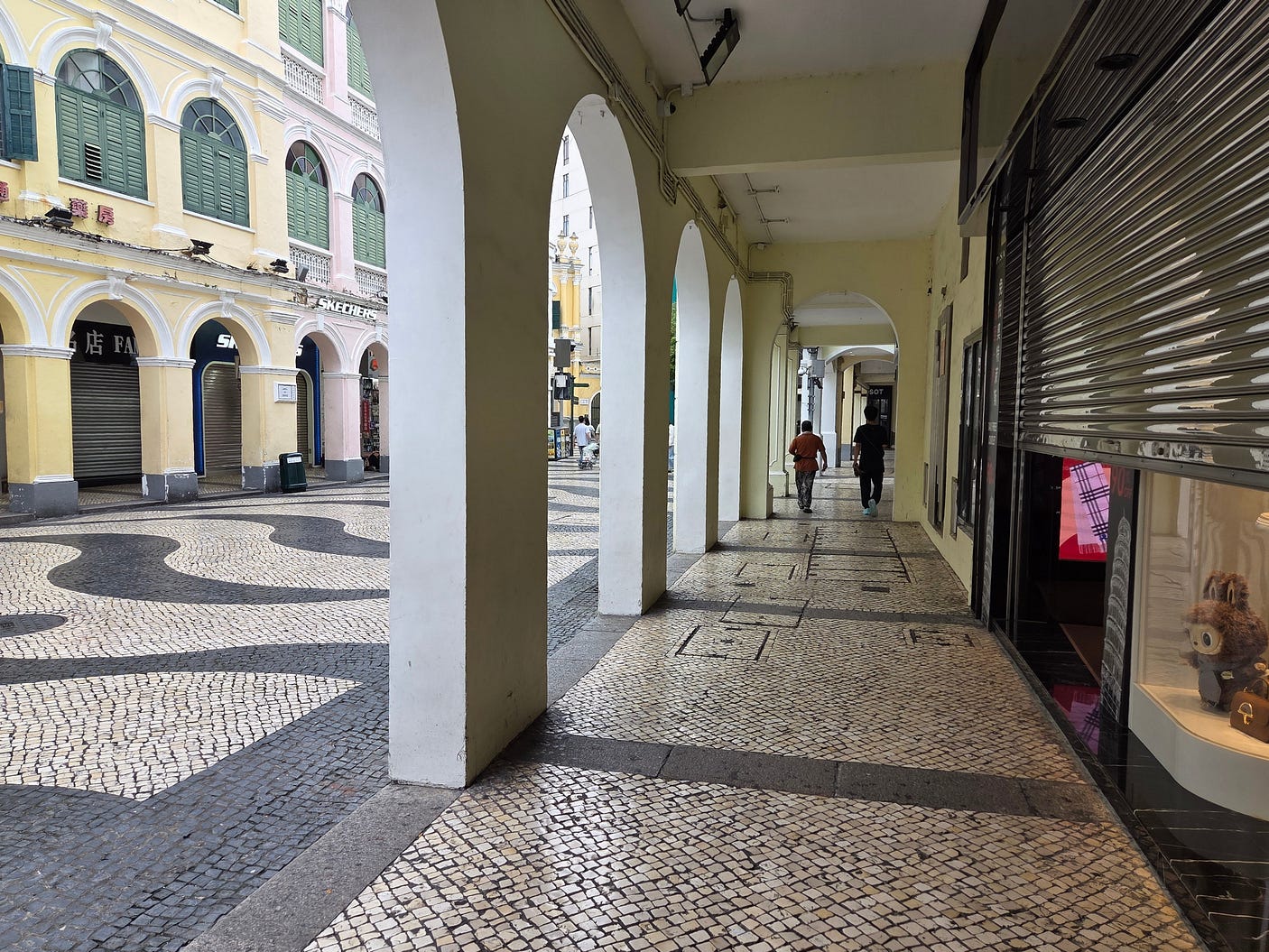
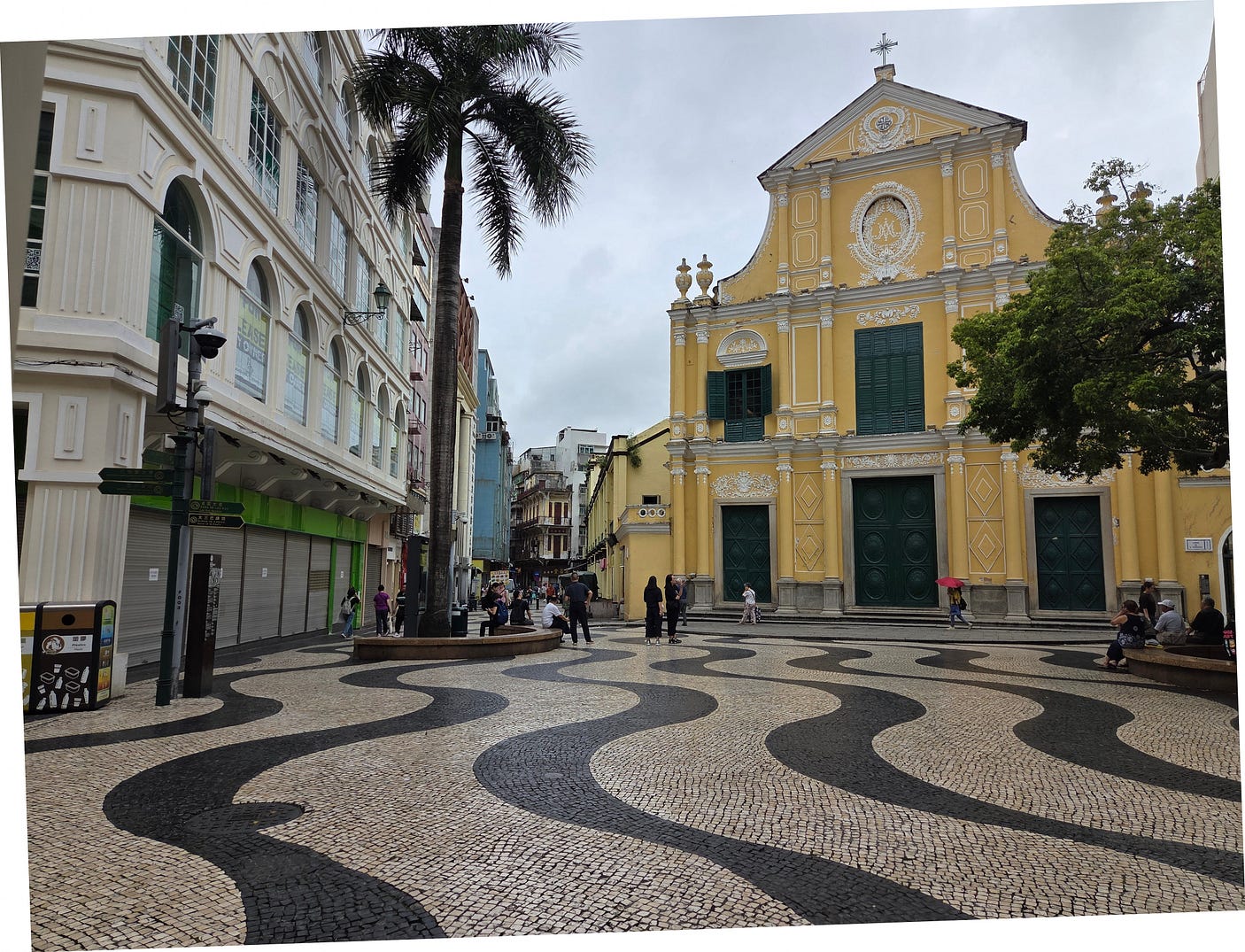
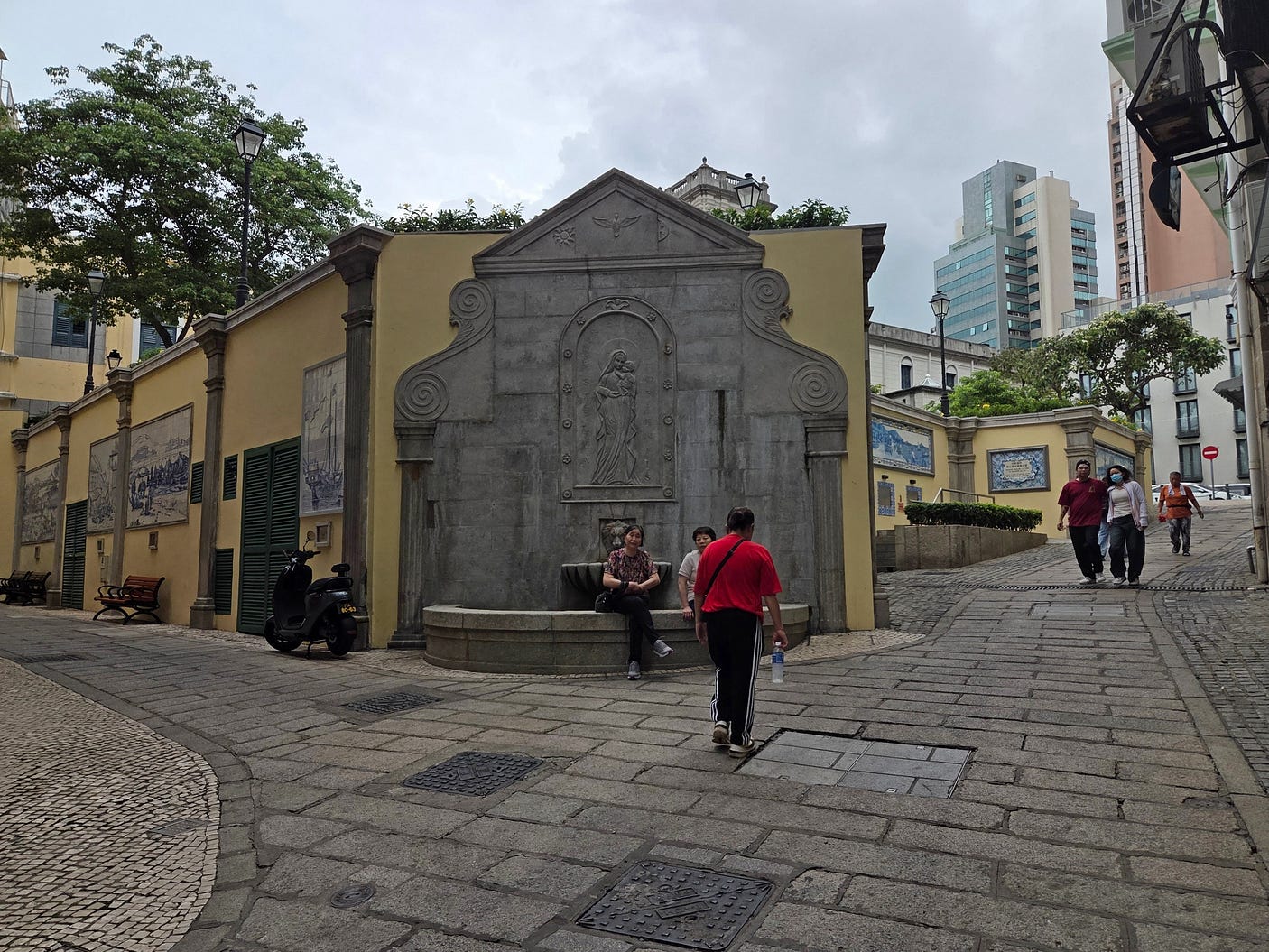
It’s possible to see the Portuguese influences at once, not just from the language on the street signs but also from the blue-pattern tiles (azulejo) and, even more distinctively, the black-and-white paving (calçada portuguesa), the real hallmark of being in a place that speaks Portuguese, or used to (for Portuguese is not really that widely spoken in Macao anymore, with Chinese understandably taking over, and English also making inroads from Hong Kong).
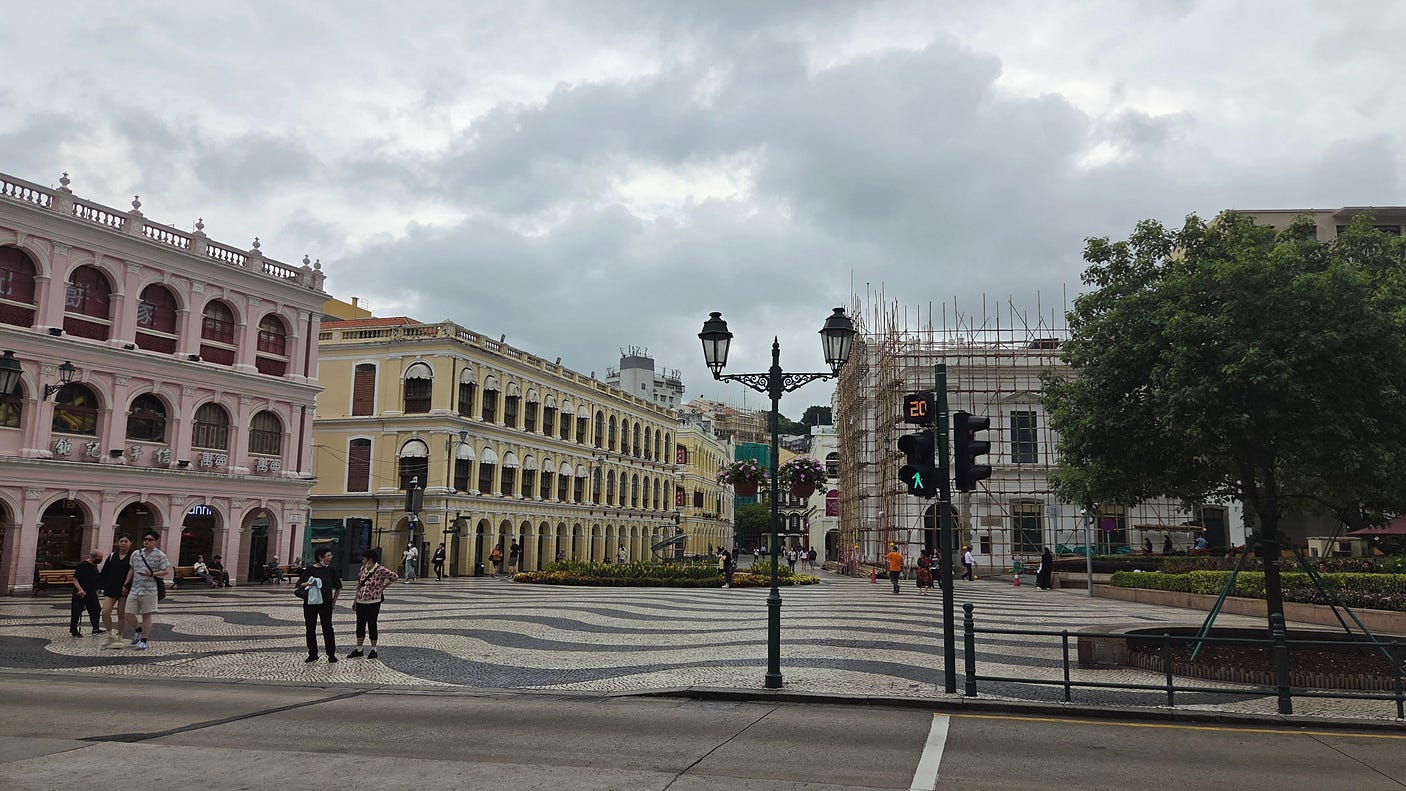
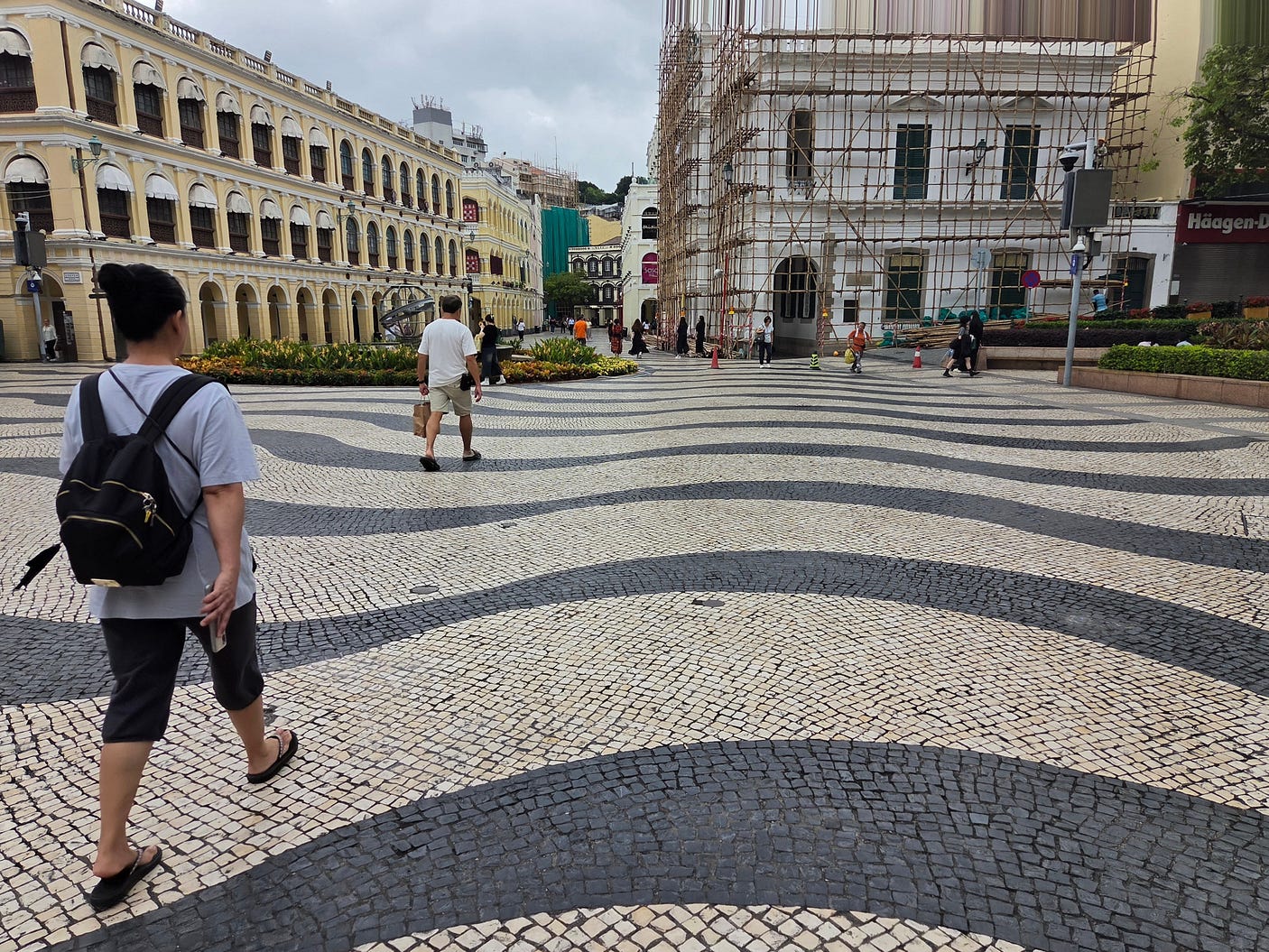
The old town is quite relaxing, after the go-go of the casino areas.
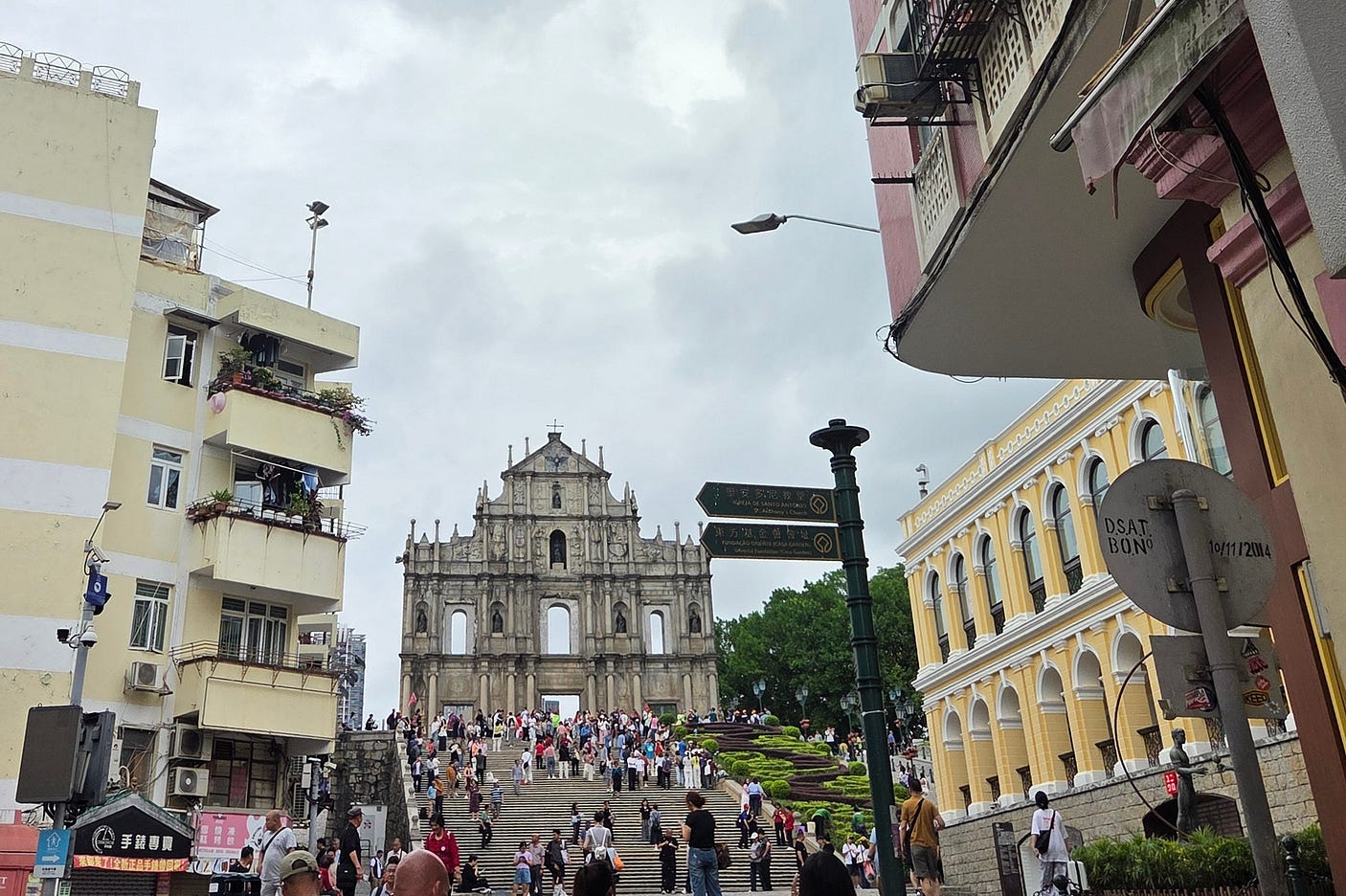
And here is perhaps the most famous landmark of the old quarter and symbol of Macao, the surviving façade of St Paul’s Church (Ruínas de São Paulo), and the old steps that lead up to it from Largo da Companhia de Jesus (Plaza of the Society of Jesus, or, in other words, the Jesuit order of Catholic missionaries).
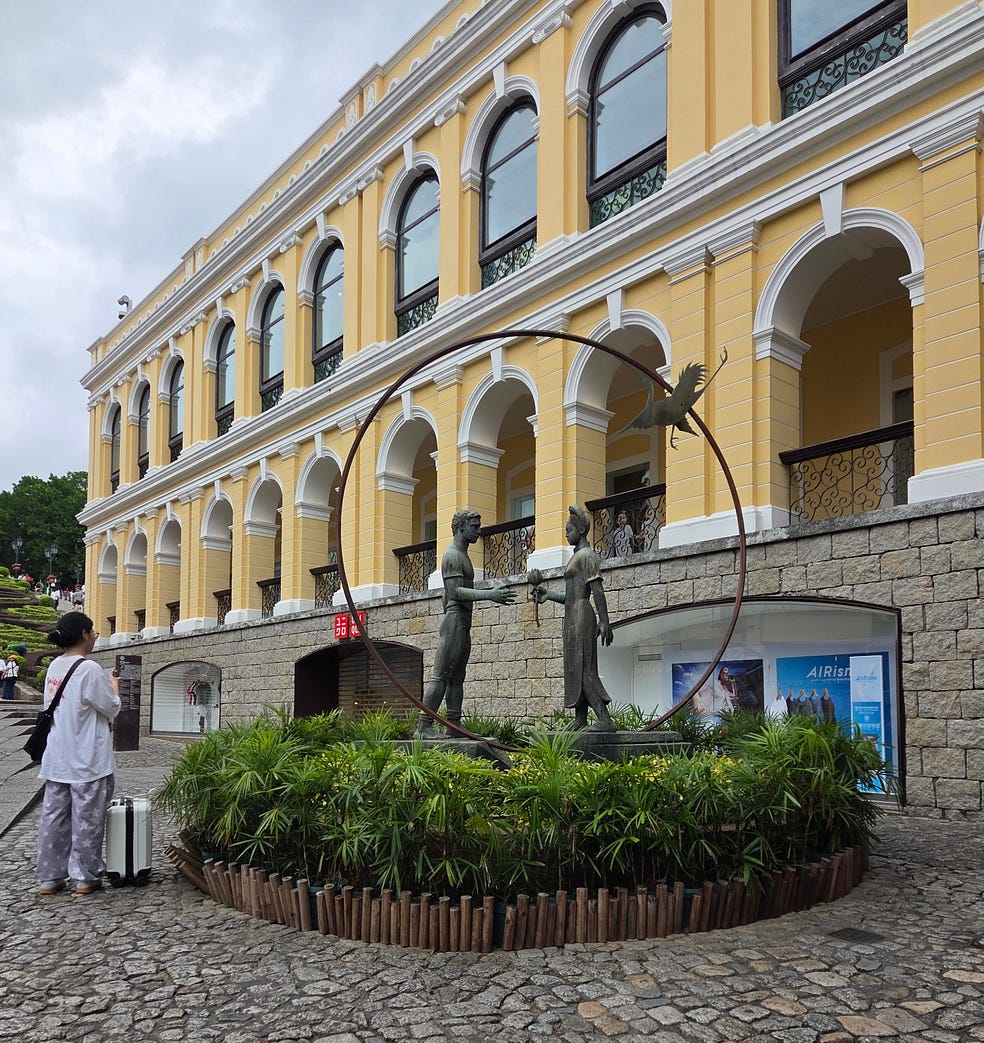
Just to the right, you can see half of a public artwork, the Portugal-China Friendship Monument, which is shown more clearly in the next photo. It shows a Chinese girl passing a lotus flower, symbol of purity, to a Portuguese boy, encompassed by a hoop and overseen by a flying crane. The monument was created at the time of the handover of macao from Portugal to China. The plaza is often very crowded, and travel advisors say that to be sure of a good photo of the monument you have to get there early. So, I was fortunate.
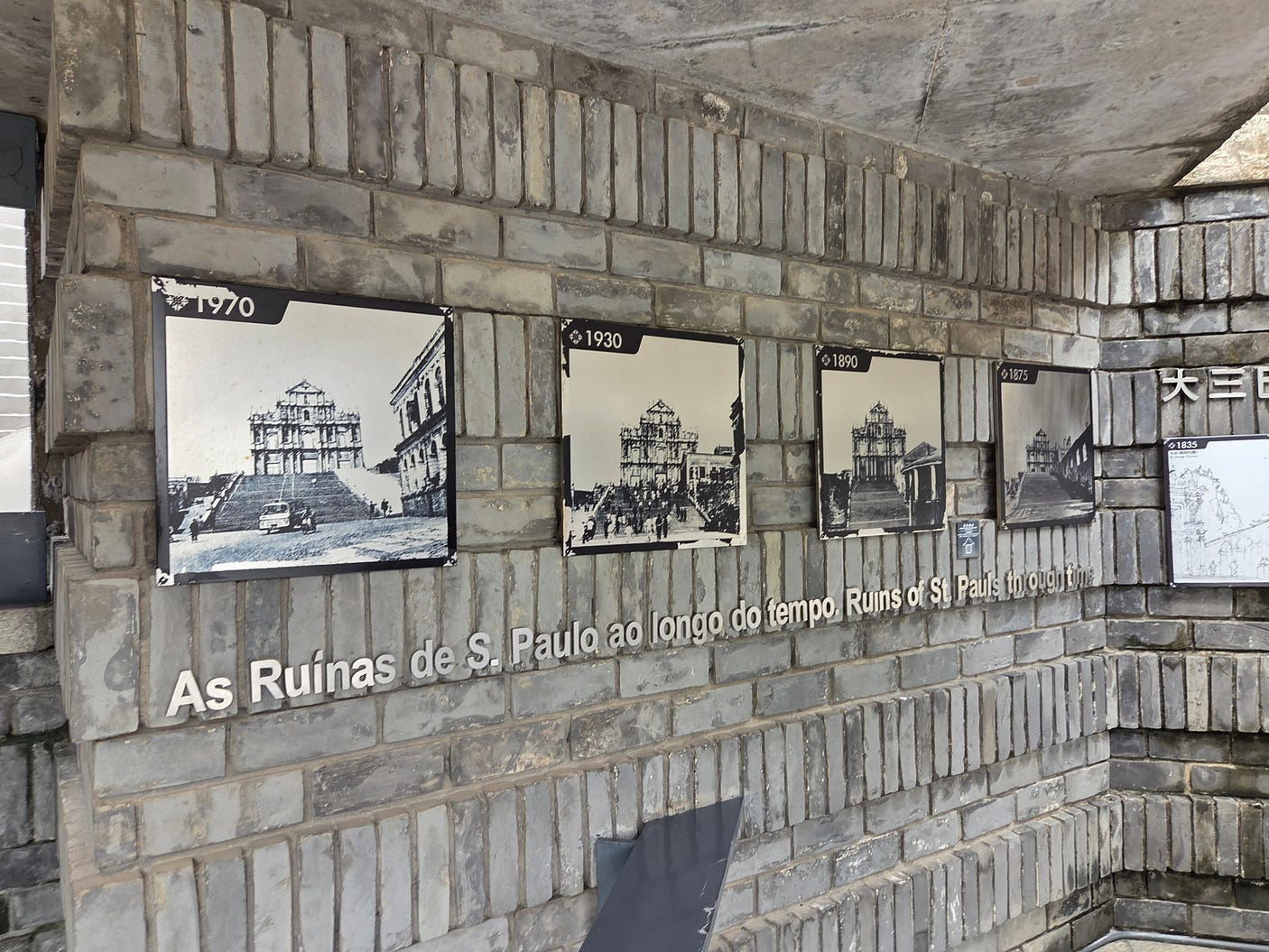
I came across some photos and sketches of the ruins of St Paul’s over the years. The church was originally built in the 1600s, and was destroyed in a combination typhoon and fire in 1835.
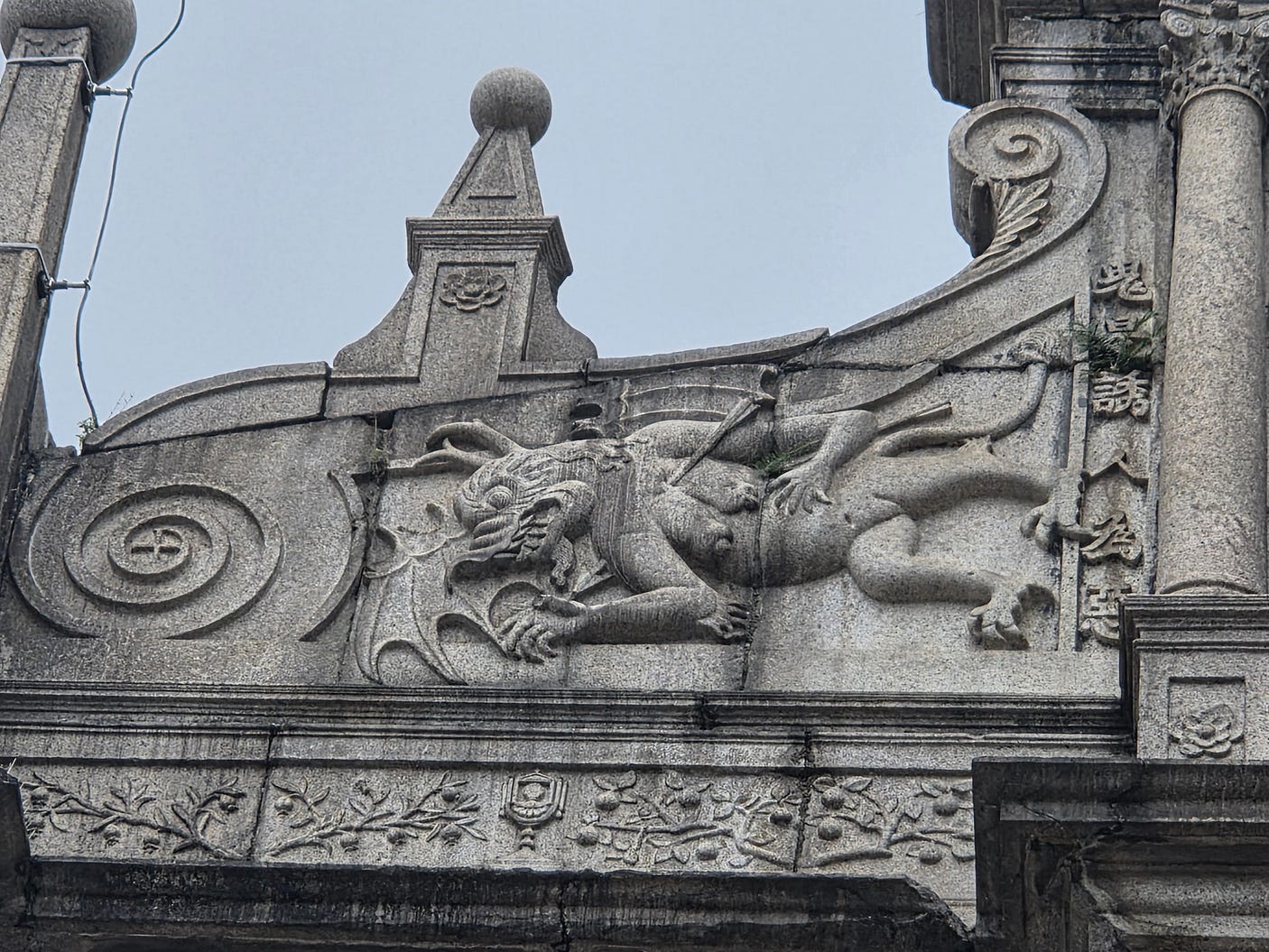
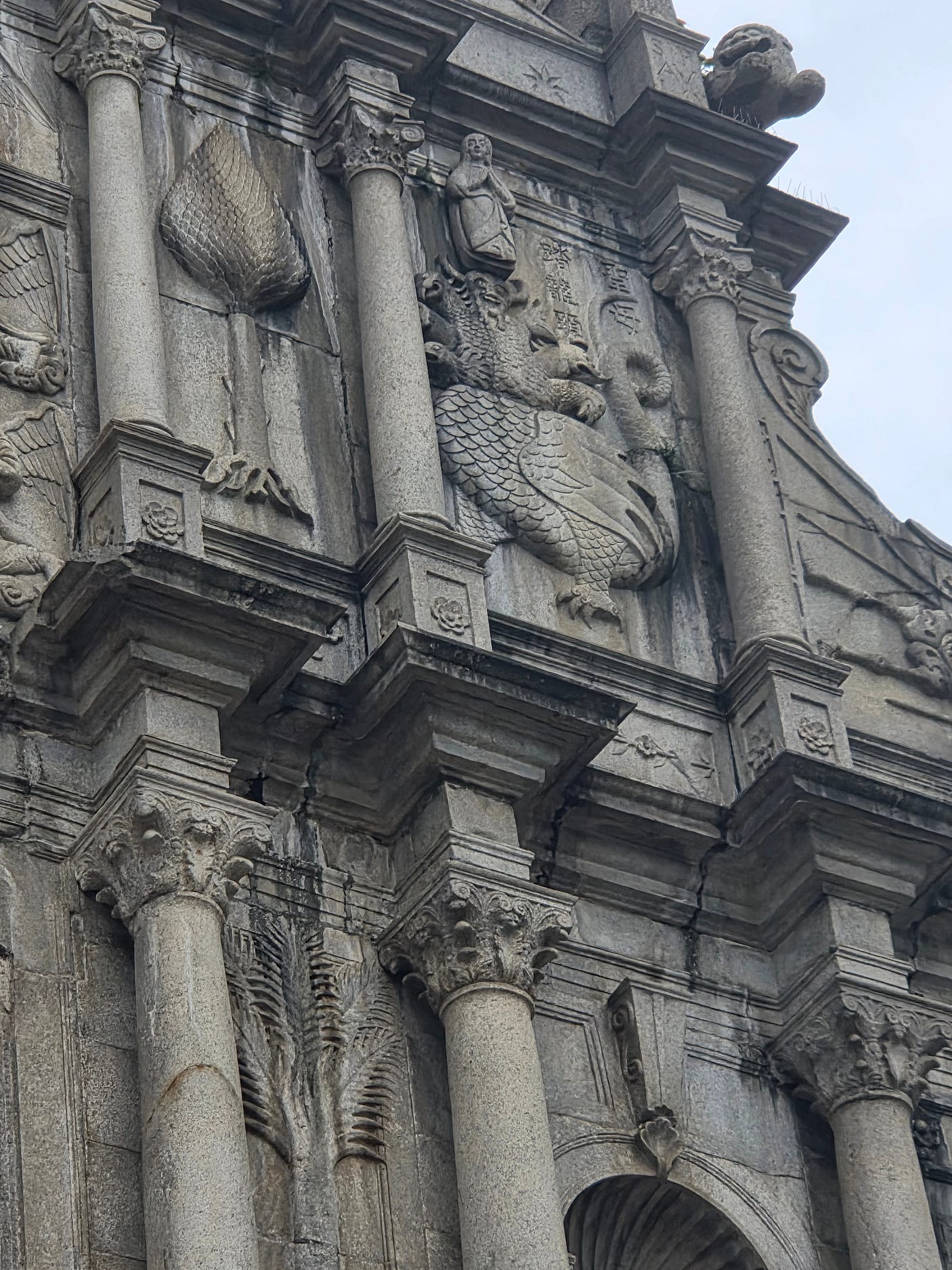
Here are a couple of photos of details on the facade, first of all rather shocking image of a female demon pierced by an arrow, on the left, and then, on the right, the Virgin Mary standing on top of and thereby subduing a hydra, or many-headed mythical serpent symbolising evil, in line with Genesis 3:15 (“she shall bruise your head”) and, perhaps, the Book of Revelations as well.
By the way, many of the squares and plazas in the old town are referred to, on the road signs, by the word ‘largo,’ though the precise Portuguese equivalent, or cognate, of our word plaza is praça.
Though largo is similarly related to the English word large, and means ‘wide,’ it actually refers to a small plaza, an open space that, in the old days, was usually formed by accident, at a spot where several higgledy-piggledy streets intersected.
So, the largo is wide compared to the streets that feed into it, but small compared to a praça, the word that Portuguese speakers tend to use when referring to a square or plaza that is more formal and grand.
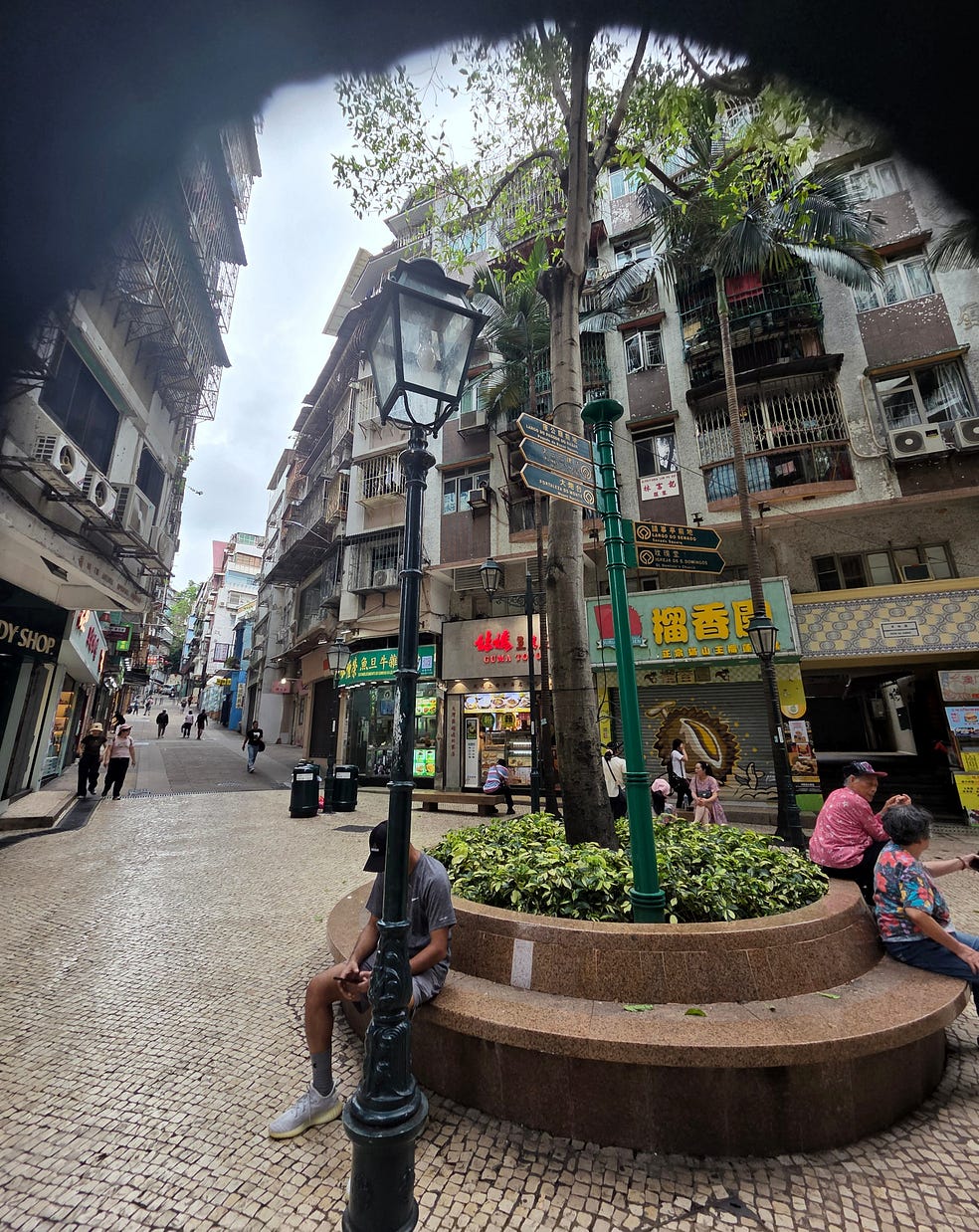
Largo is an excellent word for an important physical aspect of a laid-back way of life that doesn’t have any exact equivalent in English, though I suppose ‘cosy nook’ comes close.
After St Paul’s, I went up to the Mount Fortress Park, a park formed out of the former Portuguese fortress of Macao, the Fortaleza do Monte (‘Mount Fortress’), whose guns did not face China but rather out to sea to fend off other maritime powers such as the Dutch, who tried to take over Macao in 1622.
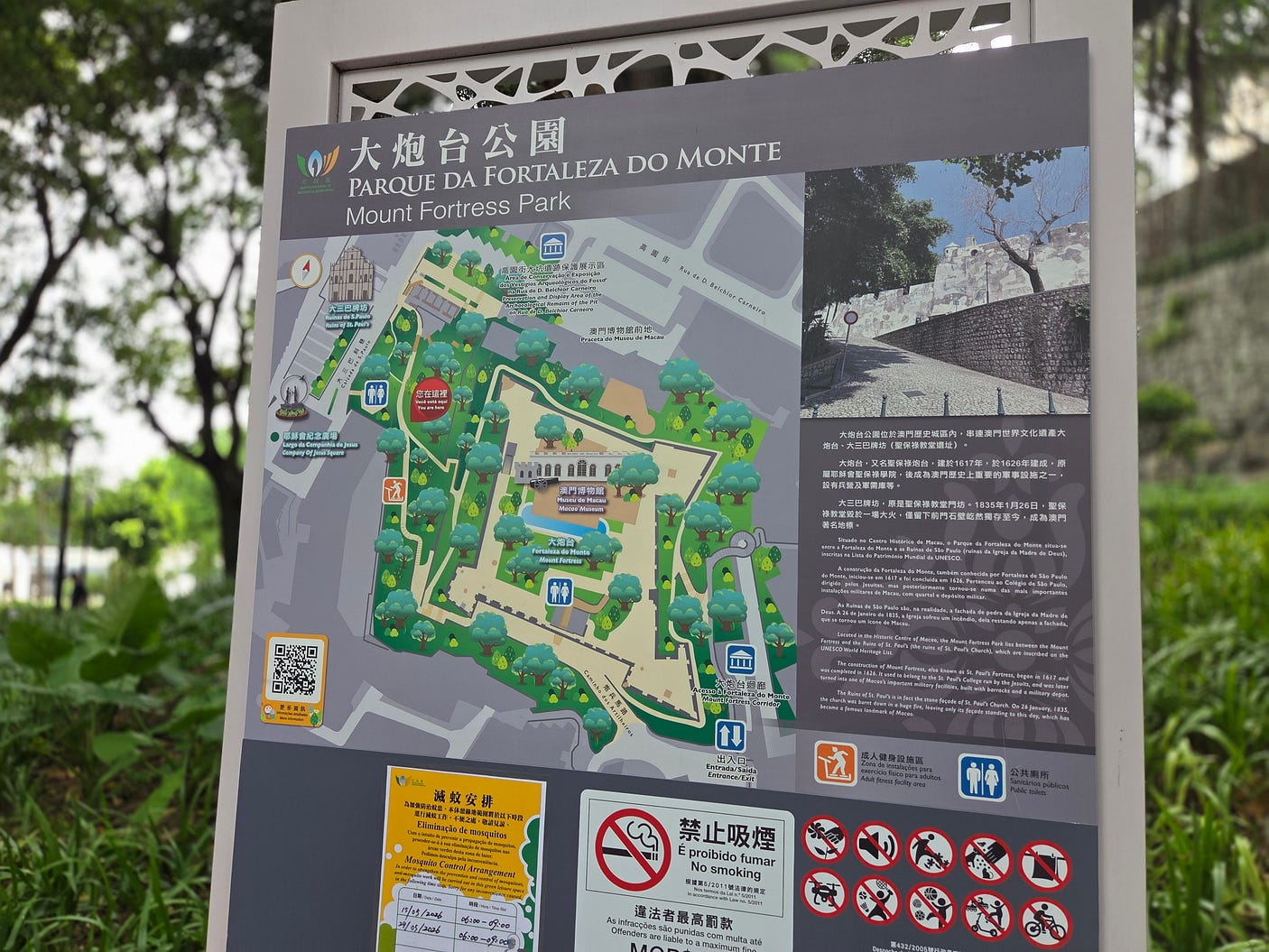
These days, the Museu de Macau, or Macao Museum, sits on top of the still-intact fort.
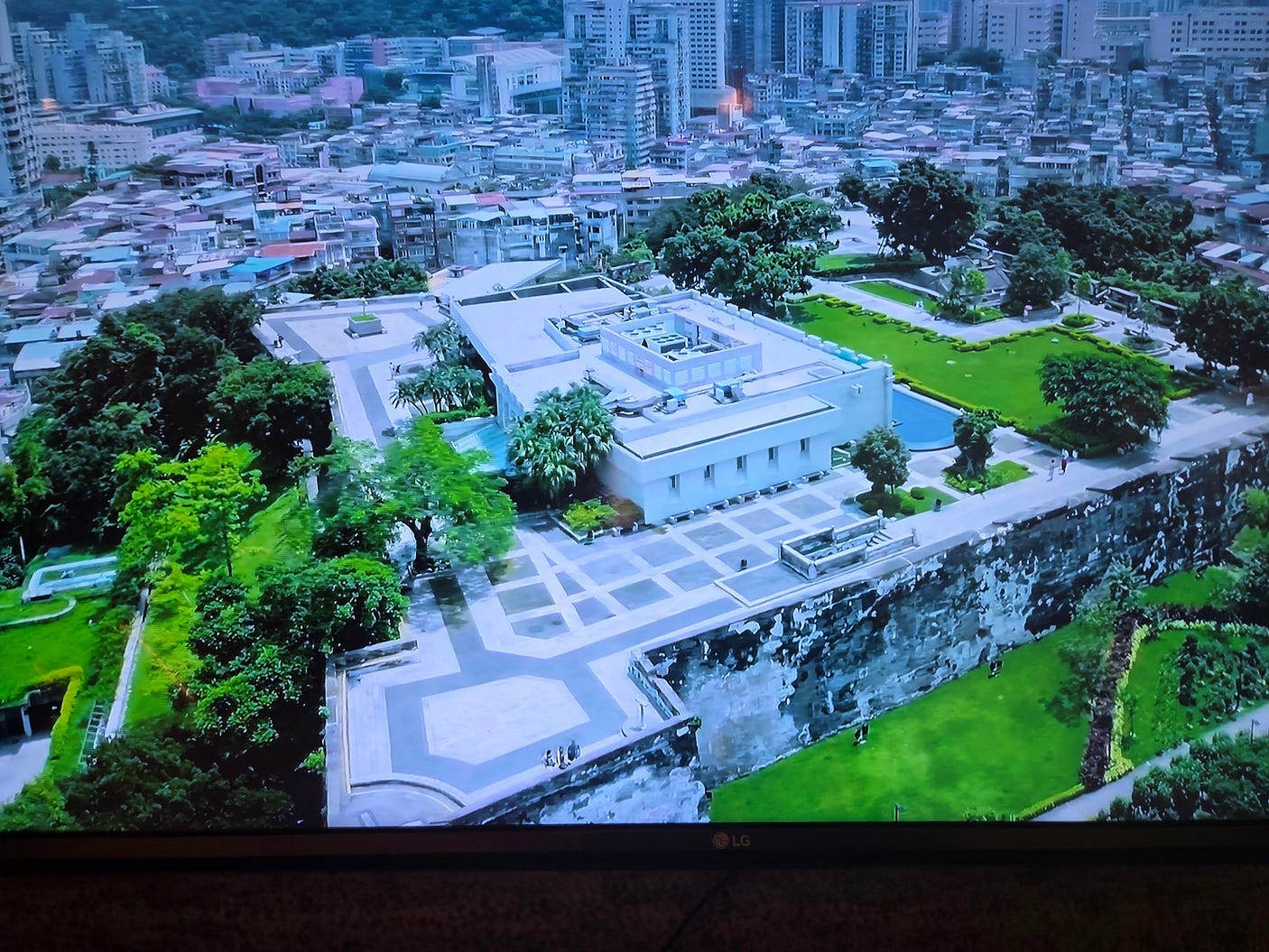
In Part 2, next week, I will describe a visit to the fort and the museum on top, and then go on to describe more of Macao, including a lovely park, more street scenes, and what some of the casino resorts are like inside.
Subscribe to our mailing list to receive free giveaways!

