Giveaways
AFTER Nepal, I flew to India to explore the Ladakh region, in Indian-controlled Kashmir. But first, I went for a tour around Delhi, with a focus on New Delhi, the district designed after the First World War by Sir Edwin Lutyens, as a new seat for the British government of India (formerly located in Calcutta, or as it is now called, Kolkata), and which is now the seat of the Indian government.
I arrived via Indira Gandhi International Airport, which was amazing: very modern and efficient. It is served by two Delhi Metro lines, the Airport Express and the Magenta Line.
The Delhi Metro began service on 24 December 2002, and is now quite extensive, with no fewer than nine currently operating lines, and a tenth line forthcoming.
Even so, I paid 2000 rupees for a ride on one of the lined-up taxis to my digs near the Bahá’i Lotus Temple. I could have got an Uber for 350 rupees, apparently, but it would have been a lot less convenient than just grabbing a taxi, which was still quite affordable.
The first sight I saw when I got out and about the next day was the wonderful Lotus Temple.

Much of Delhi has been done up lately, as this publicity piece for the Humayun’s Tomb Museum suggests. Humayun’s Tomb is a palace-like memorial complex on the southern edge of New Delhi.

Humayun’s tomb was built by order of the Mughal emperor Humayun’s consort after he died; so it is a bit like the Taj Mahal in spirit, except in memory of a husband rather than a wife. It is also the first garden-tomb complex of its type in the Indian subcontinent: the Taj Mahal came later.
The Mughals were Muslim emperors of India, originally from the Islamic parts of central Asia: Mughal is another way of saying Mongol, though they weren’t purely from Mongolia.
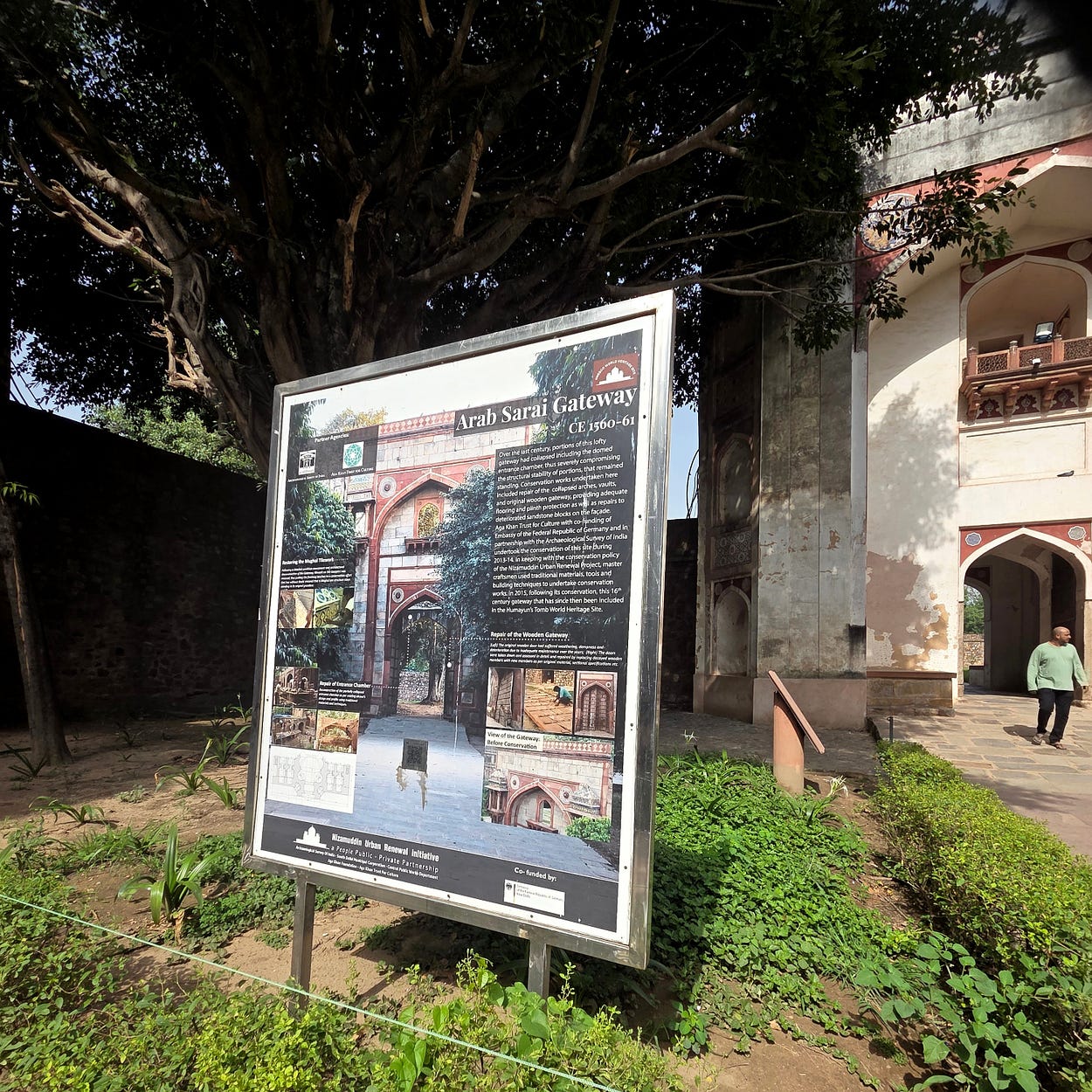
The Arab Sarai Gateway is part of the Humayun’s Tomb complex.

Here’s a view of the main building of the Humayun’s Tomb complex in its entirety, with pathway and ornamental pool.

Directly below the big dome, there is a white marble sarcophagus. The actual, physical tomb of Humayun is beneath the sarcophagus, which is purely symbolic.

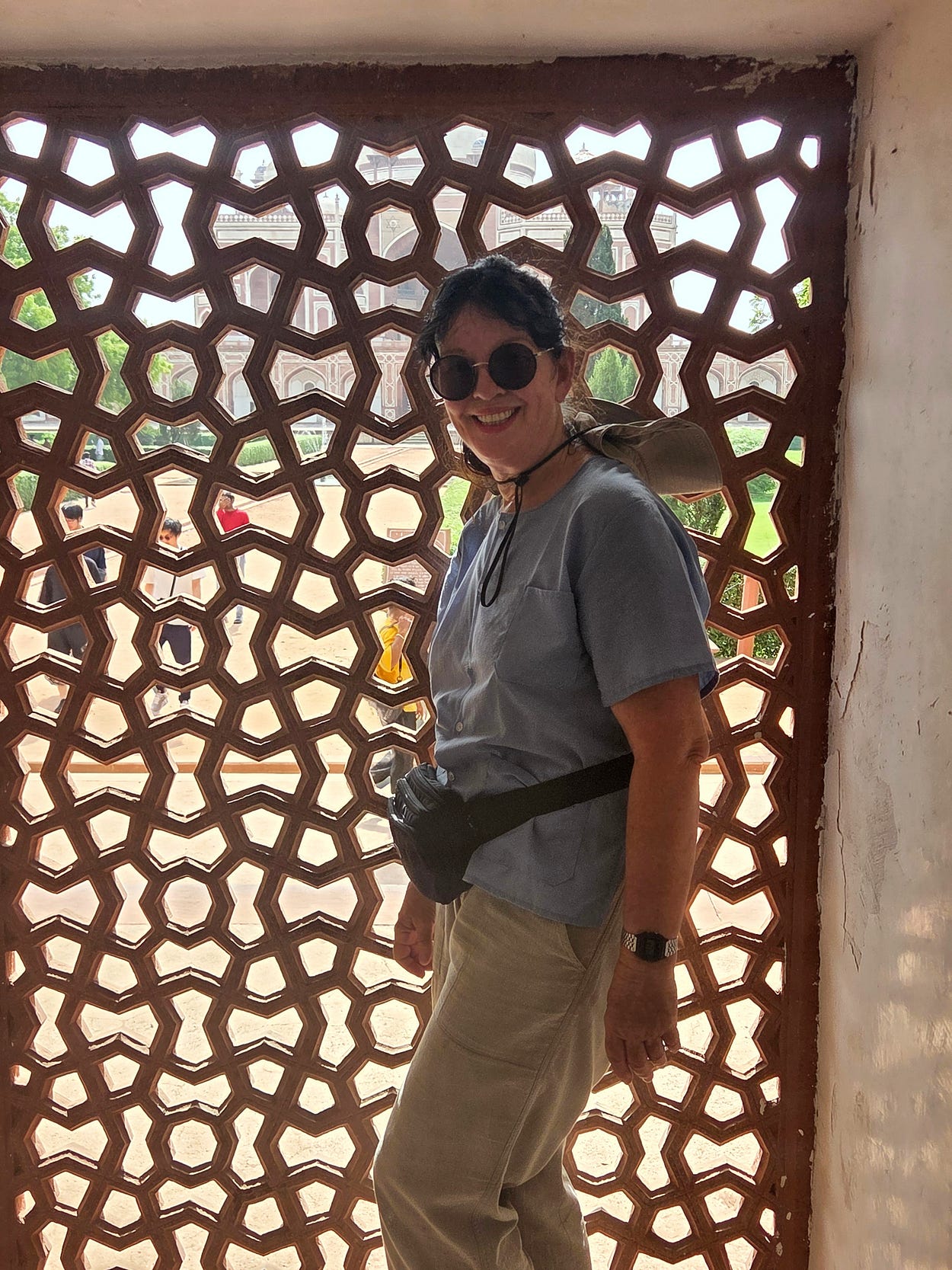
The next photo shows myself behind one of the ornate window screens that are such a feature of Indian architecture and Mughal architecture in particular. These screens permit air to circulate while allowing people to see out and maintaining a degree of privacy at the same time. You can just see the main building of Humayun’s Tomb in the background.
Here’s a video I made at Humayun’s Tomb:
The next photo shows the India Gate, a huge war-memorial arch on the eastern edge of the so-called ceremonial axis of New Delhi. The India Gate is often considered to be an iconic symbol of Delhi, in the same way that the Eiffel Tower is of Paris or the Brandenburg Gate of Berlin.

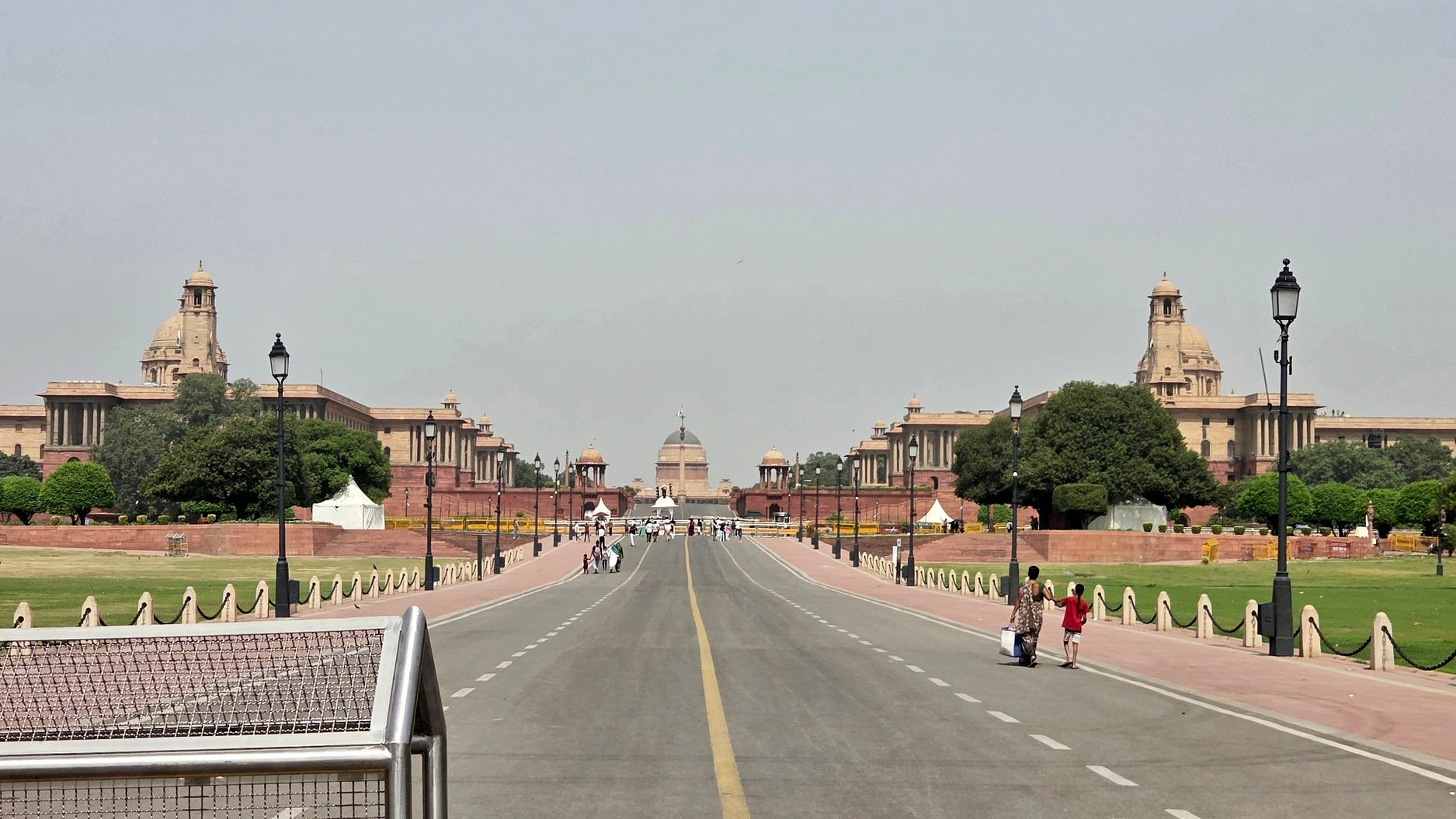
And here are the amazing government buildings at the other end of the ceremonial axis, with the former viceregal palace, built for the British Governors-General of India and occupied nowadays by the President of India, in the background. The palace is known today as Rashtrapati Bhavan, and you can take a virtual tour on its website, linked here.
I toured the Sikh temple known as the Gurdwara Bangla Sahib, near Connaught Place, New Delhi, where they feed many thousands of people a day from huge kitchens.

Gurdwara, literally ‘door of the guru,’ means a temple, which in the Sikh tradition also serves as a community centre rather than a pure place of worship. And Bangla Sahib means ‘Lord’s Bungalow,’ after a building on the estate of the Jaisinghpura Palace where a Sikh holy man, Guru Har Krishnan, stayed in 1664 CE while helping to combat a smallpox epidemic.
Here’s a video I made inside the Gurdwara Bangla Sahib, showing their remarkable programme of feeding so many thousands a day!
After the Gurdwara, I visited a famous mosque in Old Delhi, the Masjid-i-Jehan-Numa, more commonly known as the Jāmā Masjid, the Imperial mosque of the Mughal rulers, whom the British deposed after the Indian Rebellion of 1857.
(Indeed, it was at Humayan’s Tomb, above, that the last Mughal emperor surrendered to the British. Queen Victoria announced a series of reforms in 1858, and formally became Empress of India in 1877.)
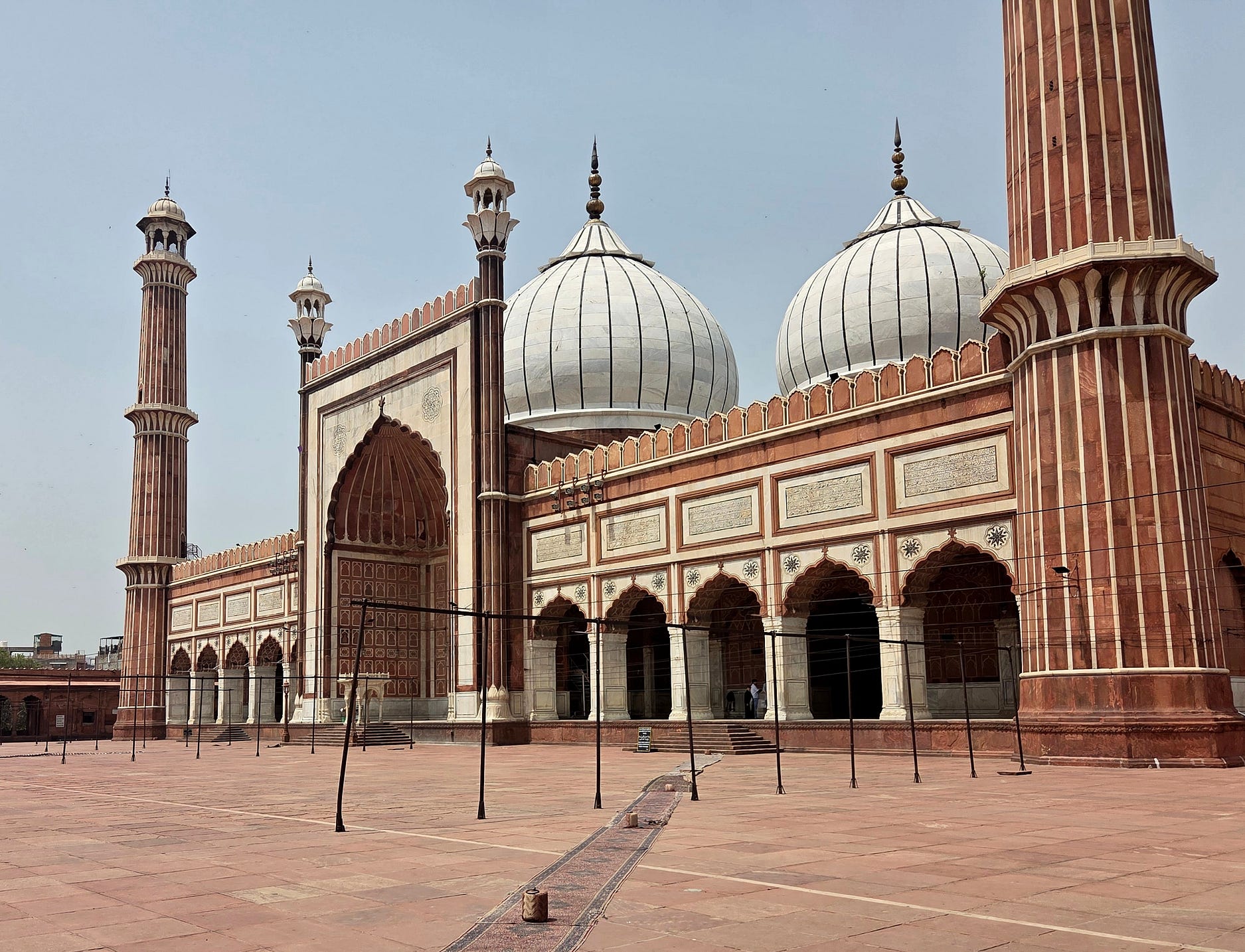
Though it is in Old Delhi, the Jāmā Masjid is only just over two kilometres from Connaught Place in New Delhi.
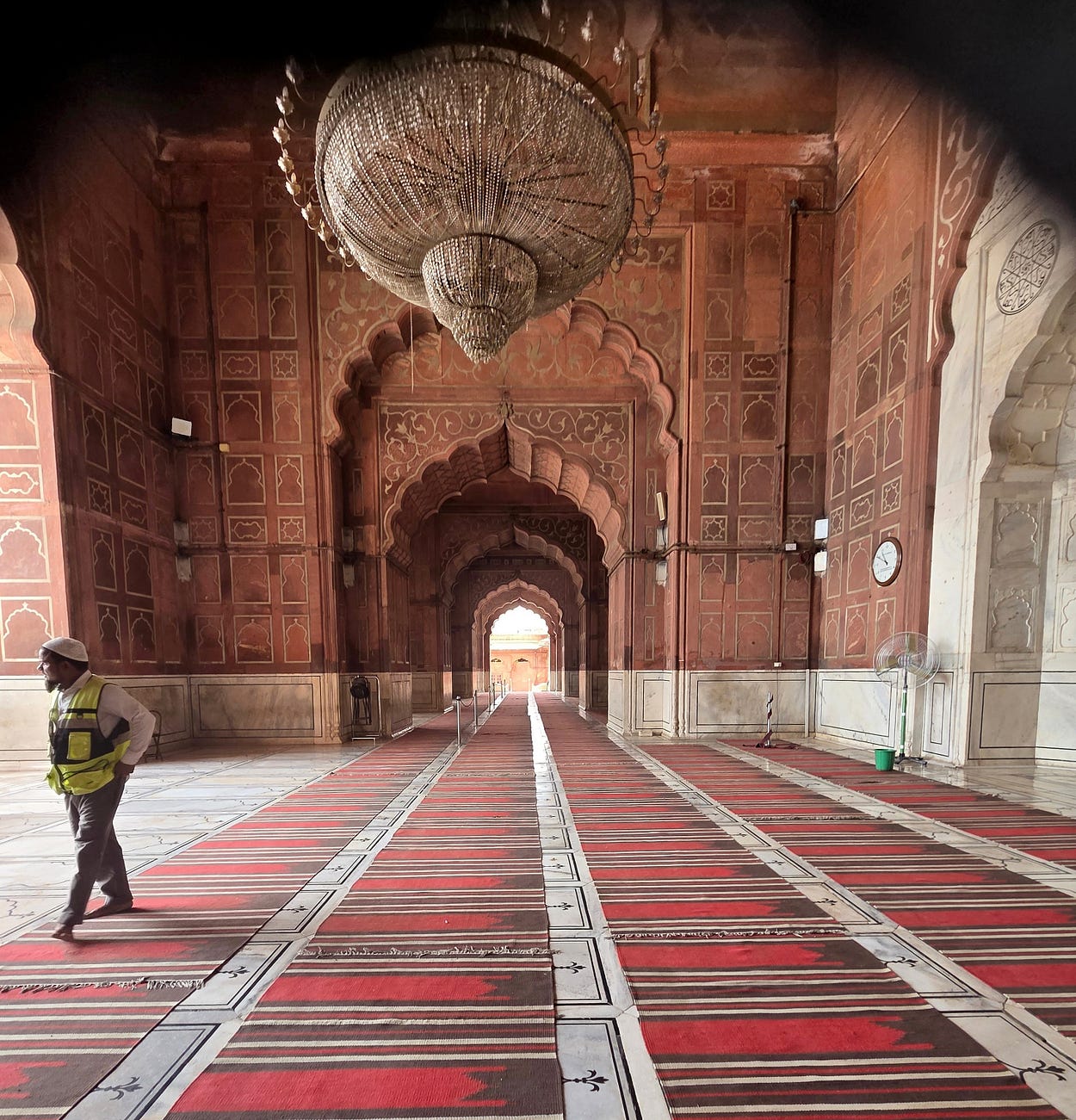

Though it was the Emperor’s mosque, I thought the Jāmā Masjid was rather plain-looking and unornamented by the standards of the fabulous mosques I saw in Iran; perhaps all the more surprisingly so given that Persian was the court language of the Mughals.
This may be because the Mughals were Sunni rather than Shi’a Muslims, and Sunni mosques tend to be less colourful than Shi’a ones. This does not seem to be a matter of doctrine, however, and there are some colourful Sunni mosques elsewhere.
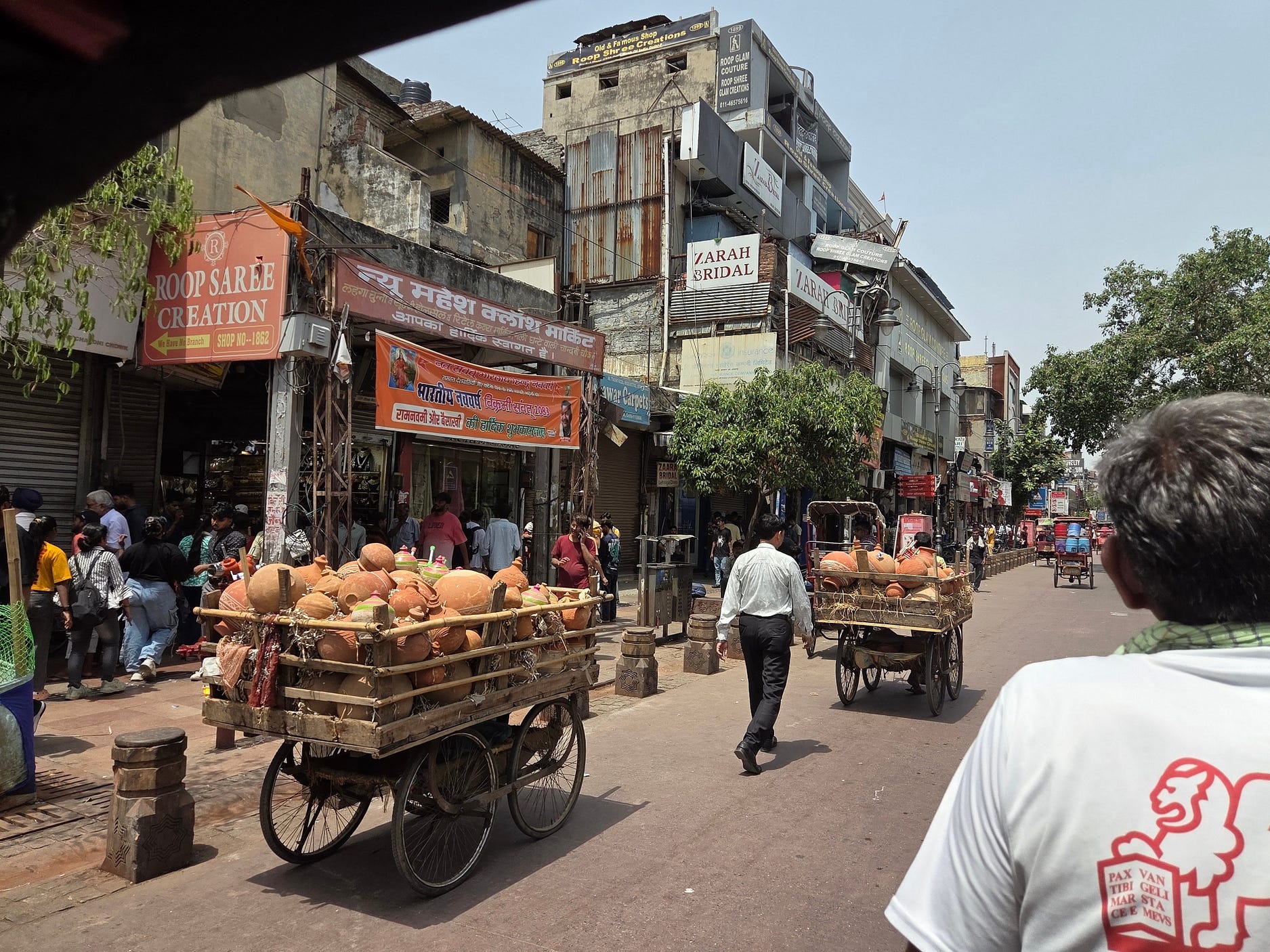
I also took some street photos while I was in Delhi. For instance, of picturesque carts, of which there are still a few:
And spices!

Unfortunately, there are also still snowdrifts of rubbish to be seen.


Here’s a curious sort of little mini-taxi:

And here is a photo of the entrance to one of the pedestrian subways under Connaught Place in New Delhi, built to serve as underground shopping arcades, and lately refurbished.

Despite the civic improvements, the Indian government has faced large ‘Generation Z’ protests against corruption and lack of opportunities, and the formation of the spoof-like Cockroach Janta Party, after the Chief Justice of India, Surya Kant, claimed, in a loose remark, that some of the young people of today were useless, like cockroaches!
Now, I saw all the things I photographed and filmed, above, in one day. There’s vastly more to see in this great city, such as the Iron Pillar of Delhi, a surviving wonder of the ancient world.

The Iron Pillar of Delhi was made in the days when the Western Roman Empire still existed. And yet, while made from ordinary iron (for stainless steel would not be invented until the twentieth century), the Iron Pillar of Delhi has stood without rusting (or only a little bit). Even after the best part of two millennia, its engraved inscriptions, in an old form of Sanskrit, can still be clearly read.
Fittingly, the Iron Pillar of Delhi is in Mehrauli, considered to be the oldest part of Delhi. It stands within Mehrauli’s World Heritage Qutb Minar complex.
All this and more are the things I must see the next time I am in Delhi.
My next post will be about Ladakh.
Subscribe to our mailing list to receive free giveaways!

