Giveaways
FROM Taipei, I caught the Taiwan High-Speed Rail (HSR) train to Zuoying HSR Station, in Kaohsiung.


Kaohsiung is Taiwan’s second city and most important port, through which two-thirds of the trade of the island passes.
Kaohsiung is near the southern end of Taiwan, on the western shore, about 350 km from Taipei on the HSR.

The fastest HSR service covers the distance between Taipei and Kaohsiung in a little more than an hour and a half!
There are 1,500 registered temples in Kaohsiung: it’s a religious site as well as Taiwan’s largest port.
Twenty of the best-known temples are clustered around a lake in the northern suburb of Zuoying, called the Lotus Pond.
Zuoying was also where I got off the HSR, so that was handy!

I managed to visit four temples and two pagodas near the Lotus Pond before 8 am. It was quite stunning to be around here before the crowds came out.
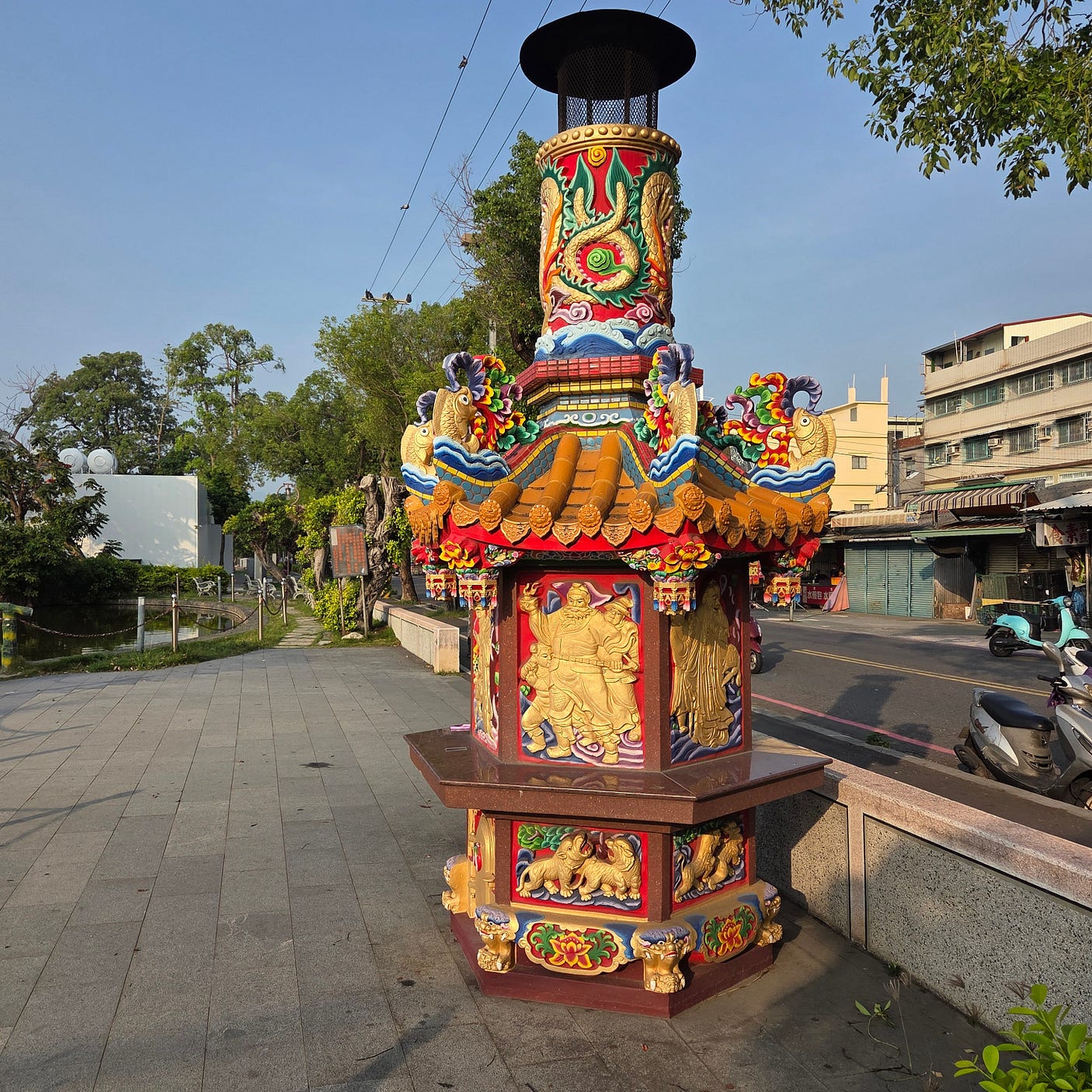
(I meant to do a free tour, but the free tour was cancelled, so I was left to my own devices.)
Here is the entrance to the pier leading from the Yuandi Temple to the huge statue of the Xuantian God, a major deity in Taoism (or Daoism).
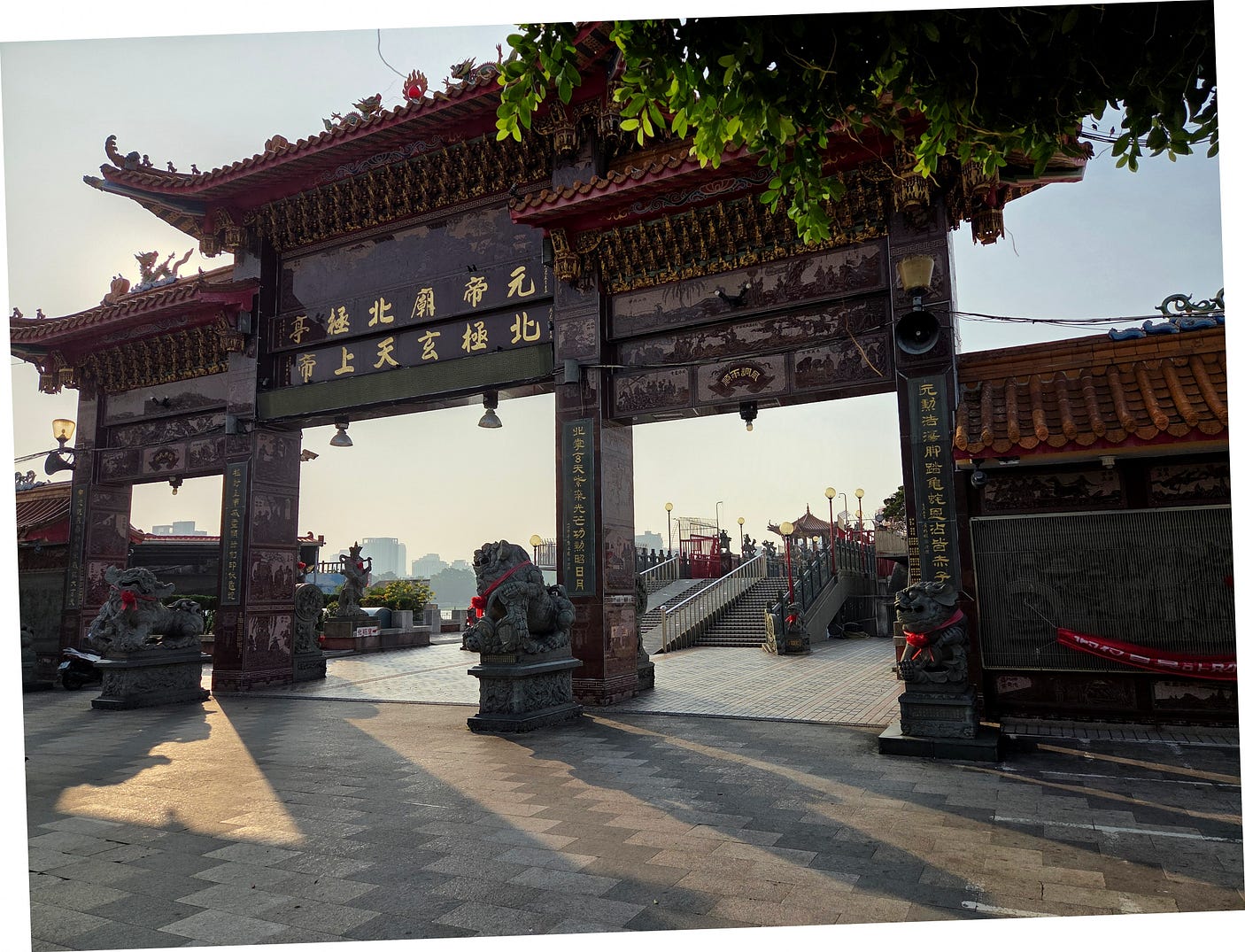
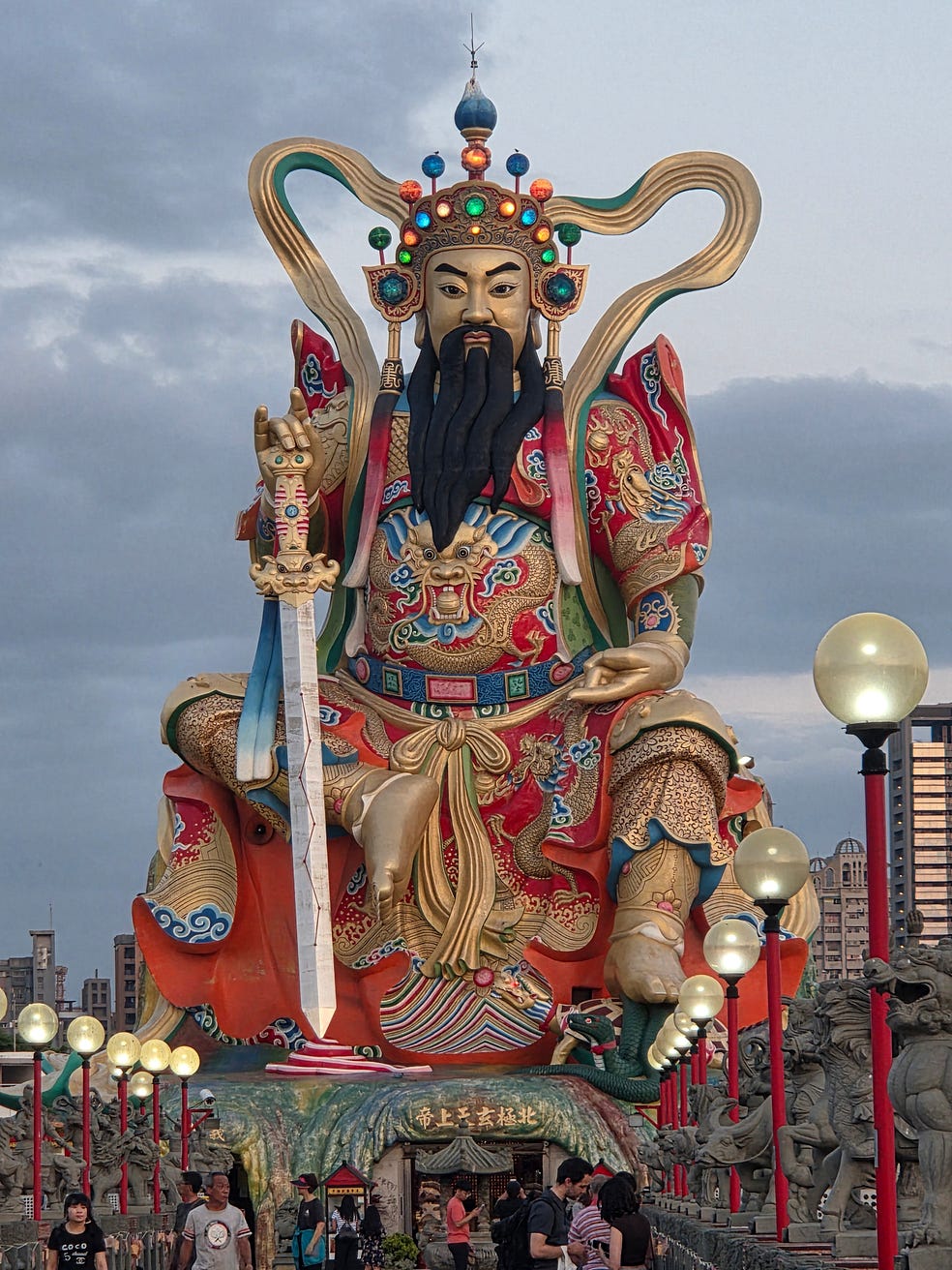
I made a video of this walk:
Here is another small temple with weathered rocks, a Chinese aesthetic specialty:
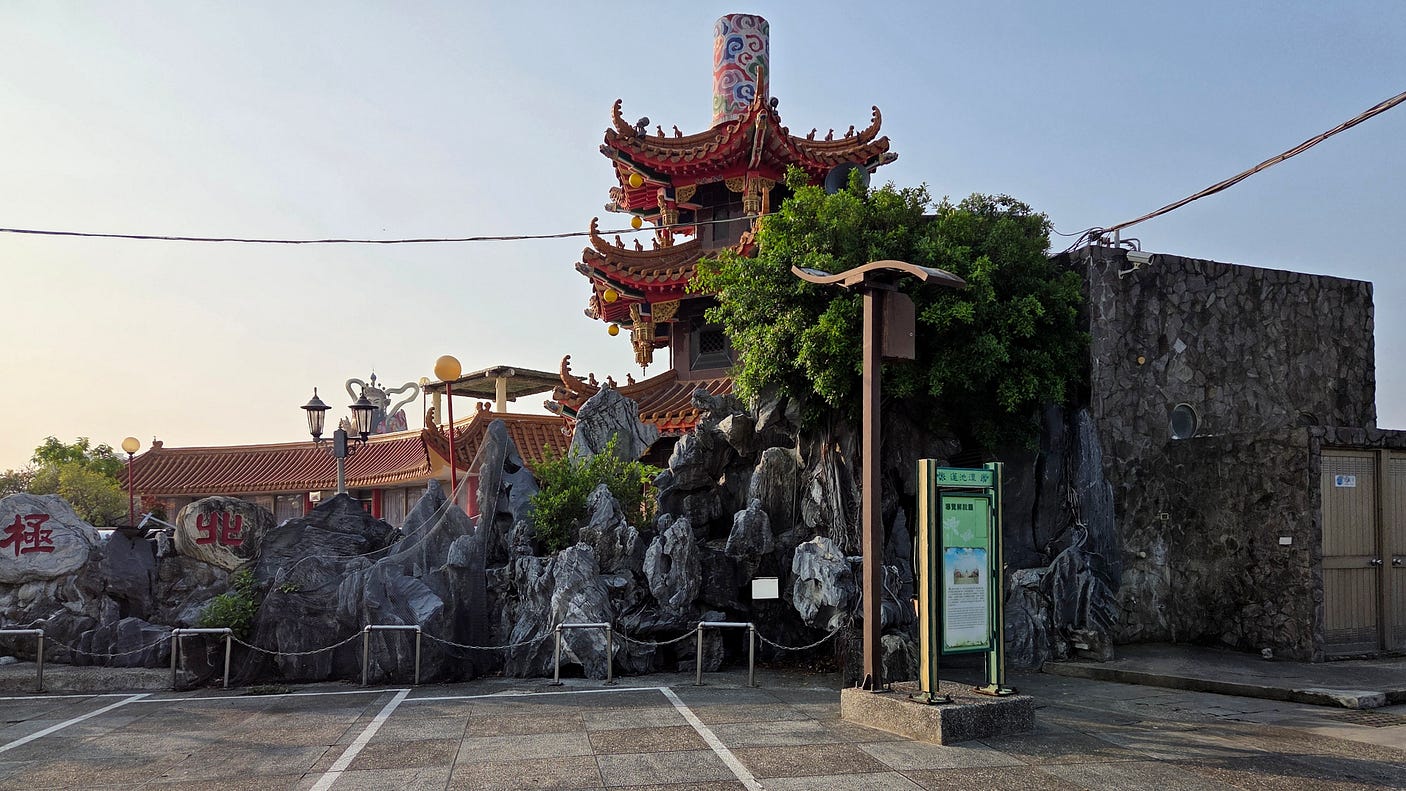
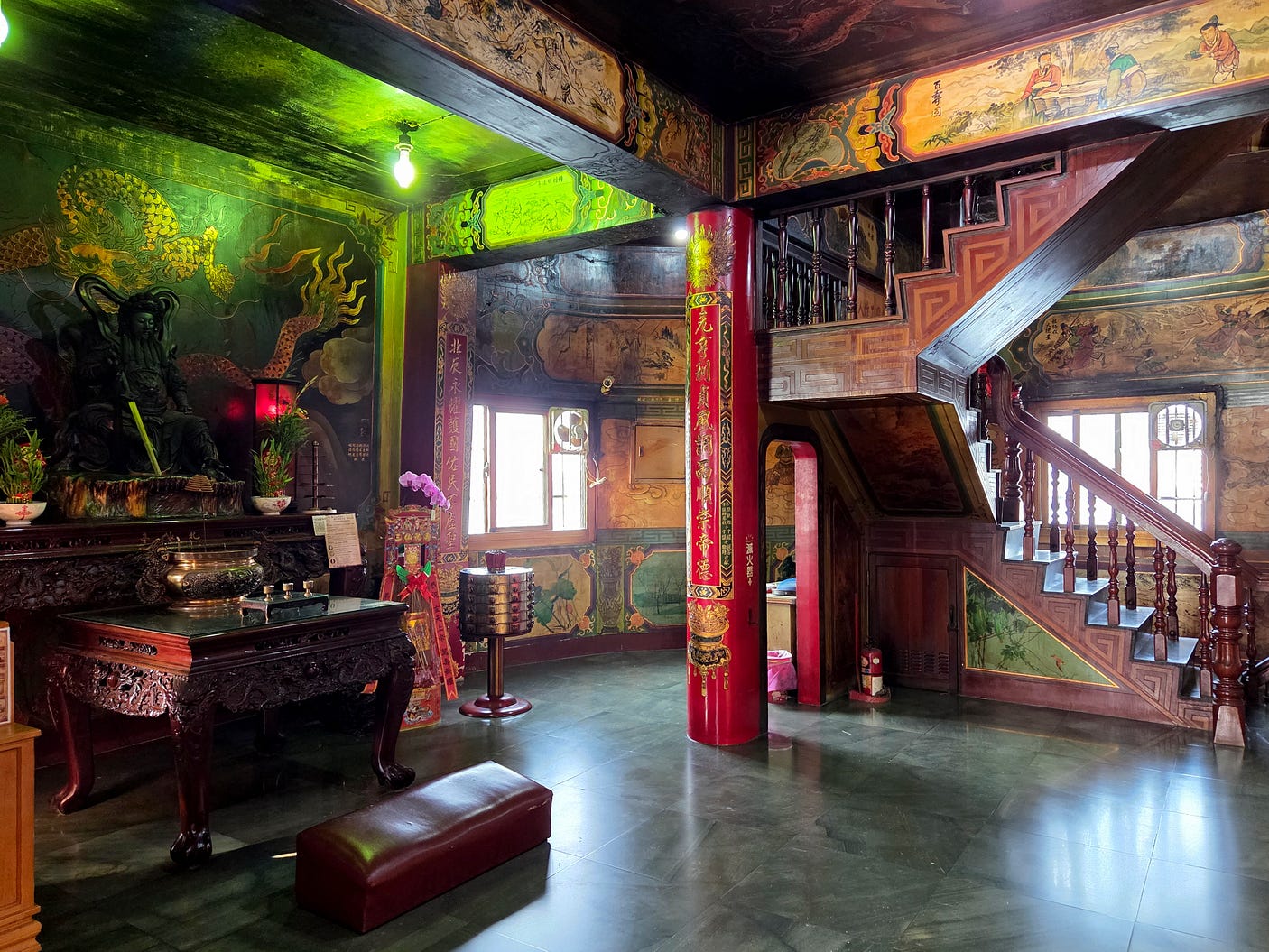
The next photo is of the small but charming Hu’an or Hu An Temple, simultaneously Buddhist and Taoist at 116 Liantan Road, directly opposite the Yuandi Temple and the pier that leads to the statue of the Xuantian God.
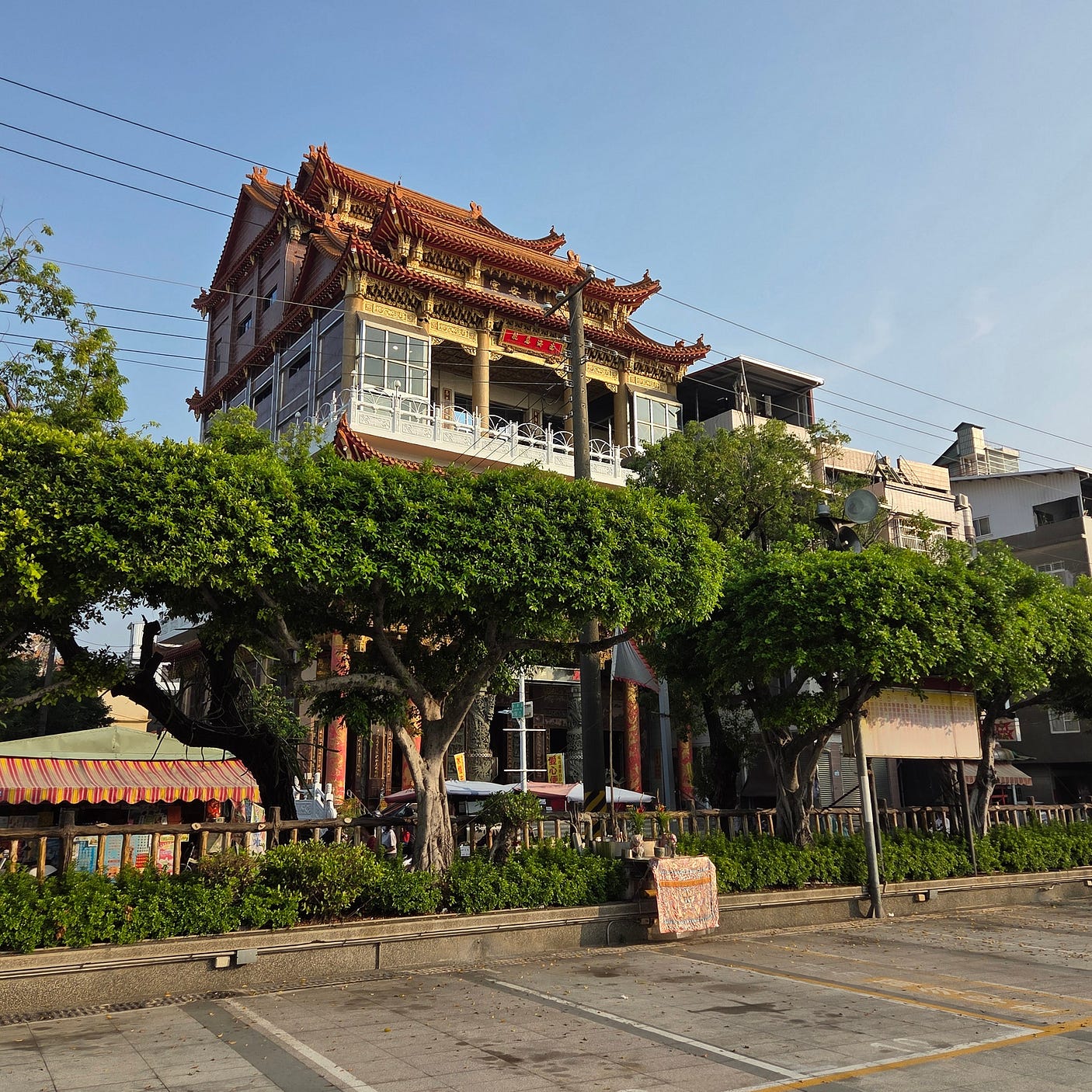
And here is the Hu’an Temple in relation to the pier.
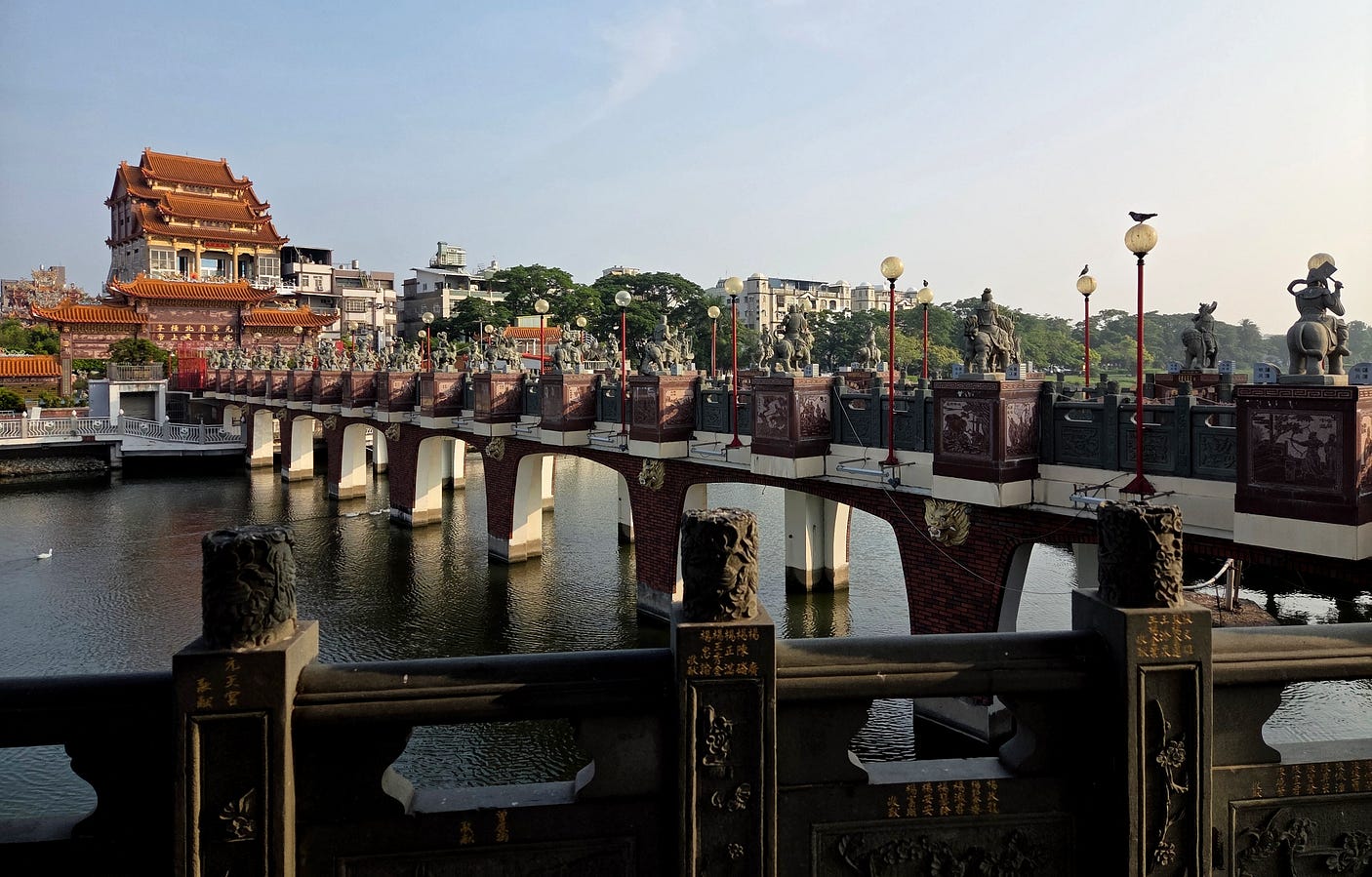
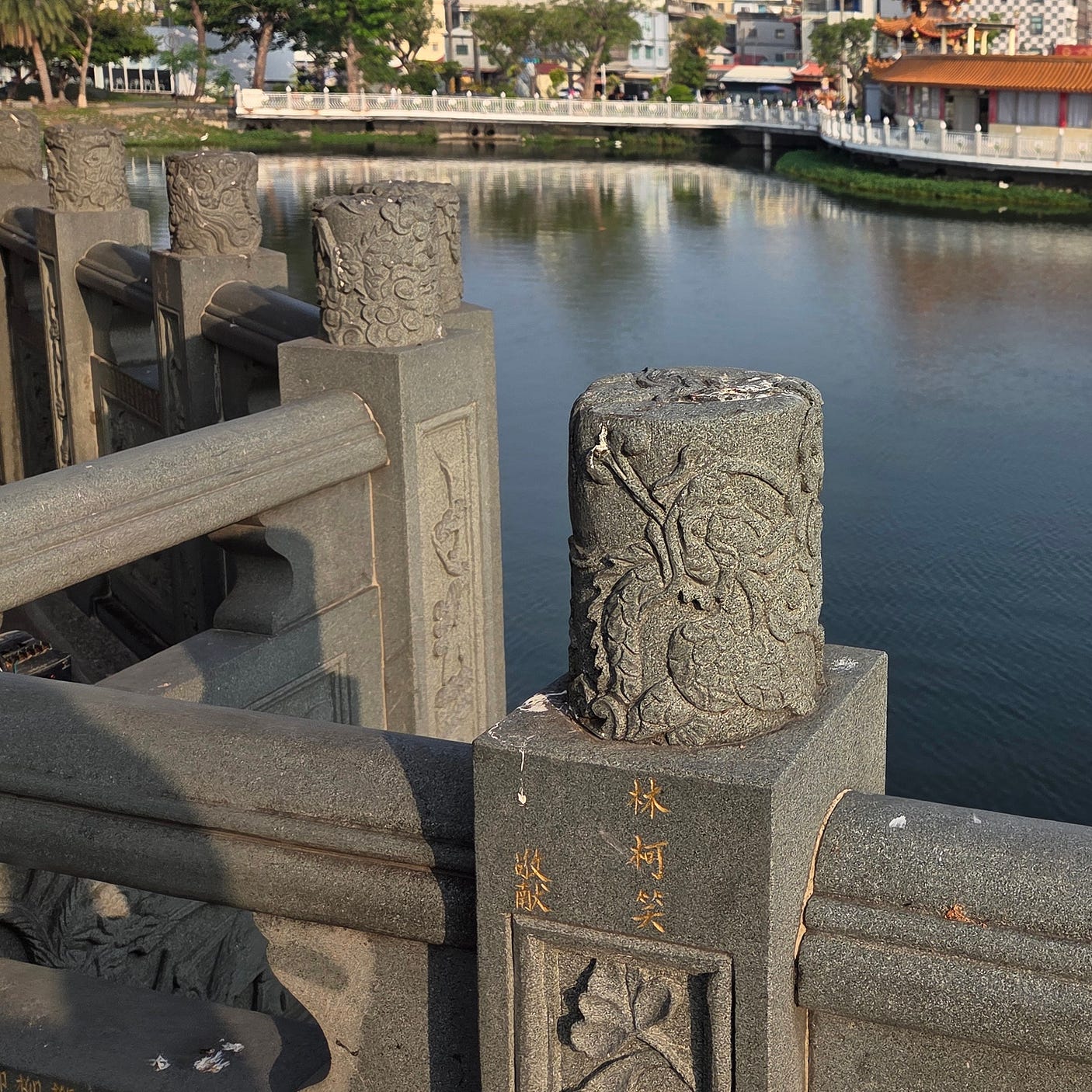
And another view from the pavilions at the end of the pier, showing their ornate stonework.
And a photo I took inside the Hu’an Temple.
Here is a photo of the little pagoda of Wuliting, at the end of another pier on the Lotus Pond. This pier juts out between the Spring and Autumn Pavilions.
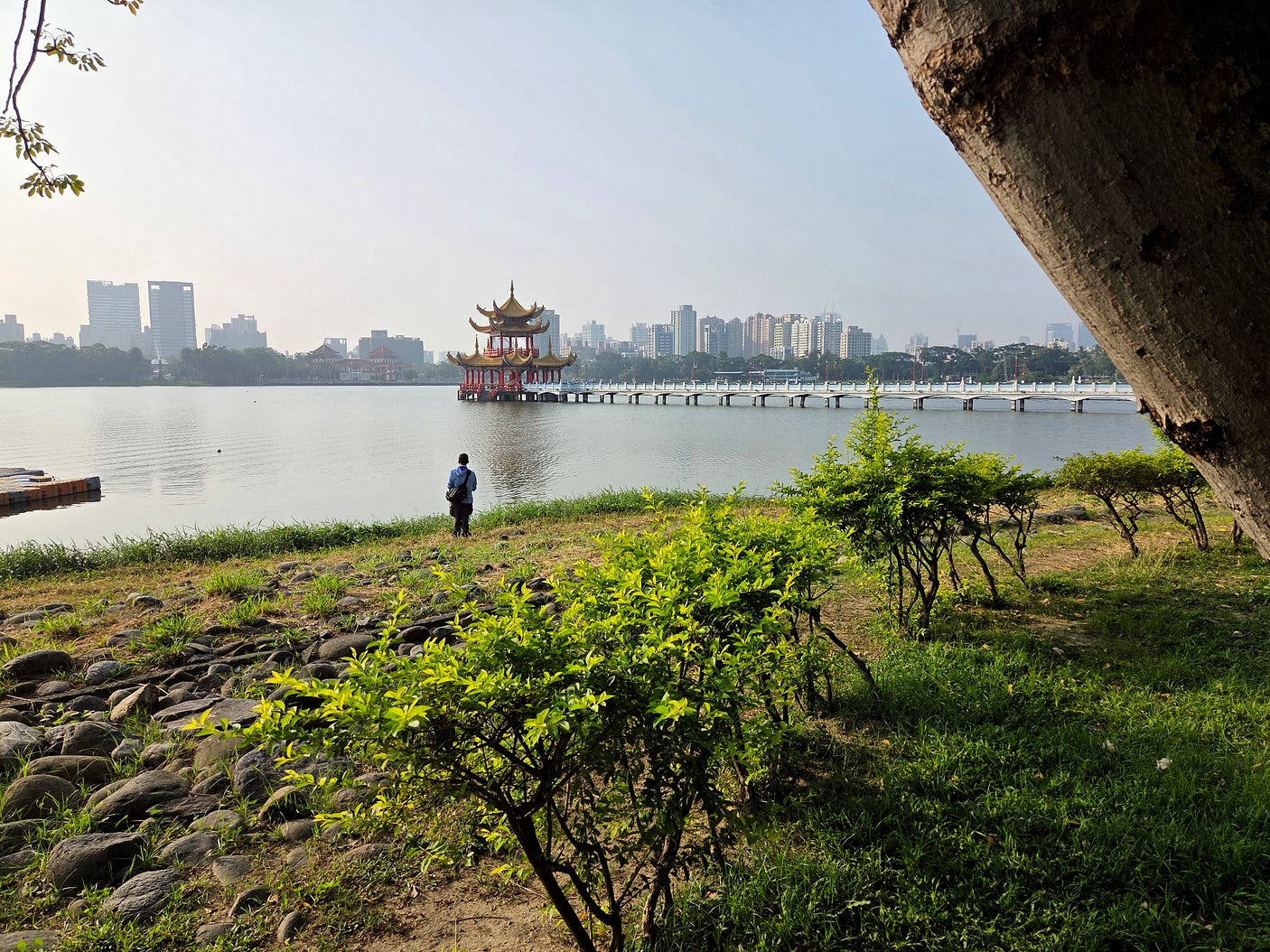
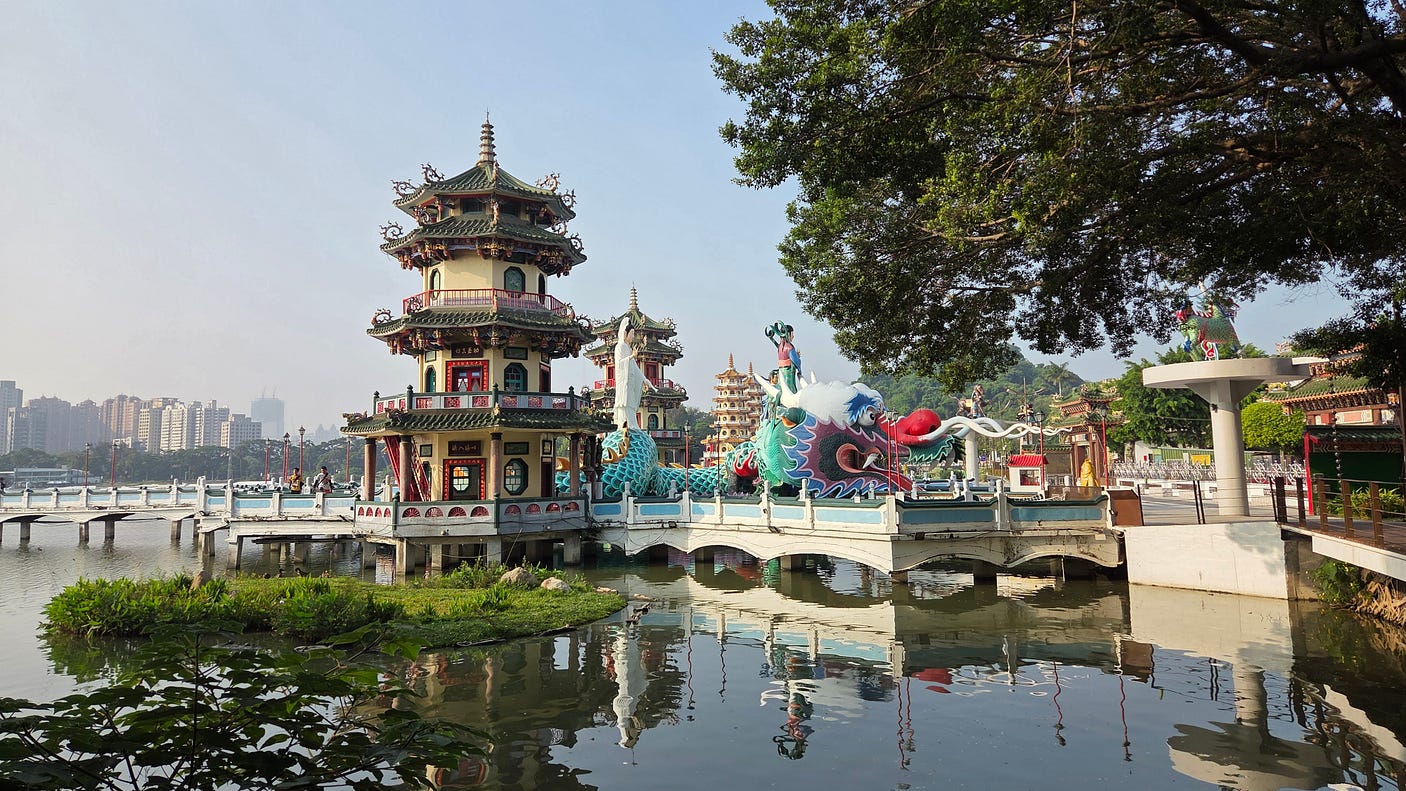
At the water’s edge, the Buddhist goddess Guanyin, goddess of mercy, stands atop a dragon at the Spring and Autumn Pavilions.
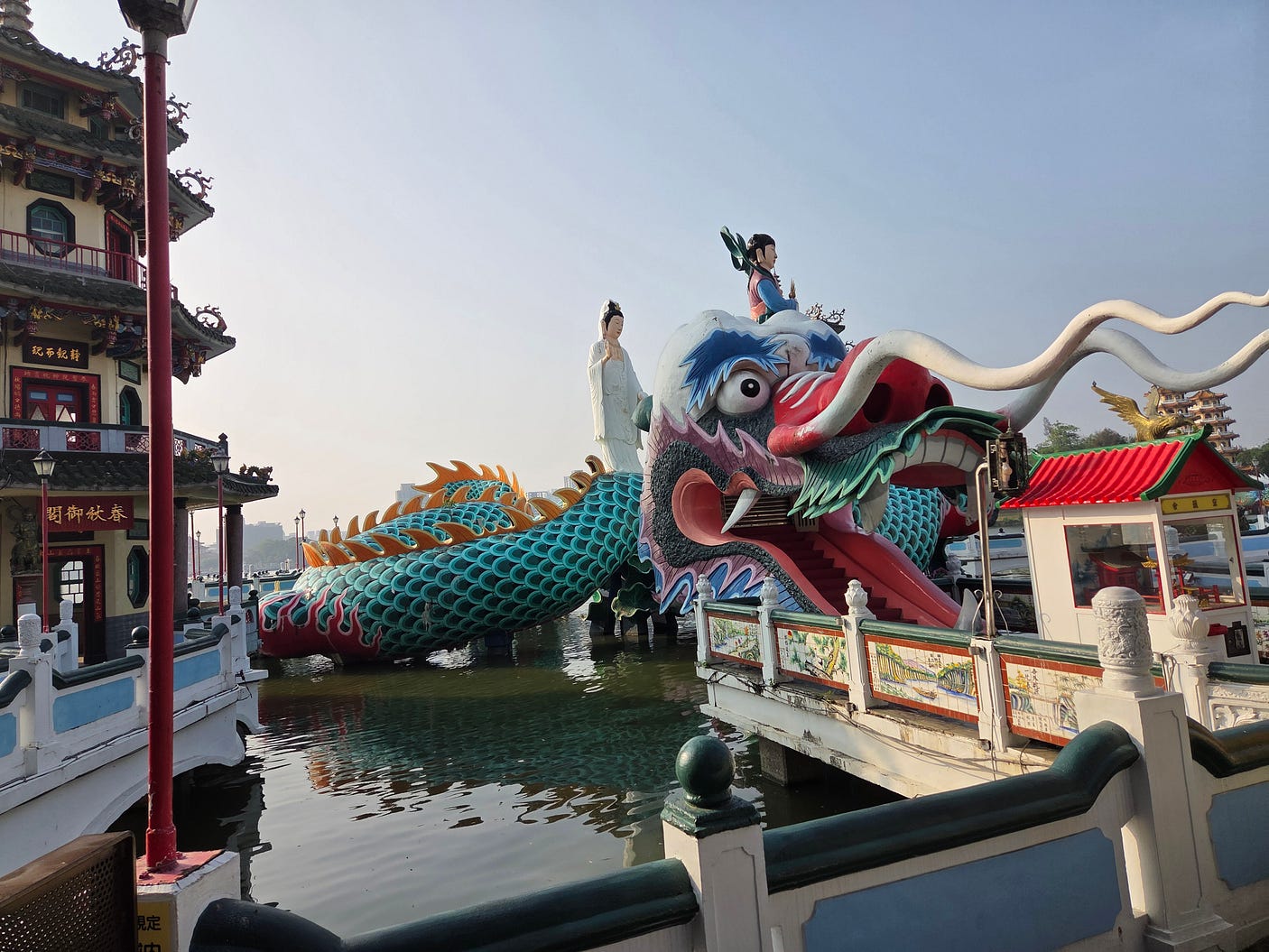
Here’s a closer view of Guanyin and what looks like the dragonmaster, atop the dragon.
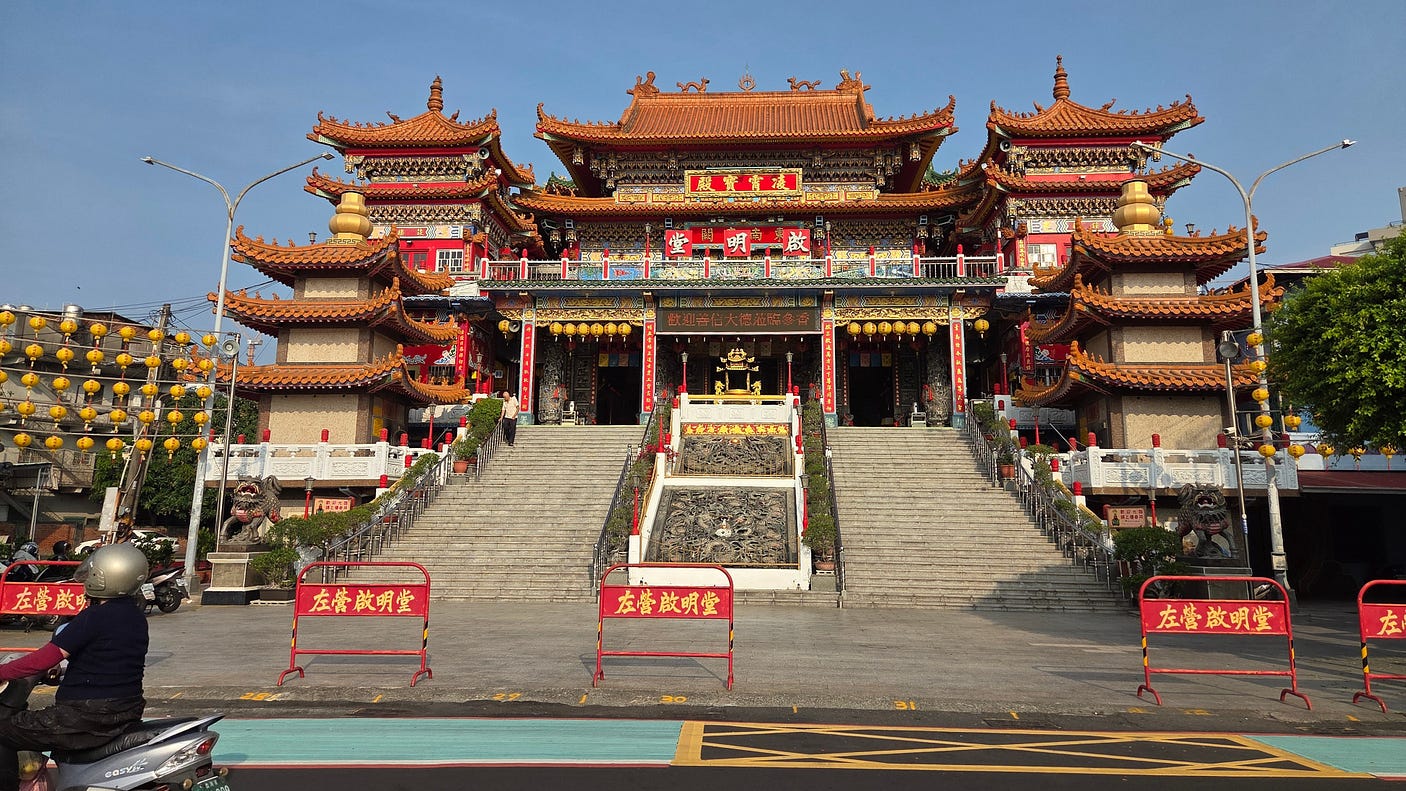
The next photo shows the Chi Ming Palace, a very ornate temple next to the Spring and Autumn Pavilions.
I made a video of the interior of the Chi Ming Palace:
And here are the Dragon and Tiger Pagodas, of which there was a glimpse above. The dragon of the Dragon Pagoda is a bit more fierce-looking than the one at the Spring and Autumn Pavilions.

Visitors must enter the twin towers, which are connected, through the mouth of the dragon and exit through the mouth of the tiger: a sacred direction which is supposed to bring good luck.
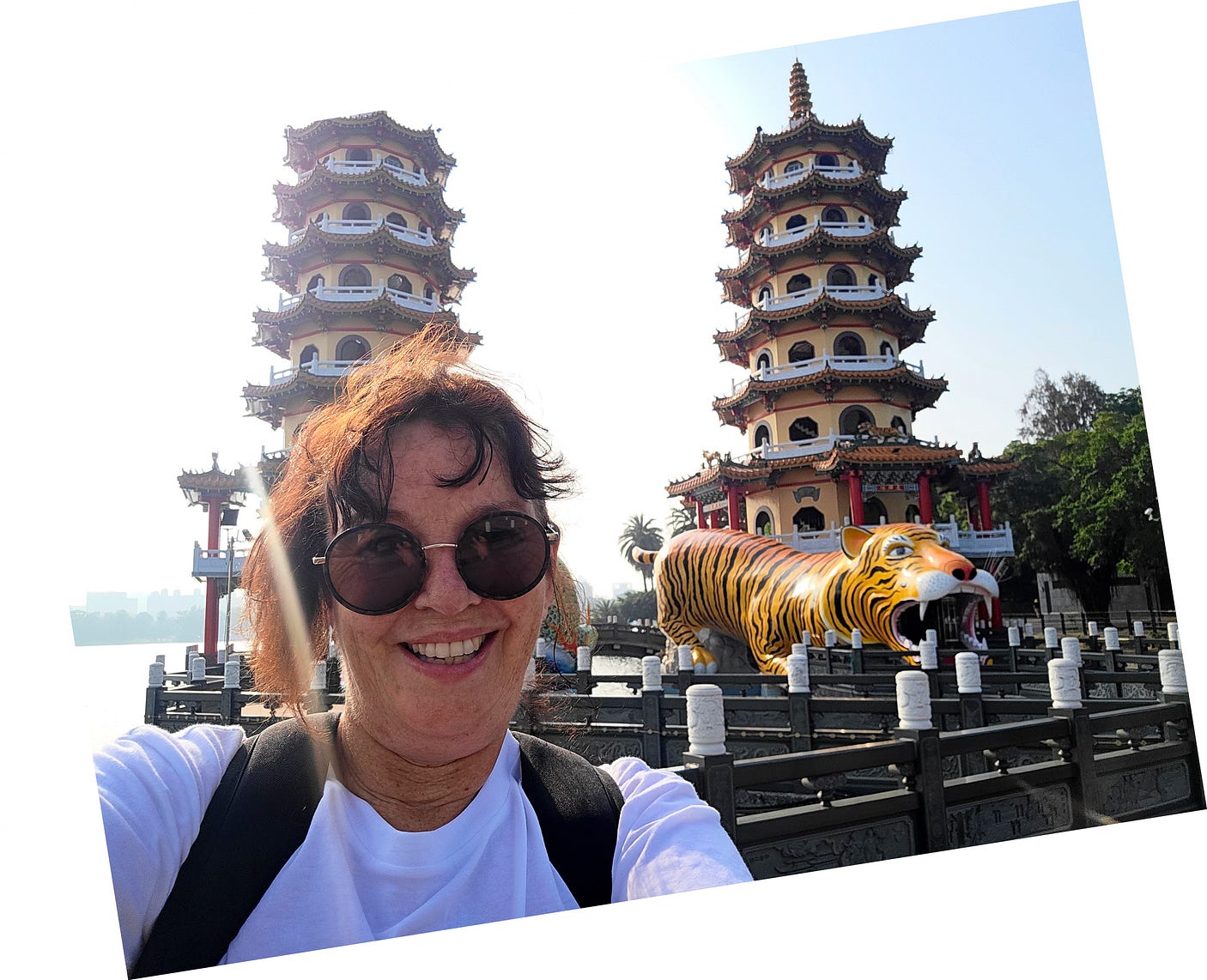
Here is a rearward view of the two pagodas, showing the bridge that connects them.

And here is another temple with especially ornate roof decoration, the Zuoying Ciji Temple.
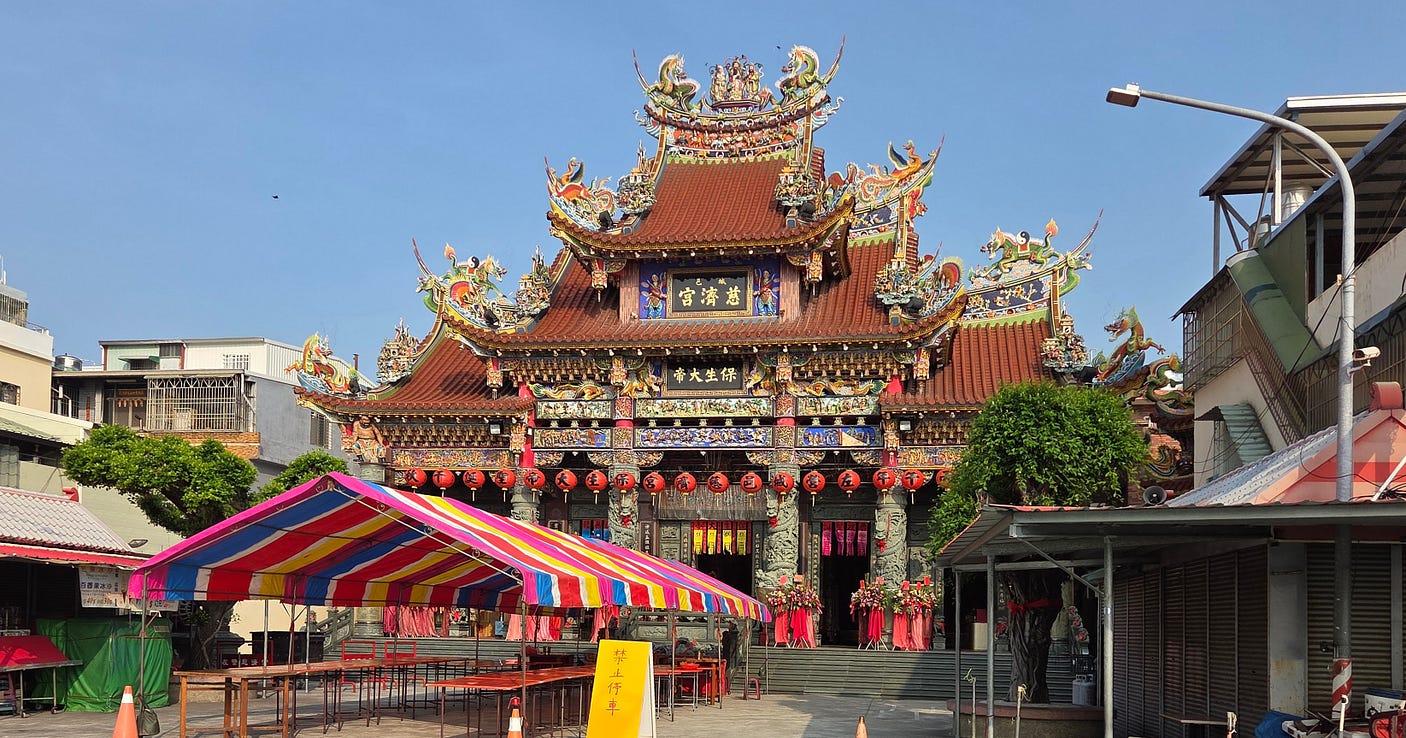
The Ciji Temple honours a Song-dynasty physician, Bao Sheng Da Di, who has become deified in Chinese folk tradition, and the temple incorporates elements of Buddhism and Taoism as well.
One temple I did not manage to visit was the Temple of Confucius, where the third major traditional religion of the Chinese is practiced. The three religions — Buddhism, Taoism, and Confucianism — overlap to a degree and aren’t exclusive with regard to each other.
It is said that one might worship at a Buddhist temple one day, and attend a Taoist ceremony the next. Nominally Taoist, the splendid Chi Ming Palace, depicted above, nonetheless upholds all three religions.
The Lotus Pond is also surrounded by parkland, where I saw this sign.

In the parkland, I saw a little squirrel eating the seeds out of tree cotton, or kapok, a white fluffy material released by certain trees that grow in warm climate, which disperses their seeds by blowing about. Humans use the cotton for much the same purposes as the cotton that grows on plantations — while squirrels, of course, are more interested in the nuts!
There are lots of squirrels in Taiwan, perhaps because there is a lot of tree cotton as well. The island supports no fewer than six species of squirrel: three of the ordinary sort, known as tree squirrels, and three species of flying (or gliding) squirrel as well.
If I’d ever managed to get a good look at this squirrel’s belly, it would probably have been red, for the so-called red-bellied tree squirrel, also known as Pallas’s squirrel, dark on top but with an orangey-red breast like a British robin, is the most common sort in Taiwan.
After the park, I went down to the waterfront, which is partly open to the public even though Kaohsiung is such a busy port.
Near the port, I visited the Hamasen Railway Cultural Centre, one of two railway museums in Kaohsiung.
In the thumbnail, you can see an old Japanese Pacific-class steam locomotive, recognisable mainly for having six driving wheels, the big ones.
Interestingly enough, the Pacific locomotive was first developed in New Zealand for our railways, which is why it is called Pacific.
The Pacific was first introduced to New Zealand’s railways in 1901. Earlier railway engines normally had four driving wheels, so the Pacific was a step up in size and power — the Jumbo Jet of the steam age.
However, in the video, I am comparing the trains at the railway museum to New Zealand ones for a different reason. Namely that, today, our trains are no longer world-leading but tend to be older than the ones still in service in Taiwan.
We certainly don’t have any high-speed trains!
Down on the waterfront, I saw this interesting sign for cycleways!

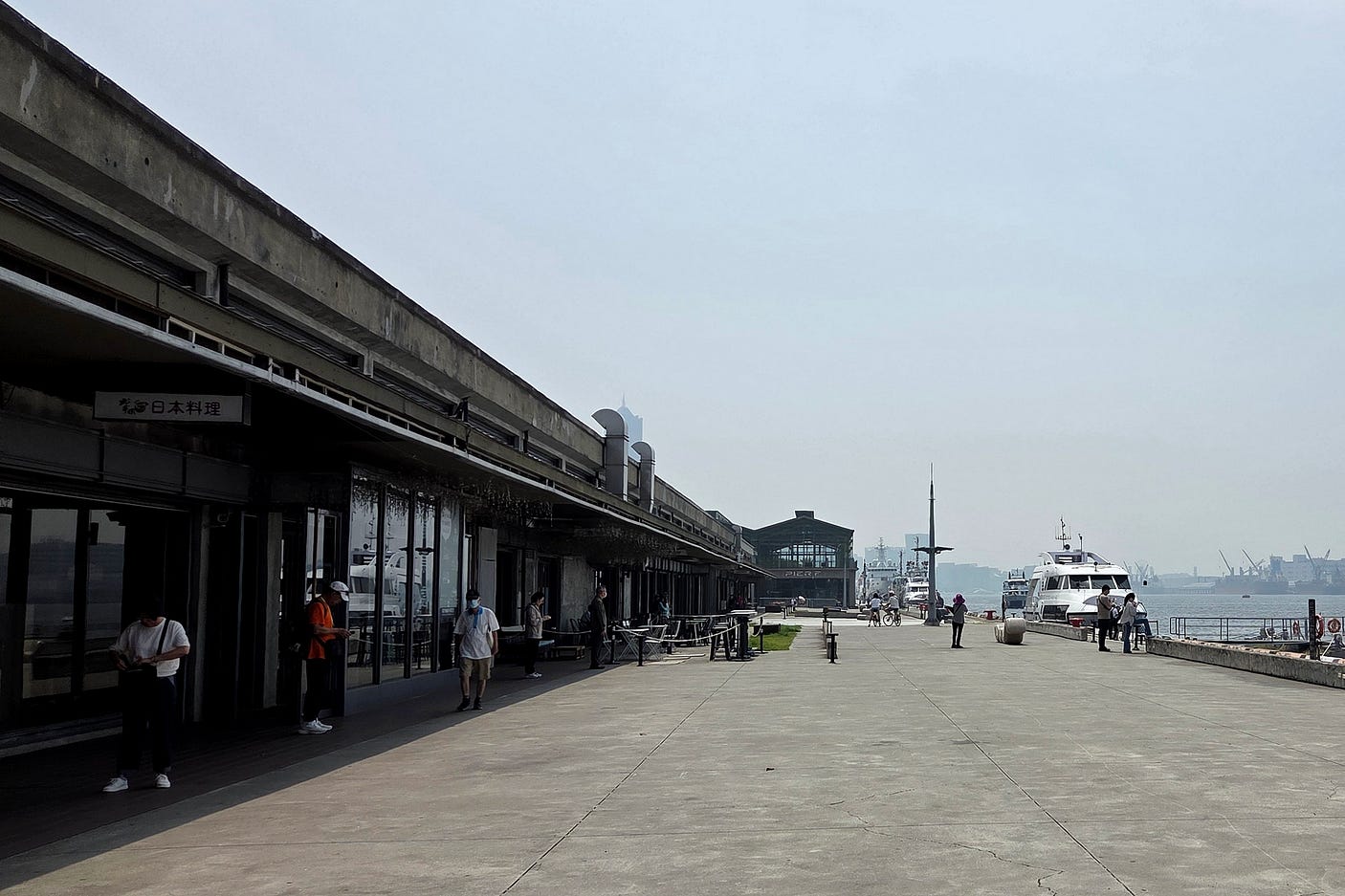
And rows of shops, with few people standing in the sun.
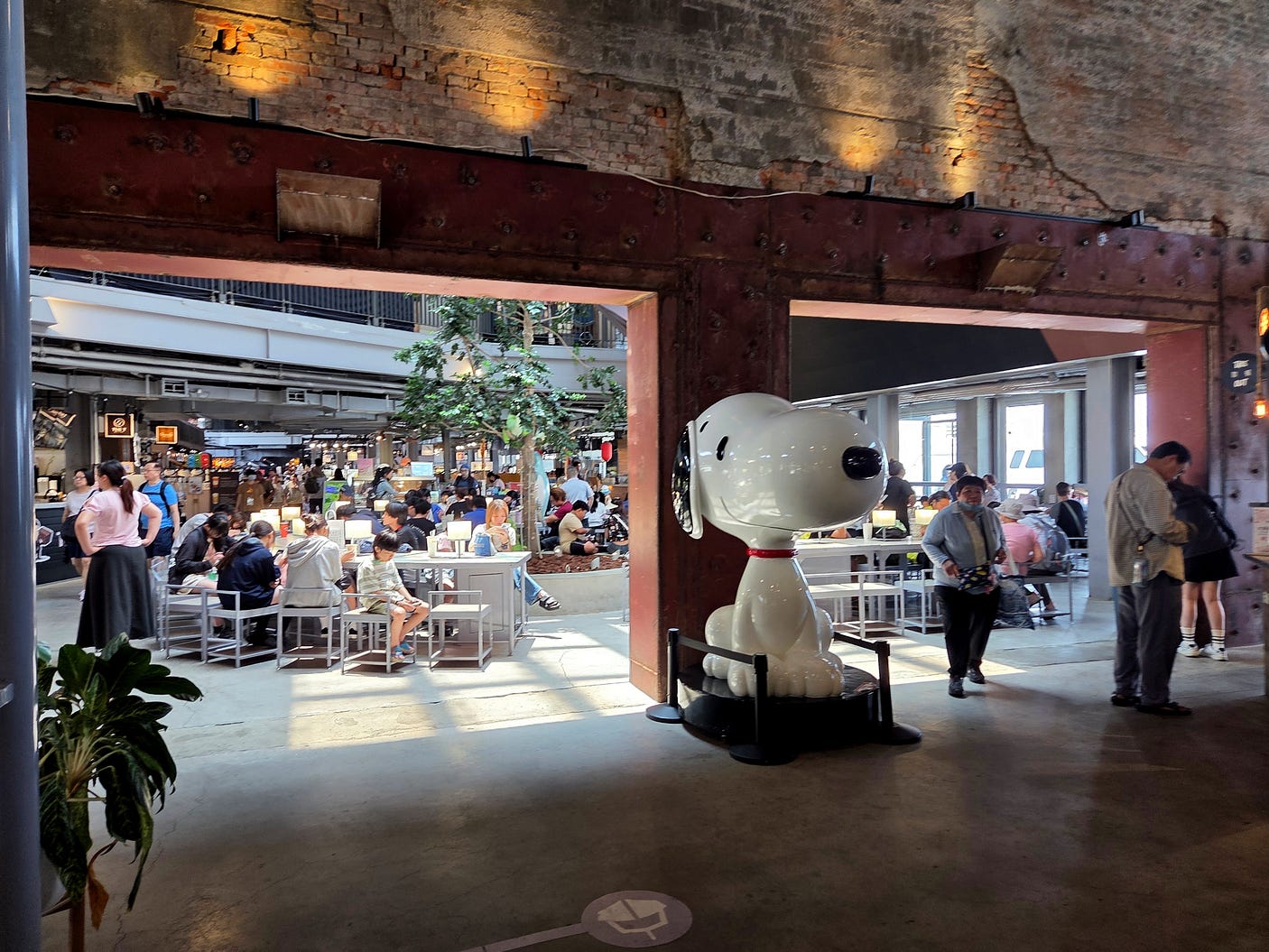
There was a foodhall inside a picturesque decaying warehouse.
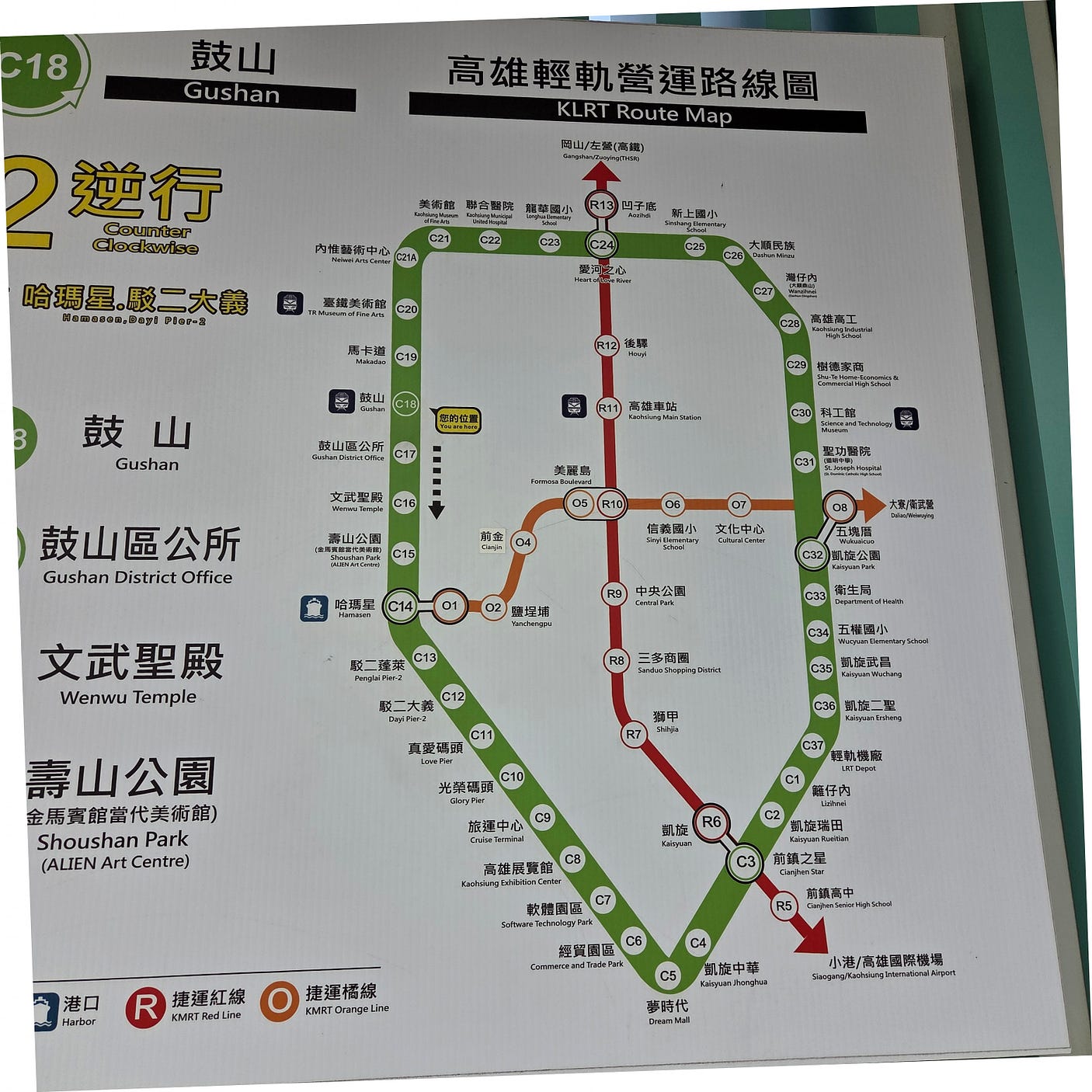
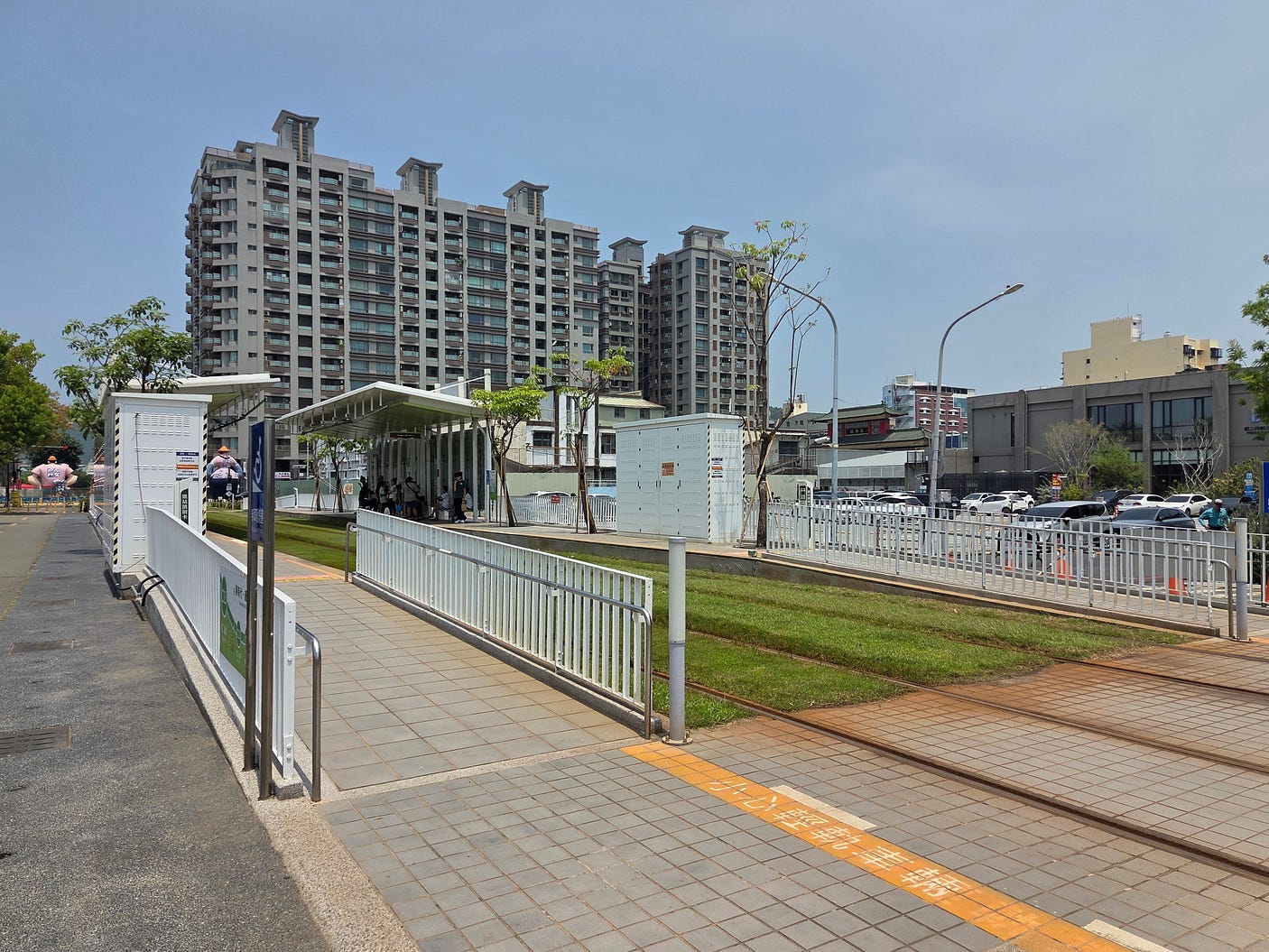
Like much of Kaohsiung, the waterfront is served by a tramway or light rail system.
Here’s a stop close to the watefront. See how the tram runs on attractive grass tracks!
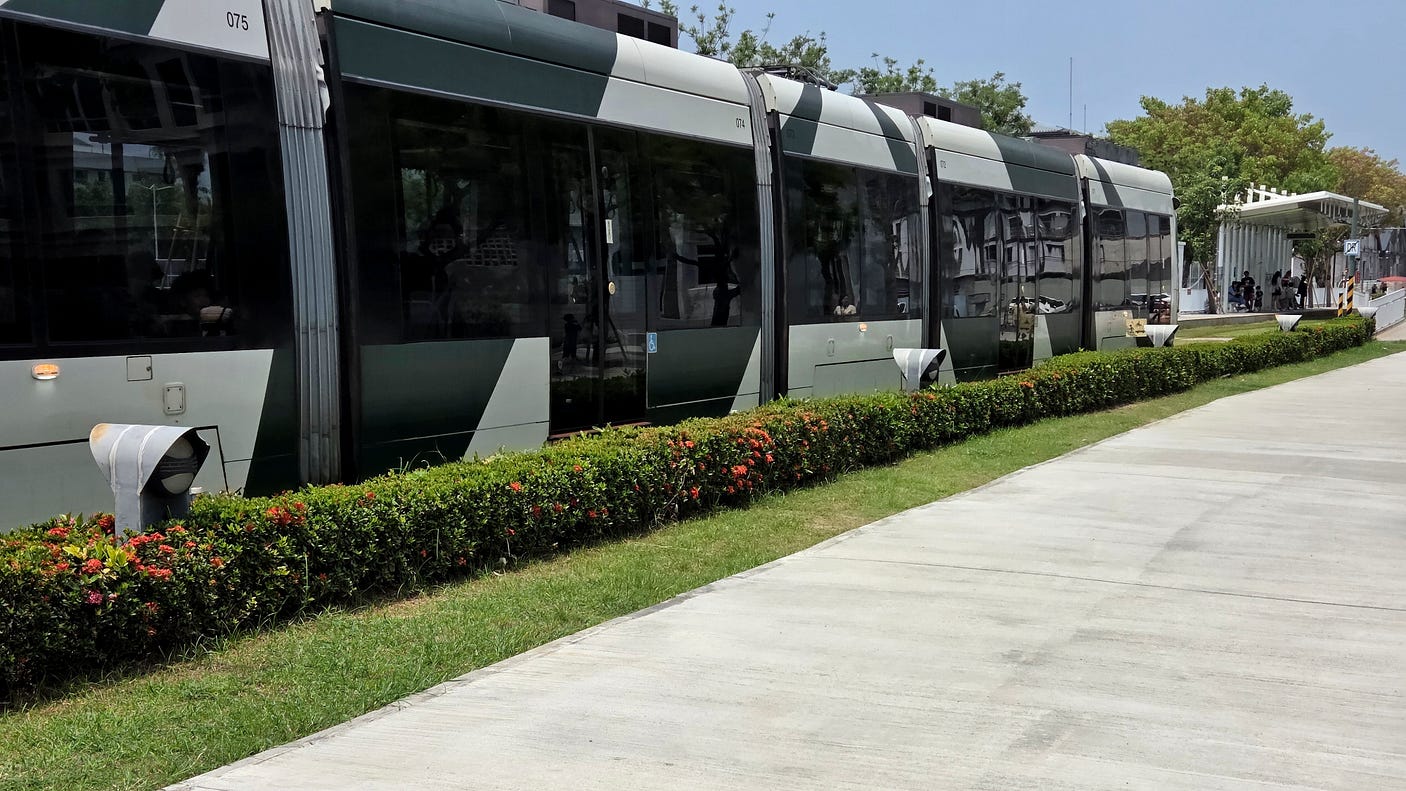
And the tram, as it arrived.
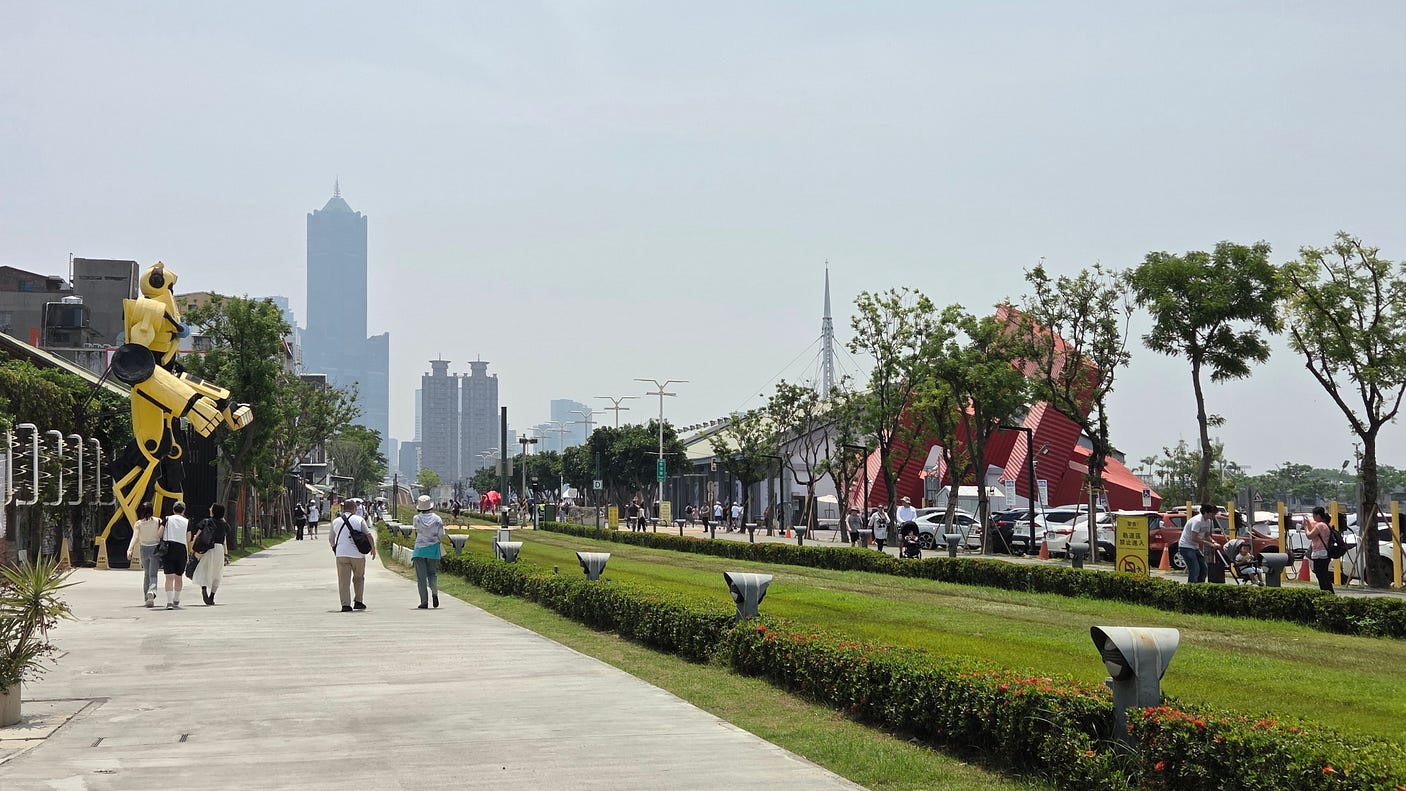
Here, people were rambling along outdoors.
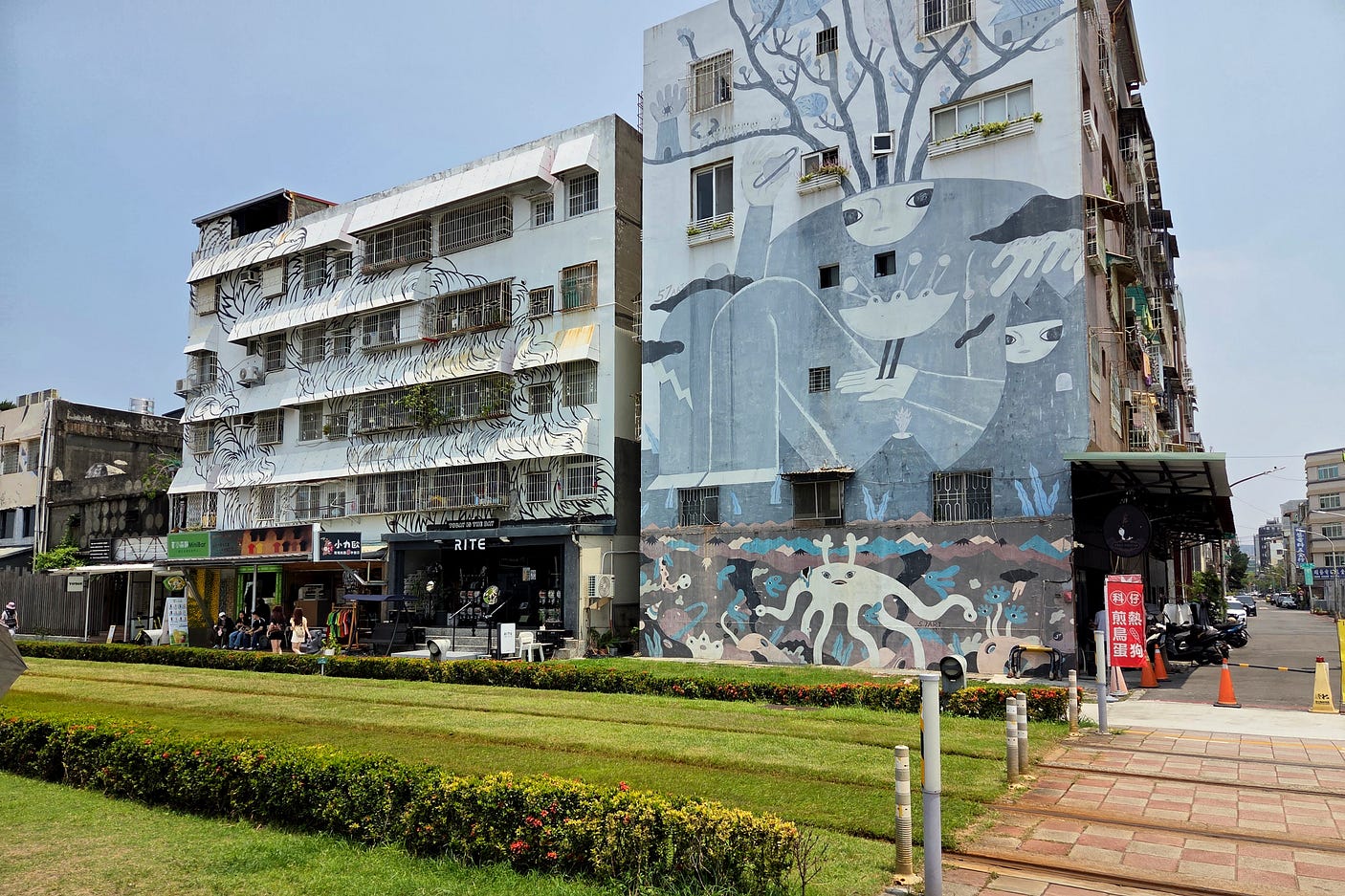
There was lots of public art, such as this mural on a building of the Pier-2 Art Center, set up to convert derelict buildings into art spaces.

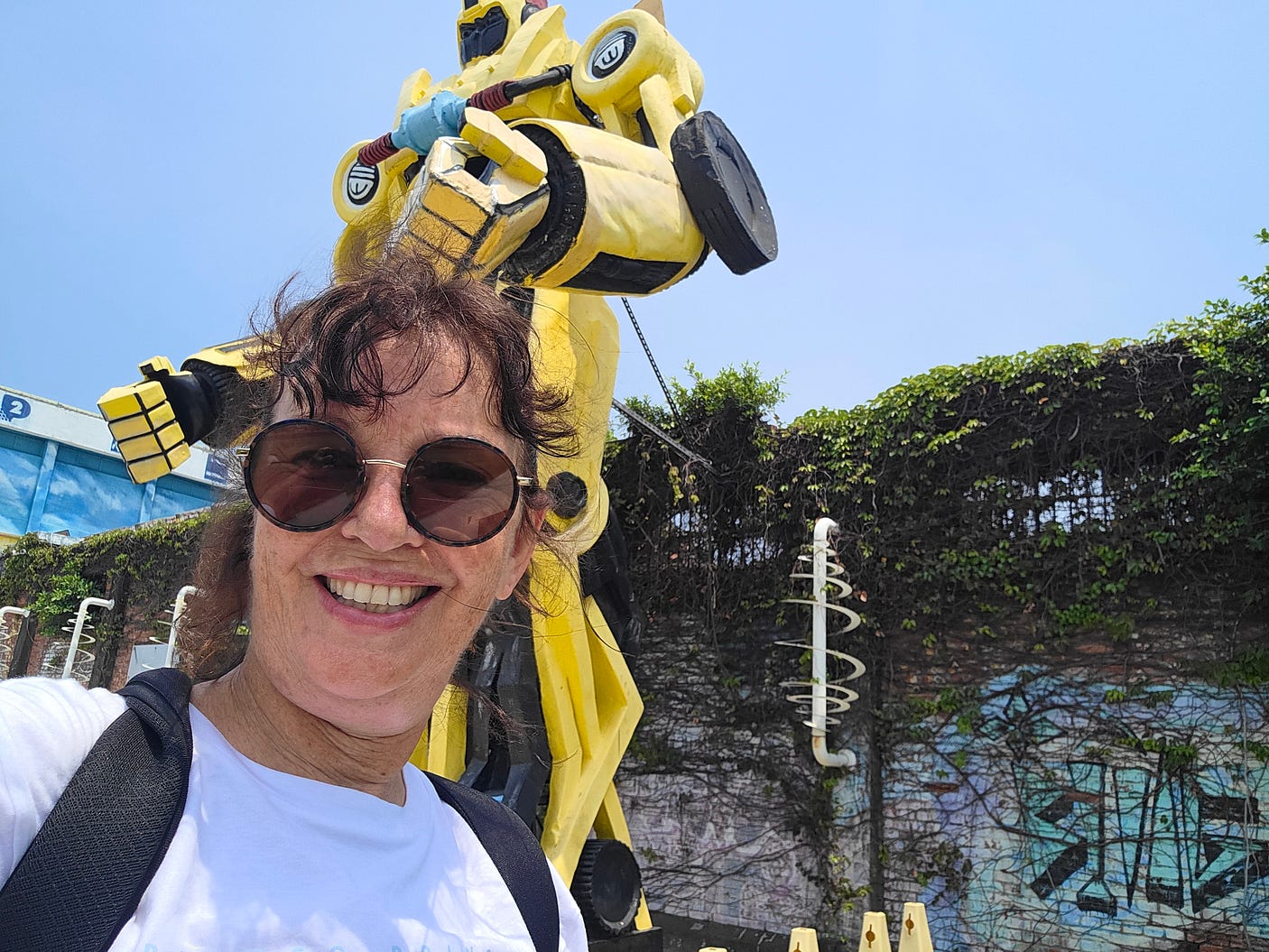
The public art included a yellow robot!
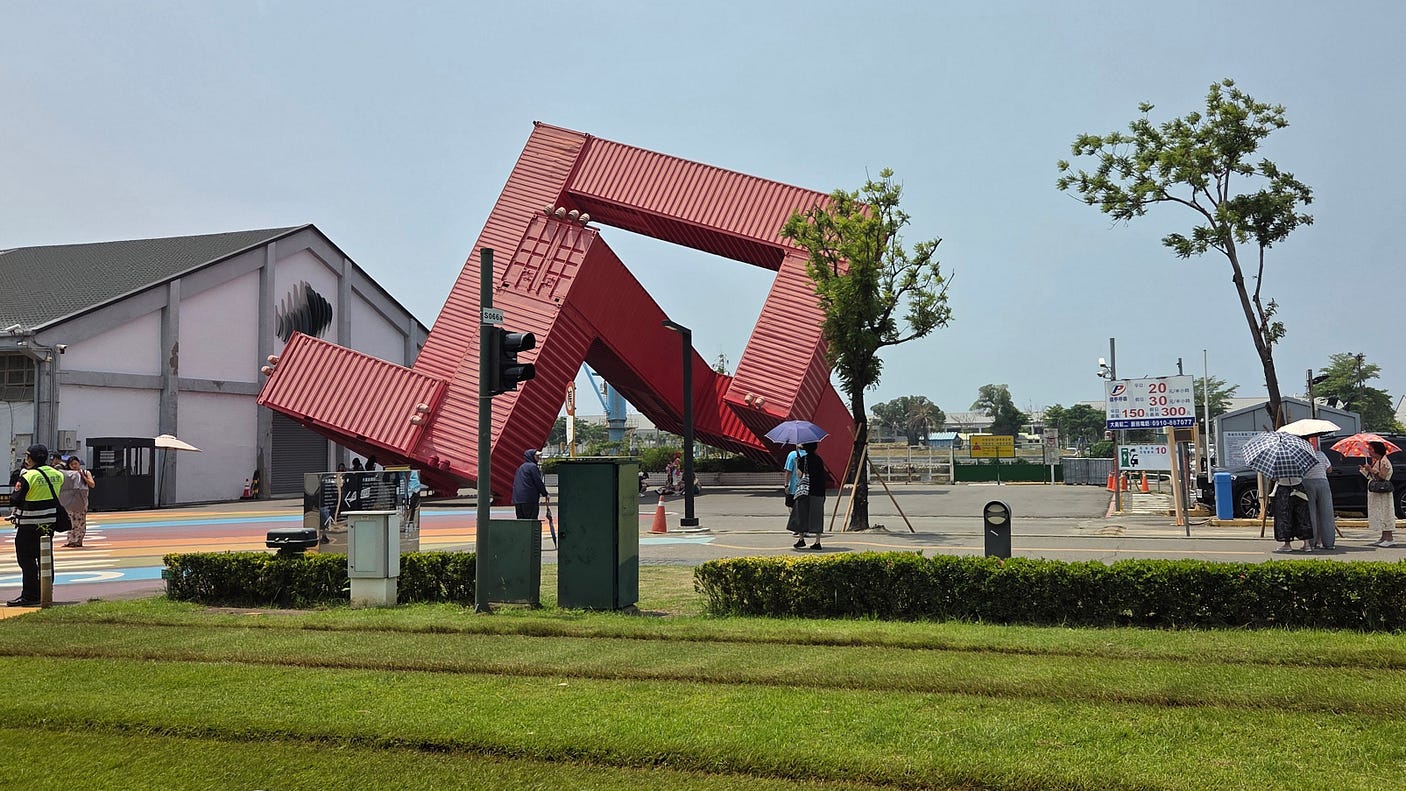
And something really strange made out of shipping containers.
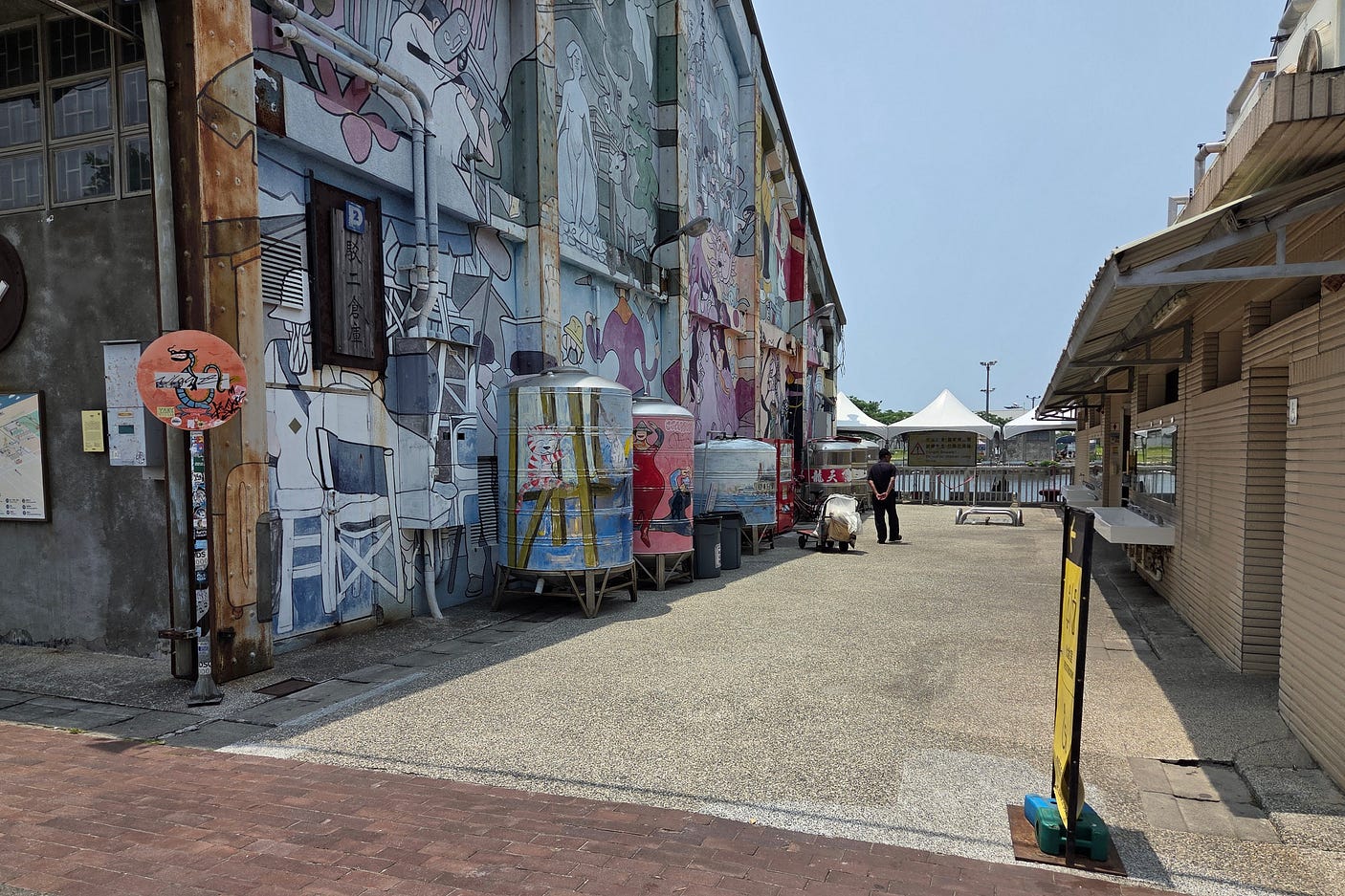
Even in the dingier bits, there were murals.
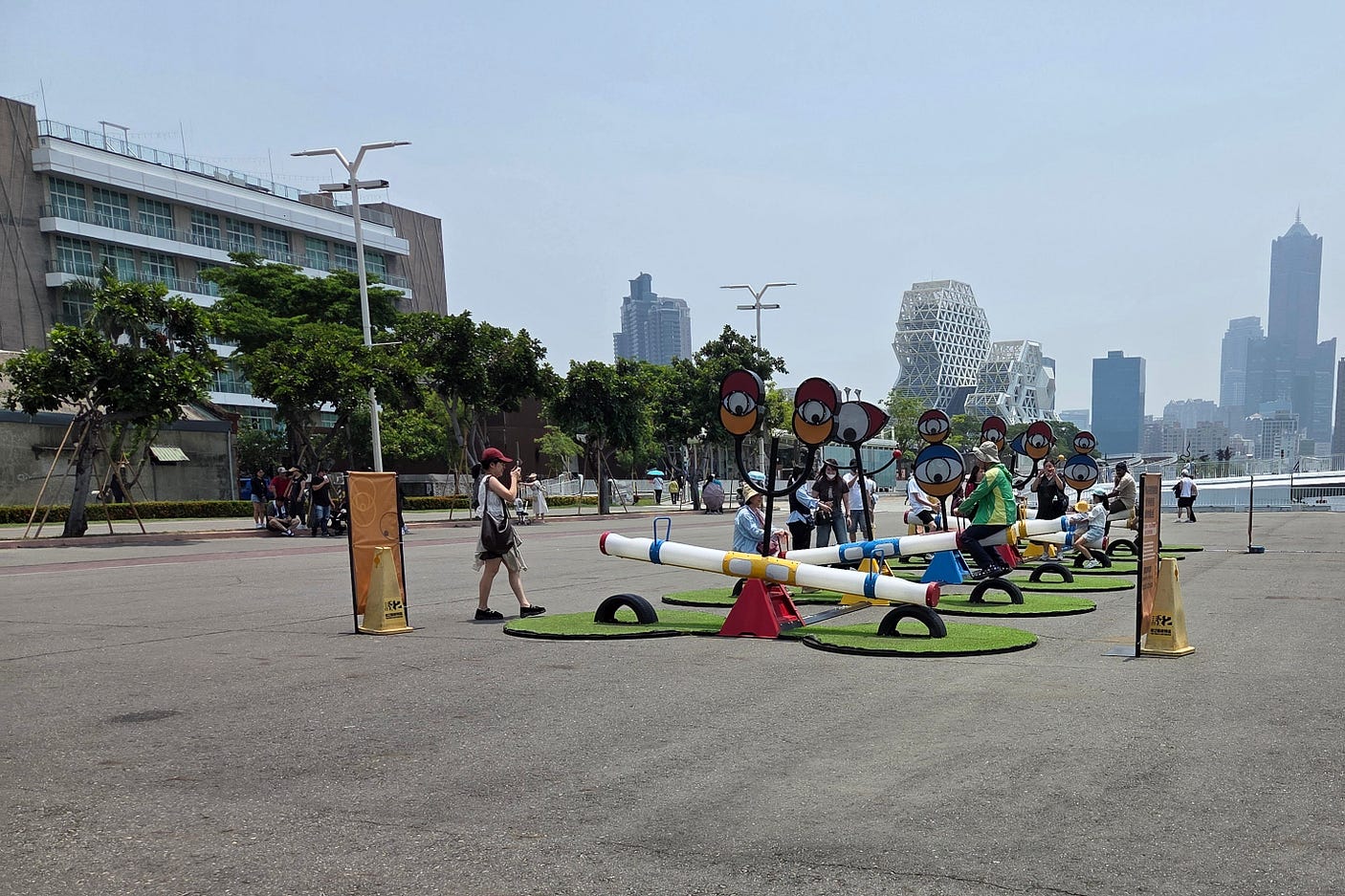
I also saw some interesting seesaws:
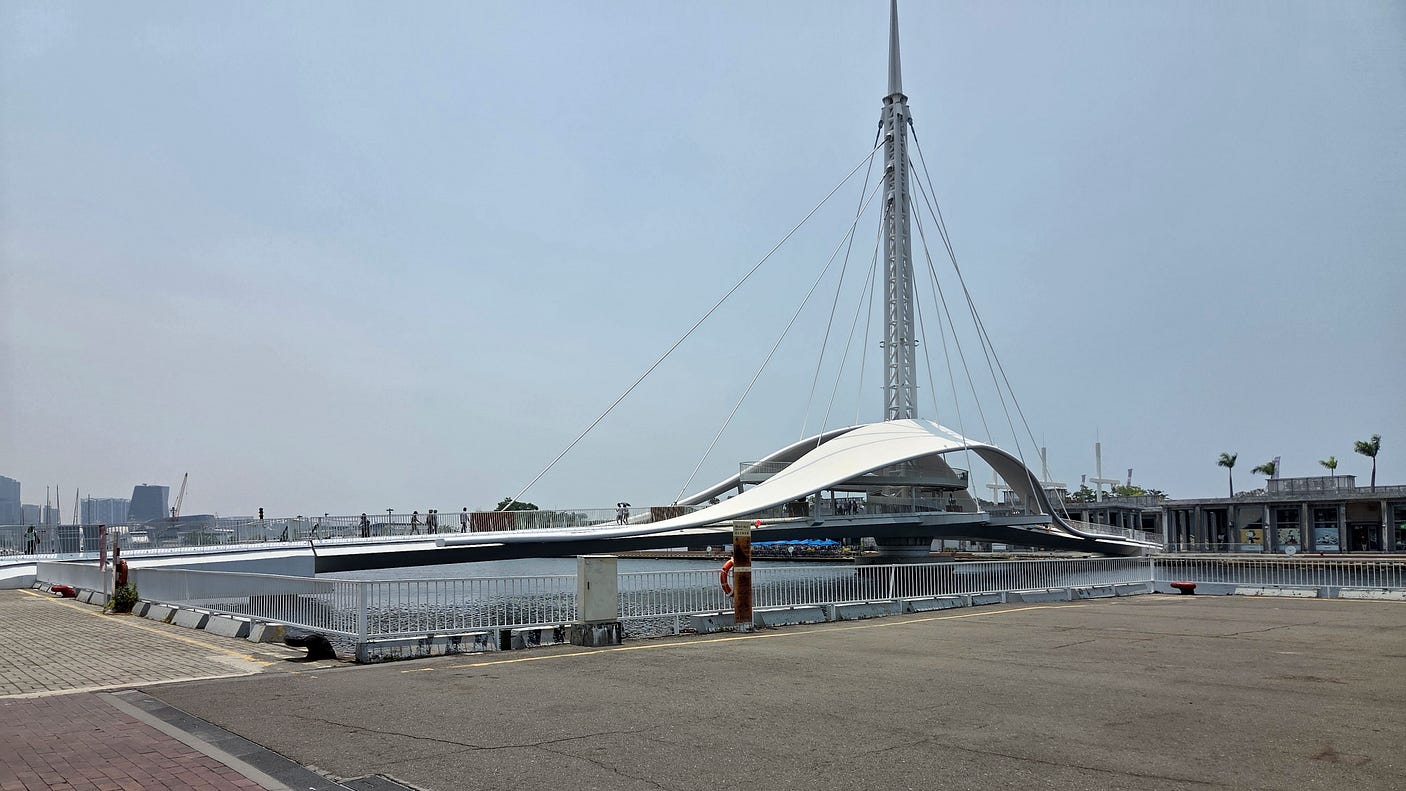
I was also impressed by the local pedestrian bridge.
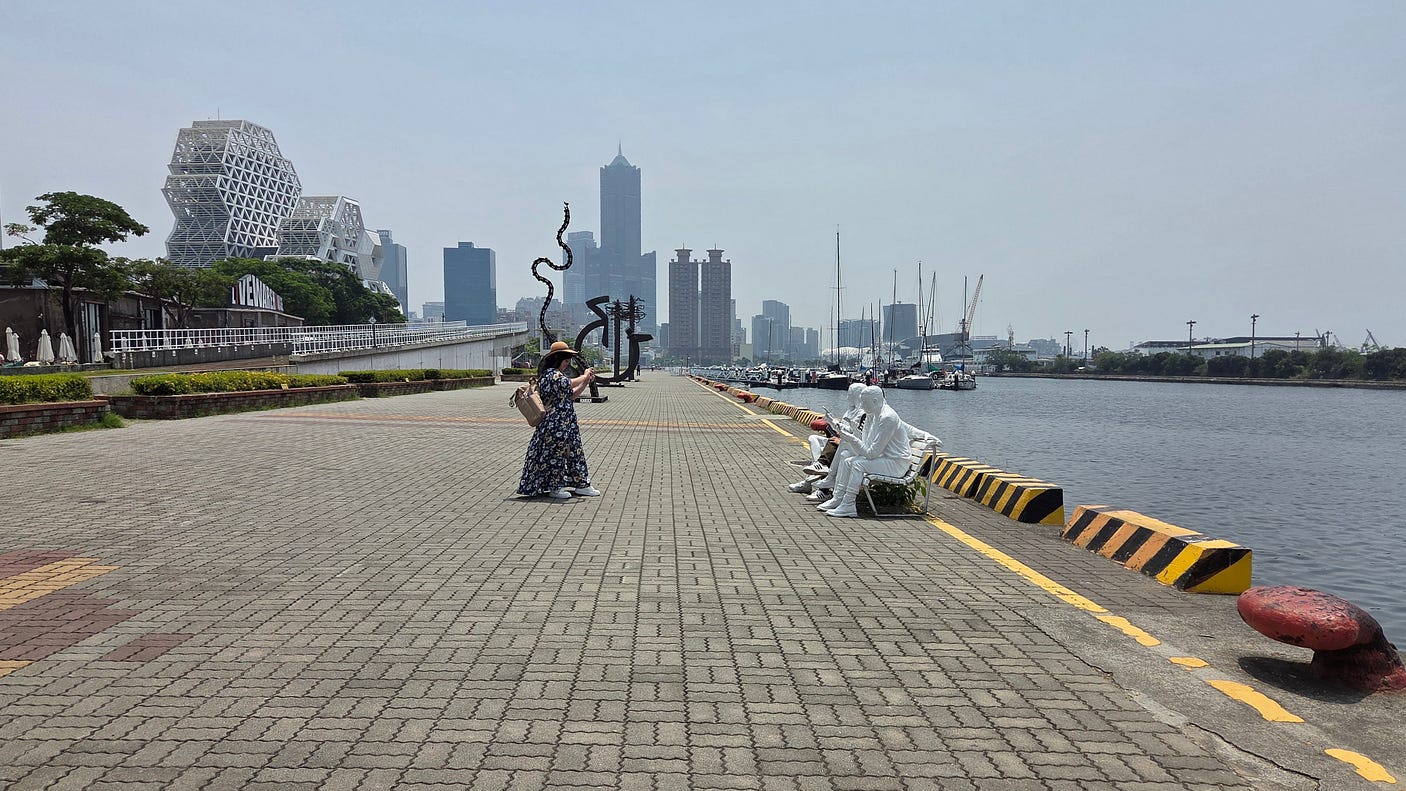
I saw a woman photographing what I took to be white statues of people on a bench, with a strange snaky thing behind her, and Kaohsiung’s impressive modern architecture in the background.
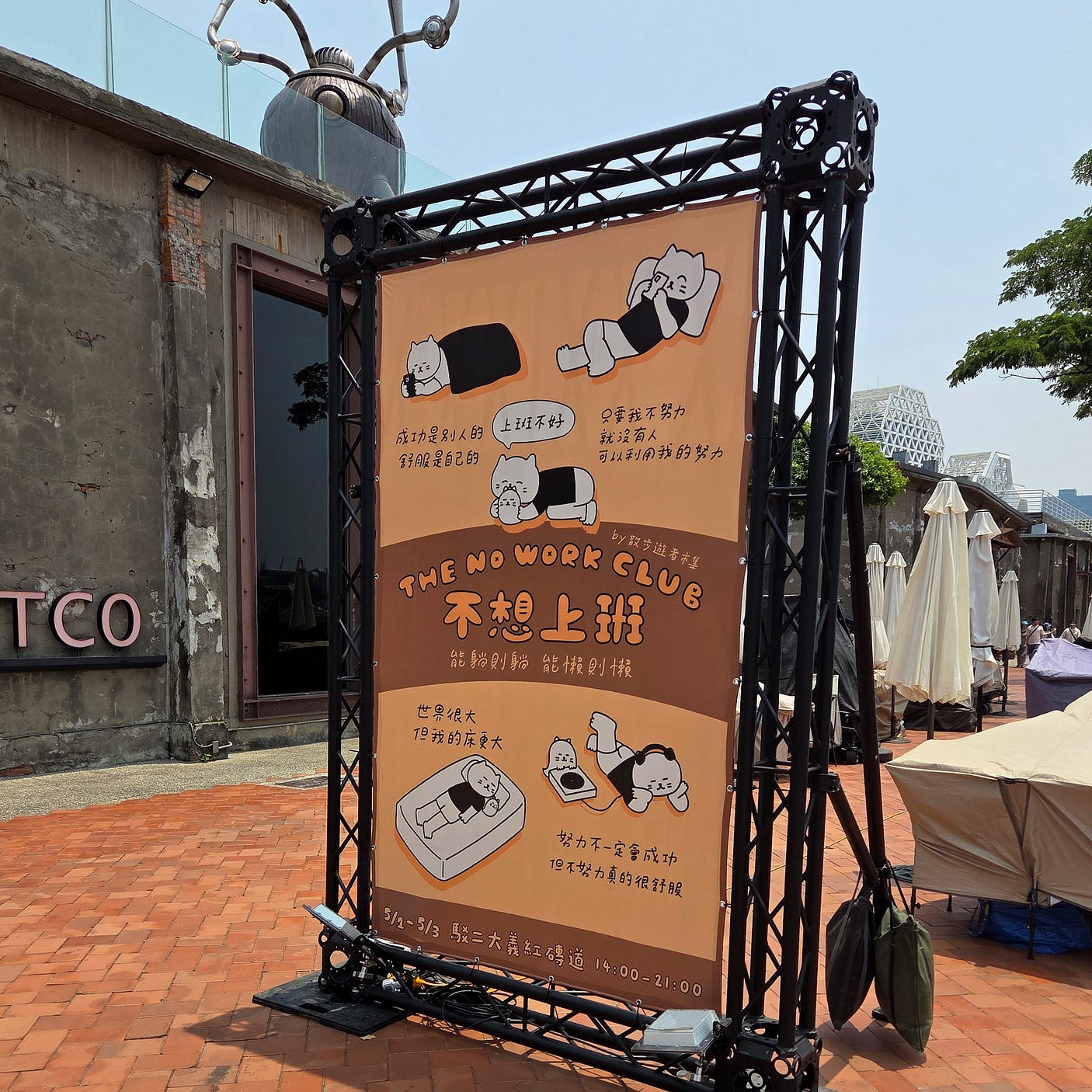
And an interesting hangout called the No Work Club.
And this little mosaic around a leaky bit of pipe, or so it would seem.

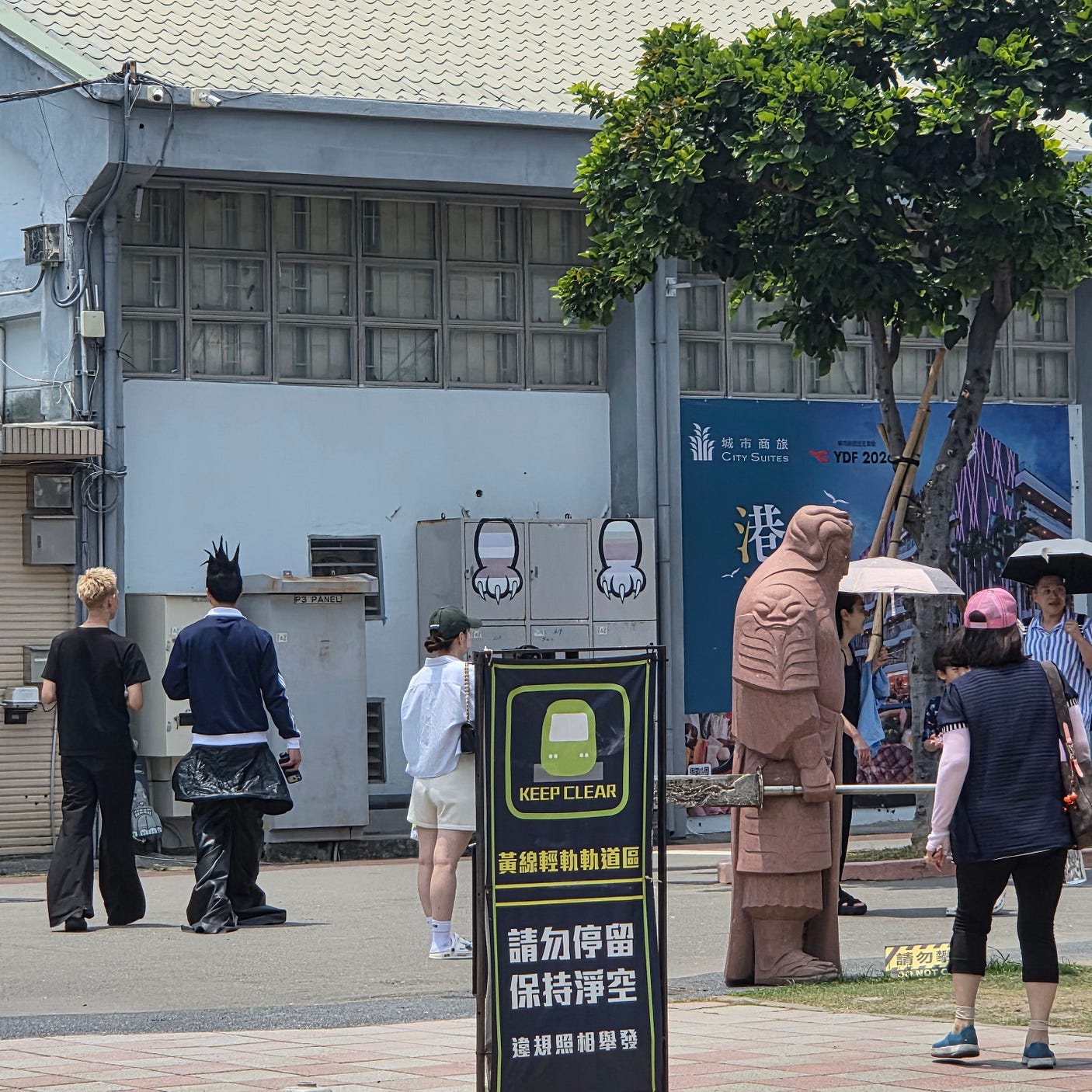
And chatting with a teracotta warrior at the tram stop, as one does.
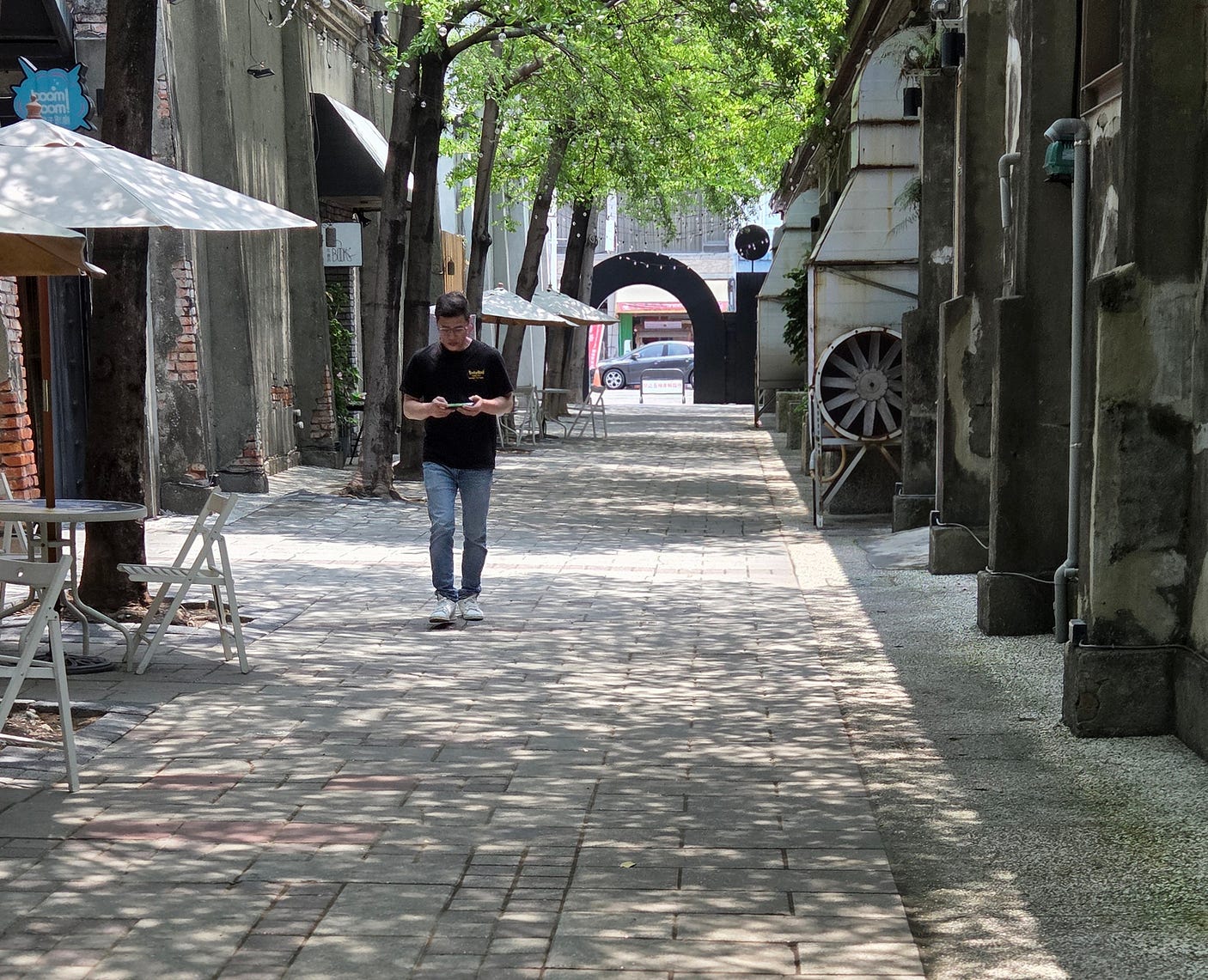
And finally, a distracted man walking down a leafy lane. What is he looking at? Could it be a video of someone walking down a leafy lane, perhaps?
Next week: A harbour cruise, a visit to a historic Qing-dynasty fort and British consulate, and back to the Lotus Pond and its temples!
PS: Since this post was published, I’ve written a book about Taiwan — you can purchase it on geni.us/Taiwan.
Subscribe to our mailing list to receive free giveaways!

