Giveaways
SOUTH of Lake Wakatipu, on the road to Invercargill, you come to the town of Garston.
This February, I decided to hike the nearby Roaring Lion Trail, 27 km of a former goldmining water race maintenance route that was restored over two years by the O’Brien family, the owners of Blackmore Station, over which the trail mostly runs. The O’Briens opened the trail to the public in 2015 as a hiking and biking track.
While the northern end of the trail runs across some New Zealand Department of Conservation stewardship land (the Hector Mountain Conservation Area), this is only a fairly small part.
You have to book to hike or bike the part of the trail that runs over the O’Brien’s land. The booking site is called Welcome Rock, after the most prominent feature of the local landscape.
The trail gets its name from the old Roaring Lion Water Race, which powered gold miners’ sluice jets in the old days.
To get to the Roaring Lion Trail, you book with Welcome Rock, and then physically go up Nevis Road, off the main highway just north of Garston, till, if headed anti-clockwise on the trail, you get to the historic Southland Ski Club Hut, nowadays maintained by the New Zealand Department of Conservation, on Nevis Road just past a 981-metre peak.
The Roaring Lion Trail then heads southward from the Ski Club Hut past a hut called the Slate Hut and then loops back northward, past another hut called the Mud Hut, and then on, eventually, to rejoin Nevis Road and then back to the Ski Hut.

Mountain bikers can only go anti-clockwise, though hikers can go either way on foot.
A custom-made map, with more emphasis on the sights to be seen along the way, can be downloaded from the Welcome Rock website, here.
Here’s a photo of a sign next to the Southland Ski Club Hut.

And the hut itself.

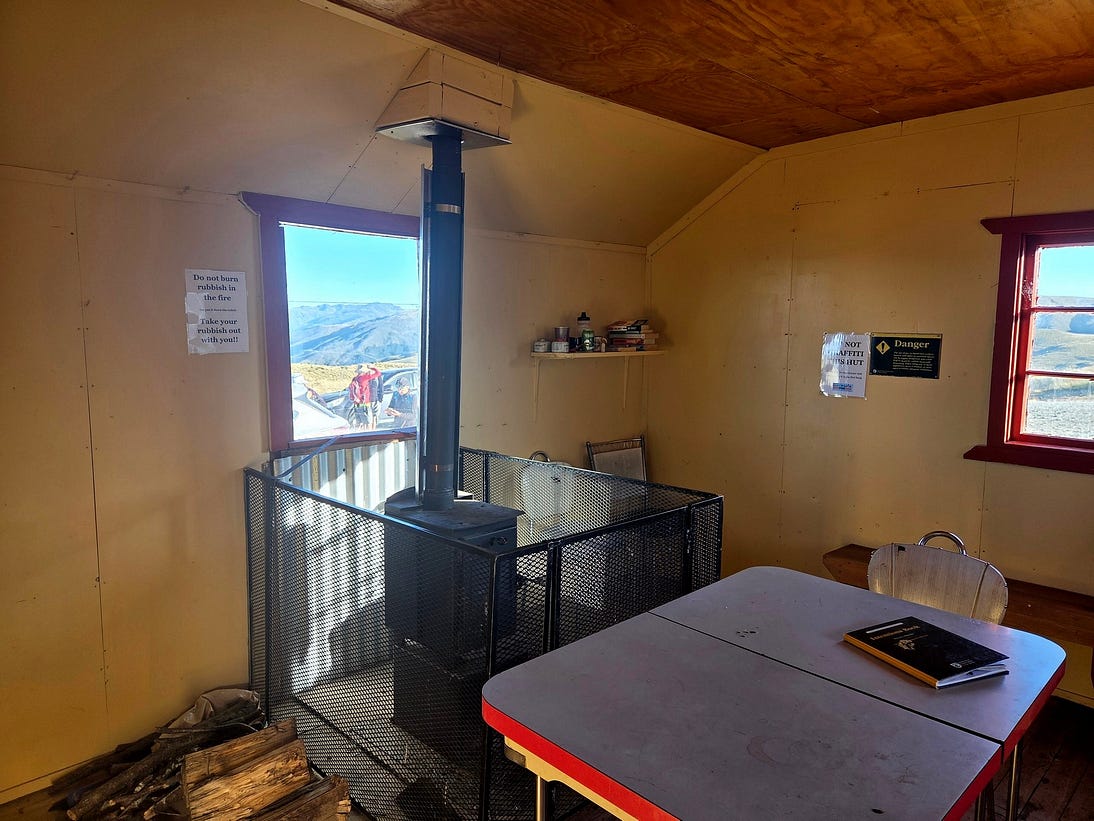
An information panel describes the origins of the Southland Ski Club Hut, which dates back to 1934. Its heyday as a ski club hut lasted until the opening of a better ski field at Coronet Peak, near Queenstown, in 1947.

In 1934, it would not have been easy to get to Coronet Peak from Southland. But after a road was built from Kingston, at the southern end of Lake Wakatipu, to Queenstown using Depression-era labour, it was.
So, the skifield at Garston only had a fairly short lease of life.
One of the people I hiked in with, who was about 85, said that his mother had hiked up to the skifield in the 1930s, and that this had taken about 90 minutes in those days.
According to another information panel, the Kennett brothers, prominent in the New Zealand cycling community, call the restored Roaring Lion Trail the “Finest Water Race Trail in New Zealand.” It is also on the Great Rides app.
Welcome Rock gets its name from a spring beside it, a welcome thing to come to in what is, basically, a cold desert.


According to the Welcome Rock website, in a quotation repeated on the rusty plaque above,
Welcome Rock is known as a meeting and trading point at the junction of three valleys, where weary explorer Clement Davis in 1886 tells of his visit 130 years ago.
It took me one hour and a half to the Welcome Rock, so called because of a small spring that issues from it. On either side the ranges rose above and below me. I arrived at the Rock and was forced to have a spell, but the lovely scenery well repaid me for my exertions. On my left hand was East and Centre Domes; to the South, I recognised several old friends of the Takitimu. Also West Dome showed its top whilst is base was enshrouded with a nasty vapour.
Turning westward I counted six district ranges towering skyward, one above the other, their bold rock peaks clearly defined against the blue sky, at the same time the setting sun adding to their beauty by bathing them in many different colours. Below in the valley of the Mataura, were many homesteads surrounded with golden grain. Everything was so peaceful and quiet that not a sound was to be heard.
Clement Davis 1886
Here’s a view into one of the valleys Clement Davis described:

At 1,130 metres above sea level, even though it was summer, it was still pretty windy when I was at Welcome Rock!

Traditionally, in goldmining days, a bottle of whisky was stashed at Welcome Rock to revive any weary travellers who made it that far: or, as another plaque puts it, “to aid those who were in need to keep warm in this cold and exposed spot.”
Whisky is not recommended for hypothermia these days, because it flushes the capillaries of the skin and thus makes people feel warmer even as they begin to lose more heat. However, the state of medical knowledge was pretty rough and ready back then, not least among goldminers.
The custom of stashing a whisky bottle at Welcome Rock has lately been revived, but you have to pay to hike the trail now, no more freebies!
Here’s a video I made there, including the discovery of the modern whisky bottle.

From Welcome Rock, you can see the Slate Hut, the newest hut on the trail.

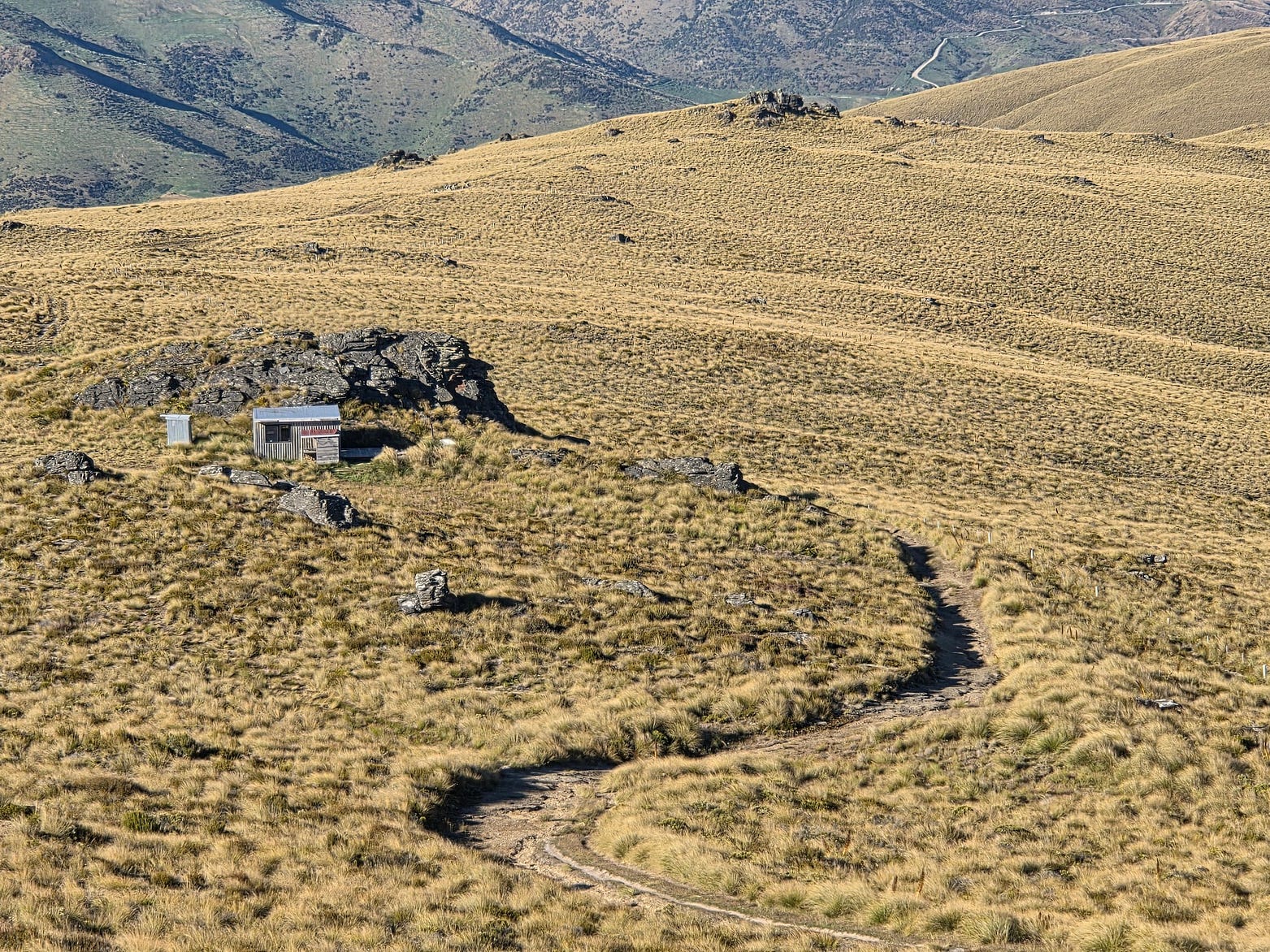
As you can see in the photo just above, if you look hard, there is an outdoor bathtub by the Slate Hut!

Further on, there is the Mud Hut, the only one of its type that you can stay in overnight in New Zealand.


The Mud Hut, dating back to the 1890s but reconstructed in 1990, also has an outdoor bathtub!
Other accommodations at Blackmore Station include the Red Shed, a former woolshed —it’s quite common for old woolsheds to have been turned into accommodation these days — and Kit’s Cabin, a modern one-bedroom tiny home 500 metres above the farm owners’ homestead.
There is an article about the newly restored trail, and its origins, in a 2015 issue of New Zealand’s Wilderness magazine. It’s called ‘A Warm Welcome.’ There is also another, shorter, June 2021 Wilderness magazine article on the trail written from a mountain biker’s point of view, called ‘A Trail that Rocks.’
An article to mark the opening of the trail was also published in the New Zealand Herald in 2015, called ‘Southland: Following in their Footsteps.’ This article also has information about one of the more obscure sights on the trail, Lee Lum’s Hut, named after a former Chinese labourer on the Roaring Lion Water Race, one of many Chinese who worked to buld the water race, which was 47 km long, and a smaller number who kept it free of weeds and other obstructions after it was built.
Lee Lum’s Hut is similar to the Mud Hut, which originally belonged to another Chinese labourer named Jimmy Long. But unlike the Mud Hut, Lee Lum’s hut hasn’t yet been restored, perhaps because something of a cloud hangs over it.
One day in 1925, Jimmy Long walked to meet his friend Lee Lum at an appointed meeting place, but Lum did not turn up. Eventually, Long walked on to Lum’s hut and found Lum sitting upright but dead, overcome by a life of hardship. The police were forced to retrieve Lum’s body on a travois because of the ruggedness of the area.
According to the article, “O’Brien hopes opening the race will raise awareness of the influence and contribution of the Chinese to New Zealand’s early pioneering days.”
And finally, a timeline-cleansing nature picture, of some mountain daisies along the way!

If you liked this post, check out my book about the South Island! It’s available for purchase from this website, a-maverick.com.

Subscribe to our mailing list to receive free giveaways!

